
Revolutions Ignited by Women... and States Divided by Patriarchal Minds
From Paris to Rojava, women revolutionaries confront legal failure, but today's struggle builds institutions, transforming street voices into legislative power that makes history.
SILVA EBRHIM
News Center — Popular revolutions prove that women have never been mere spectators but rather the leading force and the first spark of change. Yet, their role is often forgotten, and the absence of the constitutional enshrinement of their rights immediately after victory leads to their exclusion and return to square one. A recurring historical pattern thus emerges: the exploitation of women's energy during the revolution and their denial in the time of the state.
Women are the spark that ignites revolutions and the force that protects their resilience, yet they are the first to be excluded when victory is divided. From this stark contradiction begins the story—a recurring historical pattern summed up by the equation: "Exploiting women in times of revolution and excluding them in times of victory."
Tracing the paths of peoples' liberation reveals a shocking paradox. In the moments when regimes collapse, women's chests become the first line of defense, and their sacrifices turn into fuel for change and epics that inspire the world. Yet once the dust of battles settles and the spoils of power are distributed, these efforts collide with structural ingratitude, and women are once again pushed to the margins behind constitutions and laws crafted by a mindset of exclusion. Here, we pause at five pivotal stations between past and present to deconstruct the balance of this ongoing struggle between exclusion and the gains of sustained consciousness.
Leader Abdullah Öcalan says: "Revolutions in which women do not participate cannot achieve success." This truth is proven by popular revolutions throughout history. Women have never been mere spectators in the history of great revolutions; they have often been the spark that ignited them, the force that led them on the battlefronts, organized protests, and shaped revolutionary thought, bringing about radical changes in societies.
Yet the role of these courageous women is often forgotten in the pages of history, as the failure to institutionalize and constitutionally enshrine women's rights immediately after the success of revolutions has led to their exclusion and their return to square one.
The French Revolution... The Bread March and the Guillotine's Exclusion
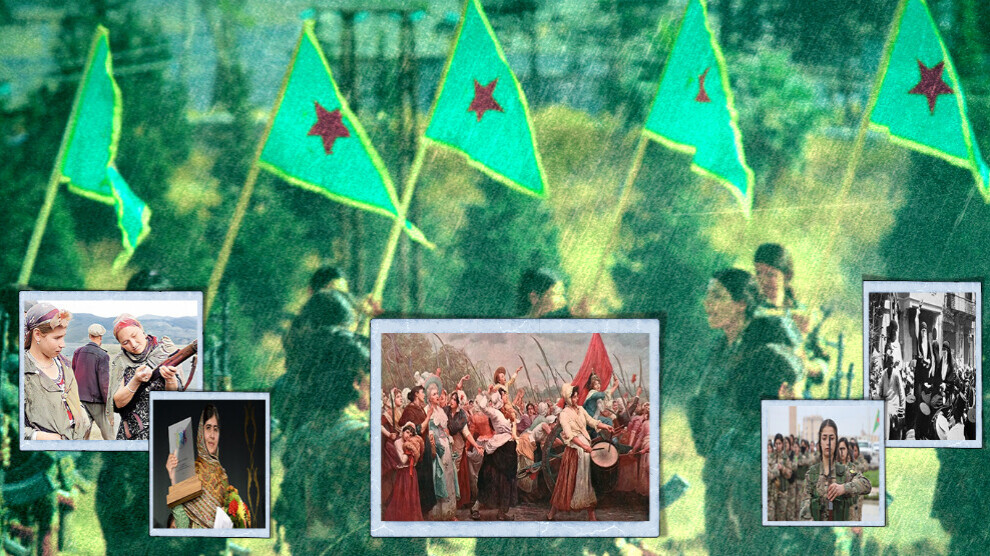
The French Revolution stands as a glaring manifestation of this historical pattern. Between 1788 and 1789, France experienced a severe economic crisis that led to an 88 percent surge in bread prices. French women found themselves unable to secure food for their children, making them the first spark and the foundational pillar of one of the greatest events of this revolution.
In October 1789, as hunger worsened, thousands of women led what became known as the "March on Versailles." Approximately 7,000 women initially set out, walking long distances in the rain toward the royal palace. In the following days, the crowd swelled to about 60,000 people. The march culminated in the storming of the palace, the killing of guards, and the forced return of King Louis XVI and his family to Paris to be under the direct surveillance of the people—events that ultimately led to the execution of the king and Queen Marie Antoinette.
However, in keeping with the equation of "exclusion in the time of law and victory," this heroic role did not secure women's rights. After the march's success, men drafted the "Declaration of the Rights of Man and of the Citizen," completely excluding women from political rights. This contradiction gave rise to prominent intellectual figures such as Olympe de Gouges, who wrote the "Declaration of the Rights of Woman and of the Female Citizen" in 1791 as a direct response to the marginalization of women. Yet the new revolutionary regime met her demands with severe repression—she was executed by guillotine, and all women's political associations were banned in 1793, reaffirming that revolutions are fueled by women's sacrifices, but their fruits are often stolen from them in the construction phase.
The Algerian Liberation Revolution... Heroines of Resistance and the Shock of the Family Code
This pattern of denying women's sacrifices was not confined to European history but recurred similarly in modern Arab history during the Algerian Liberation Revolution (1954–1962).
In this great revolution, Algerian women constituted a fundamental pillar in the struggle against French colonialism. Their role was not limited to logistical support; they participated as fighters in the heart of military battles, transporting weapons and information in both cities and mountains. From the heart of these epics emerged icons immortalized by history, such as Djamila Bouhired, who became a global symbol of resistance after her arrest and brutal torture by the colonizer, alongside Djamila Boupacha, Djamila Bouazza, Ouarda Meddad, and other free women who faced guillotines and prison darkness with unparalleled courage.
Despite this intensive participation and immense sacrifices in the war of liberation, the equation of "marginalization in the time of law" returned to erode their rights. When the Algerian Family Code was drafted in 1984, decades after independence, the revolutionaries were shocked by unjust laws that considered women "minors" requiring a guardian for marriage. This legal exclusion made those heroines feel a clear betrayal of their sacrifices and the blood they had shed for the homeland's freedom. This affirms that women's battle does not end with the homeland's liberation but begins anew to establish their rights in the constitutions of nascent states.
The Egyptian Revolution... Exclusion from the Constitution
Moving to the banks of the Nile, we find that the Egyptian Revolution of 1919 followed the same path of sacrifice and subsequent exclusion. This great revolution against British occupation recorded the beginning of the organized and honorable emergence of Arab women into the public and political spheres.
On March 16, 1919, feminist icon Huda Sha'arawi, alongside prominent women such as Safiya Zaghloul—who was dubbed "Mother of the Egyptians"—led a massive women's march of over 300 women, protesting the exile of leader Saad Zaghloul and condemning the killing of peaceful demonstrators. Women faced British soldiers' bullets with their bare chests, and many female fighters were killed, with names like Shafiqa Ashmaoui and Nagiba Jaber immortalized in history. This day was later officially adopted as "Egyptian Women's Day."
Despite this pure blood and the radical transformation women brought to the streets, the same historical paradox recurred once the storms subsided and the construction phase began. Women were completely excluded from the committee drafting the 1923 constitution and were deprived of the most basic political rights, such as voting or running for office—rights they only gained decades later in the 1956 constitution.
The Women's Revolution in Iran... From Overthrowing the Shah to the Slogan of Freedom
The chapters of this dialectic did not stop at the twentieth century but extended to shape the contours of modern Iranian history in one of the most prominent experiences of feminist struggle and reversal. In 1979, Iranian women from various political orientations and social backgrounds poured into the streets in massive millions-strong demonstrations, forming a decisive driving force in overthrowing the Shah's rule. Yet the paradox quickly manifested in the new system established after the revolution, as women were stripped of their fundamental freedoms and faced multiplied restrictions rather than justice.
This accumulated pressure generated an inevitable explosion that crystallized in modern history, specifically in 2022, when women and young girls in Iran and East Kurdistan led a massive popular uprising that shook the country's foundations under the slogan that resonated worldwide: "JIN JIYAN AZADÎ" (Woman, Life, Freedom). This contemporary revolution erupted following the death of young Kurdish woman Jina Amini, with women leading the protest scene with courage, demanding personal and political freedoms in direct confrontation with the regime's apparatus.
Today, the chapter of repression continues harshly in Iran, as women and girls face extremely difficult and complex humanitarian conditions inside prison cells, alongside rising rates of executions and systematic persecution against them.
Pakistan and Malala... A Revolution in the Face of Reality's Betrayal
If women's struggle against repressive regimes has taken the form of collective protests and million-strong uprisings, the resistance against obscurantist thought in other parts of the world has been embodied in inspiring individual sacrifices that led to major social revolutions, as occurred in Pakistan with the icon Malala Yousafzai.
Under the intellectual and military hegemony of the Taliban movement and its expansion, strict restrictions were imposed on girls, depriving them of attending schools. Despite the bleakness of the scene, the young Malala, who was barely eleven years old at the time, refused this surrender and chose to raise her voice publicly in defense of girls' right to education. This brave resilience made her a direct target—in 2012, gunmen shot her in the face in an assassination attempt, after which she was transported abroad for complex reconstructive surgeries and intensive medical care in England.
But the bullets did not extinguish the flame of her will; rather, the assassination attempt became a driving force and a global catalyst. In 2014, her efforts were crowned with the Nobel Peace Prize, making her the youngest person in history to receive this prestigious award. Her exceptional journey marked the beginning of a true revolution led by girls in Pakistan and around the world, demanding the breaking of shackles and their inherent right to learning and knowledge.
Despite this global resonance, Pakistani society today finds itself facing a bitter reality dripping with betrayal. What Pakistan is currently witnessing reflects a sharp regression and a major setback for that young revolution. While Malala Yousafzai lectures at international forums, the society and girls at home live under renewed threats and constant fear. The Pakistani arena is witnessing a growing return of extremist influence, increasing attacks on girls' schools, in addition to economic and social obstacles that have returned millions of girls to the square of deprivation and ignorance.
Pakistani society has been left alone to face a patriarchal and extremist system tightening its grip once again, amid clear betrayal from official institutions and the international community—both of which have been content to celebrate symbols and create shiny slogans, leaving women's reality on the ground sinking in the same setback and darkness.
The Rojava Revolution... The Institutionalization of Kurdish Women's Rights
In the heart of the conflict-ridden Middle East, the struggle of Kurdish women in Rojava is no different from that of their revolutionary counterparts throughout history. Rather, today it presents a unique model that broke the cycle of "exploitation then exclusion" through conscious institutionalization and fierce resistance on two fronts.
Kurdish women shook off the dust of racist ethnic discrimination practiced against them by Ba'athist authorities for decades and challenged the prevailing patriarchal mentality, engaging in a dual struggle: geographic liberation from terrorism and societal liberation from constraints. With the outbreak of the Syrian crisis in 2011, women led a revolution that crystallized with deep ideological dimensions. Waging an intellectual enlightenment battle in an environment permeated by religious and tribal bigotry is nothing less than a true volcano of radical change.
This movement was not spontaneous but was the product of a secret political struggle led by women for half a century under Ba'ath rule. With the launch of the July 19 Revolution, this great labor emerged into the open, embodied in women's movements and organizations that managed the scene on both military and societal levels.
Militarily, the Women's Protection Units (YPJ) took the front lines, leading historic battles against ISIS until the elimination of their last stronghold in Deir ez-Zor, within an exceptional humanitarian context that included the liberation of Yazidi women whom ISIS had kidnapped during its attack on Sinjar.
Alongside this, the units displayed epic resistance against Turkish occupation attacks, with thousands of fighters offering their lives for the path of women's freedom and the protection of the land. Their struggle topped the international media agenda and produced international films that echo the legend of their resilience, which saved the world from the danger of extremism.
On the social and institutional level—the arena where women were historically excluded—the Rojava Revolution achieved a qualitative leap over 14 years. Women succeeded in establishing a system of co-presidency—gender parity in the management of every institution—and drafting a social contract granting women representation of no less than 50 percent in all institutions and parties.
In addition, strict laws were enacted to protect women's rights, guaranteeing their right to child custody and prohibiting polygamy. Although this model was achieved amid the furnace of war, repeated violations, and the targeting and assassination of movement leaders by Turkish occupation aircraft, it has become a source of inspiration for feminist movements around the world.
With the major political transformations, the fall of the Ba'ath regime, and the rise of jihadist currents in Syria, a complex landscape crystallized that imposed fierce battles, culminating in an integration agreement between the Syrian Democratic Forces and the Syrian interim government, providing for the integration of military and civilian institutions. Despite progress in integrating many sectors, the agreement still stumbles over structural obstacles when opening the file of integrating the Women's Protection Units into the Ministry of Defense, and the new elites' attempt to limit women's parliamentary representation to only 14 percent—a percentage that recalls the same exclusionary mentality faced by women in the constitutions of France in 1793, Egypt in 1923, and Algeria in 1984.
However, drawing on their accumulated historical consciousness, women have not surrendered to this intransigence emanating from extremist mentalities. Rather, they have escalated their political and societal struggle to secure their rights legally in Syria's new constitution and protect the gains baptized with blood and sacrifices over more than a decade of revolution.
All Revolutions Pass Through Two Stages... From Street Mobilization to the Rule of Law
These successive historical stations—from Paris, Algiers, and Cairo to Tehran and Rojava—prove one structural truth: women's battle does not end with the homeland's liberation or the fall of authoritarian regimes. Military or political victory is merely a prelude to their true and more complex battle: the battle of shaping consciousness, constitutionalizing rights, and resisting exclusionary mentalities.
The great conclusion is that the failure to legally secure rights immediately after revolutionary victories has not rendered women's struggle futile but has transformed it into an ongoing existential battle that proceeds through two successive stages. The first stage is "revolution with society to overthrow the old regime." The second—the more difficult and deeply impactful—is "revolution against society's outdated legacy and patriarchal culture to wrest rights legally and protect them from regression."
If popular revolutions and uprisings have given women a free and resounding voice in the squares throughout history, the subsequent legal and intellectual battles are the only means to transform this voice into "legislative and institutional power" on the ground.
Despite every setback, political intransigence, or attempt at exclusion, the blood of martyred women and the resilience of female fighters remain the cornerstone and historical guarantee that prevents societies from complete regression. Women's revolutions continue as a blazing beacon of consciousness until freedom and equality become a constitutional and social reality lived by all, without exception.