
Palestinian Girls Hold on to Karate Despite War and Siege
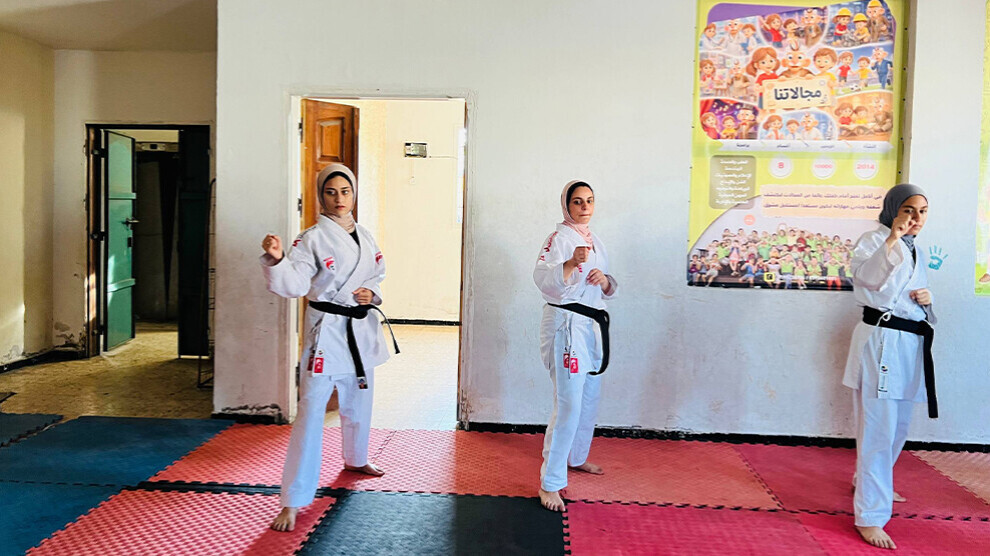
Despite war, displacement, and lack of equipment, girls in Gaza, Palestine, are holding on to Karate, trying to continue their training in narrow halls or destroyed homes, while dreaming of competing locally and internationally and raising their region’s
RAFIF ESLIM
Palestine_ The girls’ team of the Gaza Sports Club for Karate is striving to returen to training despite all the difficulties they may face, such as transportation, the loss of uniforms that are barred from entering the besieged city along with safety equipment, and the absence of a dedicated training hall after the club was bombed and destroyed in the Al‑Sudaniya area on the northwestern coast of the Strip.
Gaza's Siege and the Dream of Competing Outside the Strip
Player Hala Emad Hammad has been practicing karate for 13 years, as her father—the team's founder—was her first supporter in mastering this sport, which gives girls self‑confidence, the ability to defend themselves, and physical strength. Hala Emad Hammad noted that practicing this sport before the war was better in terms of available clubs, transportation, and security—things Palestinians lack today.
She fears her uniform may wear out or be lost because she simply has nowhere to buy a new one, along with safety equipment such as protective gear and hand pads that protect her and her training partners from moderate or severe injuries, and which prevent her from participating in any upcoming tournament, as these tools are an important condition for players' participation. She noted that she tries, according to the coach's instructions, to exercise the utmost caution to avoid injuring herself or others during play.
She also complains about the cramped training hall—it is small with a concrete pillar in the middle, making it difficult to complete training. She added that the team has 13 girls, but they are not all consistently present at training due to the recent security situation and difficult transportation, which makes going out under the sun unbearable. Still, they try as much as possible to keep up with exercises, whether at the club or at home.
She noted that she does not care about society's view of girls practicing karate; despite the criticism she faces, she continues.
The girls look up to Hala Emad Hammad with pride and often ask her if they can become like her one day, but they are met with family rejection and prohibition. She feels sad for them, believing they have the right to choose the sport they wish to practice. She said she continues training because she dreams of participating in a national competition in the West Bank and an international one outside the Strip, but she is always met with the closure of the crossing and Israeli authorities denying travel requests related to this matter.
From the Rooftop to Its Rubble
Player Batoul Wadi joined karate when she was only five years old, alongside her brothers. This made a significant difference in her training—she felt as if her body was made for this sport and was able to develop in record time. She noted that those who start later can still gain many skills but need more time and double the effort compared to their teammates, as karate is a vast school.
Batoul Wadi begins with warm‑up exercises and then continues training, either through "kata"—a form of shadow fighting between players that builds many skills for facing opponents, and is indeed a school that gives players the necessary strength and flexibility for real combat—or "kumite," which is actual fighting against an opponent.
She explained that at the beginning of the war, she trained on the rooftop of her grandfather's house using available tools, but after being displaced south, she could not perform any training and was absent for longer than her peers, as she was a high school student and later joined university. She noted that like other players, she suffers from a lack of safety equipment, while the uniform she managed to pull from the rubble of her home after it was bombed—she considered it like finding a treasure, as no one sells it today.
She dreams that Gaza could be like any city open to the world, where residents can go out and participate in international matches, and receive players from abroad to learn from their skills and share the experience they have gained over the years. But the stricken city is besieged by land, sea, and air, and all who live in it are imprisoned inside.
A Sporting Dream Despite War
Player Dana Hassan has also been practicing karate for many years. Today, she continues without a uniform because her house was burned during the war on Gaza, and the fire consumed everything. She tries to follow the coach's instructions to avoid injuring herself or her opponent. She noted that wearing the uniform gives her a feeling of strength and self‑confidence during play, so she wishes she could get one and return to the pre‑war atmosphere of the Strip.
Dana Hassan dreams of becoming an international and professional kata player, as her abilities qualify her for that. She advises all girls to start playing karate, as it gives them self‑confidence and the necessary strength to defend themselves—something girls and women might need at some point in their lives.