
For a Piece of Bread... Gaza's Women Cross the Fields of Death
Amid Gaza's war rubble and famine, Shorouq Saadallah, a widowed mother, braved displacement and bullets, becoming a symbol of women's resilience for their children.
NAGHAM KARAJA
Gaza — In a war that turned the lives of Palestinians in the Gaza Strip upside down, women were not merely victims of siege, bombardment, and displacement; they found themselves in direct confrontation with hunger, death, and overwhelming responsibilities.
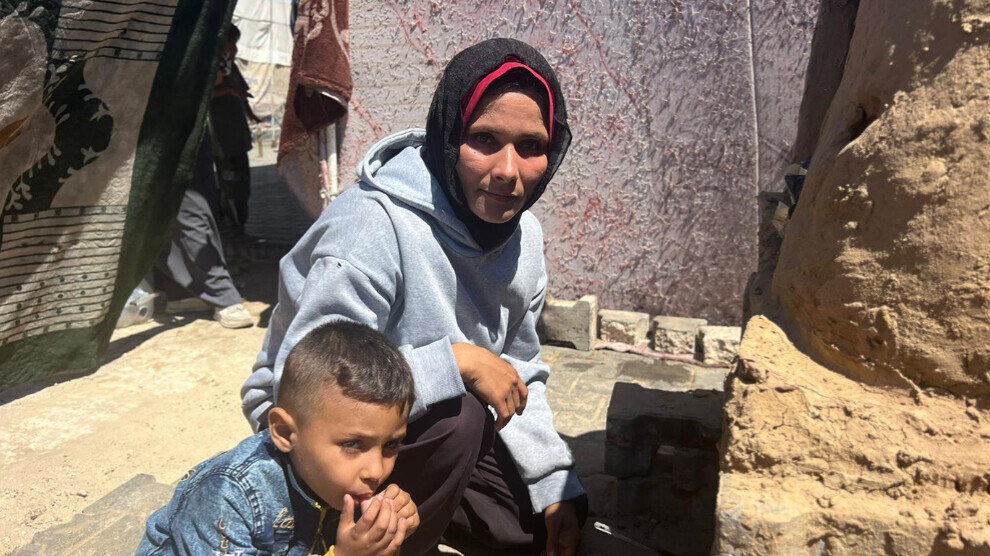
Among the thousands of women forced to wage daily battles for survival, the story of Shorouq Saadallah stands out. A mother of three, she transformed from a woman seeking safety for her family into a fighter for a piece of bread, defying bullets and famine while carrying the burdens of an entire family on her shoulders.
Shorouq Saadallah, 32, is displaced from the Jabalia camp to a tent west of Gaza City. She lost her husband in mid-July 2024 while he was attempting to return to the northern Gaza Strip through the Netzarim checkpoint. The loss was not the only hardship; she was unable to even cast a final glance at him or bid him farewell, as he was buried in the south while she was trapped in the north, trying to survive with her three children amid a merciless war.
She found herself facing repeated displacement, a lack of income sources, and the daily search for food and water. As famine tightened its grip on the northern Gaza Strip in recent months and humanitarian aid deliveries declined, she had no choice but to head to aid distribution points—what Palestinians have called "points of death" due to the many massacres committed near them.
Shorouq Saadallah says: "I did not go looking for luxury or anything beyond our basic needs. I went because my children were hungry. I would go out knowing I might not return, but I felt that dying of hunger inside the tent was crueler than facing bullets on the road."
Each time she headed to the aid distribution points, she embarked on a perilous journey amid thousands of men pushing and shoving to obtain a bag of flour or some canned food.
She recalls one of the most terrifying moments of her life when she went to the Al-Nabulsi area west of Gaza City—the area through which humanitarian aid trucks passed. There, the search for food turned into a bloody scene within minutes.
She recounts: "Suddenly, intense shelling from aircraft began, and tank snipers opened fire. People were falling around me by the dozens. The scene was beyond any human's capacity to bear. I saw bodies strewn everywhere, and more than two hundred people fell in a very short time."
She adds: "I was lying on the ground, covered entirely in dust, and I saw the sniper's scope aimed directly at me. At that moment, I raised my headscarf with my hand to prove I was a woman. I did not think I would survive. I thought those were my final moments."
Shorouq Saadallah survived that day miraculously. She crawled on her knees among the dead and wounded until she reached a safer place. But the bitter experience did not push her to retreat; she returned again to search for aid whenever hunger intensified inside her tent.
As aid distribution centers moved to the southern Strip, she made her way toward Rafah, where risks multiplied and challenges grew. She was not thinking of herself but of those waiting for her. She says: "Every time I went to get aid, I would take one of my children with me. I would leave him at a certain spot and tell him: If I am delayed more than an hour, go back to the tent. I was preparing my children for the possibility of losing me at any moment."
She tried to share the aid with fourteen orphaned children of her siblings, after three of her brothers were killed while trying to obtain food for their families following long months of hunger and siege. Although aid entry saw relative improvement in some periods, reaching those who deserved it remained complicated and difficult.
Exploitation and Bargaining for Aid
Shorouq Saadallah reveals another aspect of suffering no less harsh than hunger itself, affirming that some women are subjected to exploitation and bargaining in exchange for cash assistance or food parcels. She says: "I was subjected to an attempt at exploitation once in exchange for simple aid. I refused categorically. I preferred to go to the points of death and face bullets rather than accept that my dignity be violated or my need exploited."
Her suffering does not stop at the search for food; it extends to the simplest details of daily life. She is forced to cook using nylon and plastic pieces due to fuel shortages and high energy prices. She also sells her limited share of cooking gas—which she receives once every few months—to buy chicken or vegetables for her children, who had been deprived of them for long periods.
She explains: "I know that burning plastic harms our health and damages our lungs, but what can I do? I try to create any alternative that can help me feed my children. Sometimes we live whole days on what the soup kitchen provides."
Despite all she has endured—loss, displacement, hunger, and fear—Shorouq does not speak of herself as a victim but as a woman whom war forced to take on roles she never imagined she would bear. She concludes: "Palestinian women have proven they are capable of endurance. We have shouldered the responsibility of homes, children, and families, and stood in the face of hunger, death, and oppression. We are not seeking heroism; we are just trying to preserve the lives of those we love and create new reasons to continue from the pain."