
A Farmer’s Testimony on the Sexual Exploitation of Female Workers in Tunisia
Samer Haji showed that in the fields of Sidi Bouzid in Tunisia, the female worker turns into “merchandise with the goods,” bought along with plaster and melons, expelled if she refuses harassment, and finds no means of protection from harassment.
IKHLAS AL-HAMROUNI
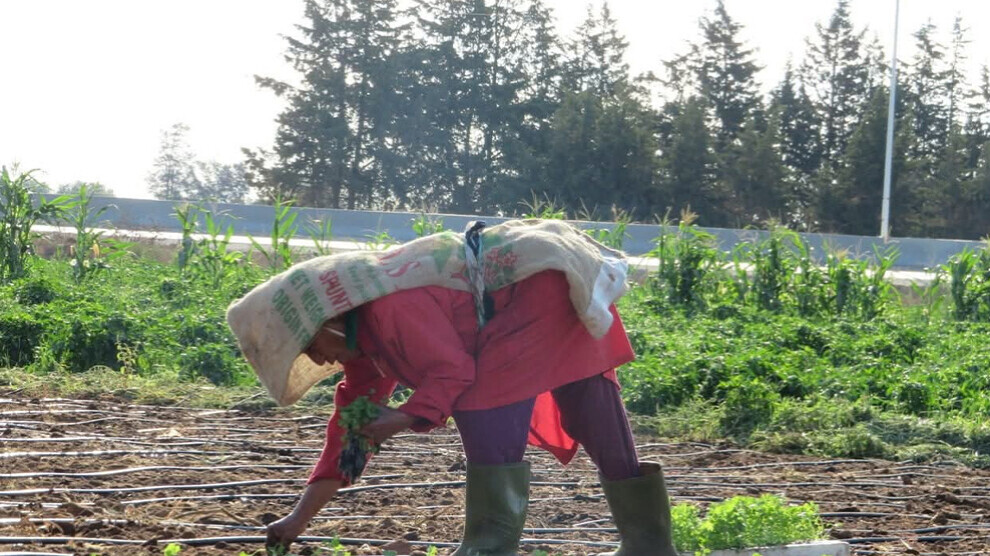
Tunisia – In the fields of Sidi Bouzid in Tunisia, where the sun extends as a blazing flame above the heads of female workers, and where boxes of plaster and melons weigh down women's backs before men's, Samer Haji stands as a witness to the harsh reality lived by thousands of girls and women in the agricultural sector, where they work under temperatures reaching 47 degrees, carrying more than twenty liters of pesticides on their backs, resisting cold and rain in winter, then returning to their homes with wounds no one sees.
The suffering of female agricultural workers in Tunisia does not stop at the limits of physical exhaustion and economic exploitation, but extends to what is deeper and harsher: sexual harassment, which remains the biggest obstacle to the dignity of women working in agriculture.
Meager Wages in Exchange for Exhausted Health
Samer Haji, an agricultural worker in the Regueb area of Sidi Bouzid governorate, says that work in agriculture begins hard from the first moments, especially in summer. She explains that harvesting fruits in vegetables such as tomatoes and peppers is less arduous than working in plaster and melon fields, where women bear a heavy burden.
She points out that the daily wage does not exceed 15 to 20 dinars, while a man receives 40 dinars for the same work, and often stands in the shade while the woman bears the hard work. She confirms that female workers pay from their high wages the price of medicines and treatment, as many of them contract diseases due to continuous exposure to insecticides and harsh conditions, while they find no health coverage or compensation.
Sexual Harassment: The Hidden Face of the Agricultural Sector
Samer Haji confirms that sexual harassment is the most painful problem facing girls and women in rural and interior areas. Some farmers, according to her, view the female worker only as an additional commodity "bought with the crop."
She adds that the problem is not limited to the farmer only, but extends to traders and workers who receive higher wages. She confirms that female workers who refuse harassment are expelled from work or deprived of wages, while those who respond to flattery receive different treatment.
She recalls an incident of a young girl who did not exceed thirteen or fourteen years old, who refused to comply with one of the supervisors, so she was expelled from her work without mercy. She notes that some mothers turn a blind eye to these practices, leaving young girls alone in the face of exploitation.
She explains that harassment is not limited to one group, but begins from the transport supervisor and the trader, and even from the farmer himself, although the farmer is the least of them in practicing it. She adds: "Honestly, I do not know how to describe them. They mistreat female agricultural workers."
A Call for a Solution
Samer Haji concludes her interview with a call full of hope and bitterness: "We hope there will be a solution. The state must bear its responsibility toward female agricultural workers." She confirms that the agricultural sector is the only one that continued working during the Corona pandemic, and the women who work in this sector continue working in summer and winter, under the sun and rain, and yet they are still deprived of the simplest rights: health, safety, and dignity.
In general, Samer Haji's story is not the story of one individual, but the voice of thousands of women in Sidi Bouzid and the interior regions, demanding their rights to decent work, protection from harassment, health coverage, and recognition of their efforts that plant goodness in the land and create life in every home.