
Escalating regional conflict deepens militarization of Eastern Kurdistan and exposes fragility inside Iran.
As military tensions rise between Israel and the US on one side and Iran on the other, Tehran intensifies attacks on the Kurdistan Region and Kurdish party bases to convey messages and tighten security pressure.
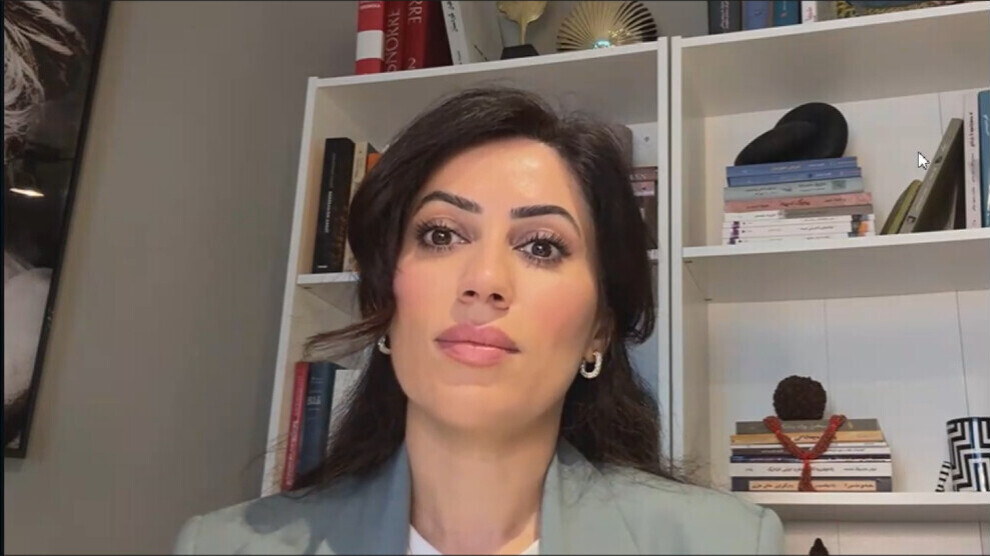
Hevi Salah
Sulaymaniyah — Relations between Iran and Israel have entered a dangerous phase following recent direct attacks between them. The United States, by sending more troops to the region, has also delivered a sharp message to Tehran. On the other hand, Eastern Kurdistan, which has always been a center of protests, is living under severe economic and security pressures, as any international tension directly affects the daily lives of its residents.
Iran is currently going through a sensitive period, as its leadership faces Israeli threats coupled with promises of a harsh response. At the same time, US sanctions are tightening their grip on its economy. In Eastern Kurdistan, security forces have spread significantly in cities such as Sanandaj, Mahabad, and Kermanshah, with increased surveillance of activists for fear that any external attacks might trigger widespread protests. Intermittent clashes on the border and drone flights have also caused psychological anxiety among the population, in addition to the rapid rise in commodity prices, which has led to deep discontent among citizens who are watching the outcome of the conflict between Tehran, Washington, and Tel Aviv and its impact on the region's future.
Within the framework of security agreements with Baghdad, Tehran continues to pressure for the dismantling of camps of Kurdish parties in Eastern Kurdistan and their relocation to remote areas. These steps coincide with increased US military readiness at the Ain al-Assad and Harir bases, in addition to Israeli threats to strike nuclear and oil facilities inside Iran, which has prompted Tehran to use Iraqi territory as an arena to settle conflicts.
The latest information indicates that Iran has prepared Fatah-type missiles in Kermanshah and Urmia provinces to target any movement by Kurdish parties or any security site in the Kurdistan Region suspected of intelligence activity. These military movements are not limited to the outside; an abnormal state has been declared inside Eastern Kurdistan cities such as Sanandaj, Saqqez, and Baneh, with reconnaissance aircraft flying over these cities.
Iranian authorities are aware that Kurdish parties have a strong popular base and might be able to mobilize the street in the event of any attack by Israel or the United States. At the same time, the cold war between Tehran and Washington through proxy groups has reached a level that could make the Kurdistan Region the first victim of any direct confrontation.
Moreover, the lack of economic stability and the historic decline in the currency's value have led to escalating internal protests. Tehran, by targeting the Kurdistan Region and opposition parties, seeks to divert public opinion from its internal crises and impose a state of military tension in the region—a situation whose end, in terms of both timing and manner, remains unknown.
"During the Jin, Jiyan, Azadî uprising, Eastern Kurdistan was completely militarized"
Journalist and human rights activist Shler Babir from Sulaymaniyah in the Kurdistan Region stated that the current situation is unstable and unclear, and that the assassination of several key figures in Iranian politics would not be easy for the authorities. At the same time, since the Iranian regime came to power, there have always been differences among its various factions, from reformists to hardliners. Even now, with talk of succession to Ali Khamenei—where it was previously said that his son Mojtaba Khamenei had been somehow prepared to succeed his father—this could be a source of disappointment for those who aspired to lead Iran after Khamenei. The presence of Mojtaba Khamenei could create and deepen further divisions, adding complexity to the political scene inside Iran alongside external complications.
She added, "I believe that throughout the rule of the Islamic Republic, there has never been genuine, deep trust between the people and politics. The Islamic Republic has always managed to control protests through killing and the use of military tools, but in the long term, it has not been able to meet people's demands regarding public services, political participation, and economic infrastructure. Therefore, the same problems persist, and people's demands and protests continue. We cannot say all of Iran is like this, but the majority of the Iranian people today are demanding the overthrow of this regime. However, achieving that requires an external force, because protests, despite their breadth, have not been able on their own to overthrow the regime, as the authorities use all means of violence to end them, including weapons."
Our interlocutor pointed out that Iranian authorities follow a systematic policy in this regard. "This is what we saw during the Jin, Jiyan, Azadî uprising, where Kurdistan was completely militarized. After that uprising, the militarization of Kurdistan increased even further, with escalating repression and rising numbers of detainees, and freedoms have significantly declined."
She noted that currently, numerous armed forces have been deployed along the borders of Eastern Kurdistan, and the targeting of 252 sites and military bases of the Islamic Republic in Eastern Kurdistan indicates the extent of the region's militarization, enabling authorities to suppress any potential protests and control them easily and at any time.
"Internet blackout makes accessing information difficult"
She explained that the internet blackout and lack of communication means make it difficult to know the real situation in Eastern Kurdistan, and also to "determine whether current conditions are suitable for organizing protests or not." In her view, the situation is unclear: on one hand, there is war; on the other, the economic infrastructure is extremely poor; and on a third hand, the Islamic Republic now has greater opportunities than before to suppress people under the pretext that they threaten national security. Therefore, "current conditions are not suitable for widespread protests."
She added that Iranian forces are widely deployed in areas such as Kermanshah, Ilam, and Urmia, and that over 47 years of its rule, the regime has established numerous military bases in Eastern Kurdistan to facilitate control over any unstable situation, whether inside Eastern Kurdistan or on the border. "During the Jin, Jiyan, Azadî uprising, the type of weapons used against people was clearly visible."
She also clarified that the Islamic Republic's attacks on Kurdish parties in Eastern Kurdistan, outside the region's borders, "are not new, but are a continuous policy." In 2018, it bombed the headquarters of the Kurdistan Democratic Party, and at the same time targeted the bases of the Komala Party (Society of Workers of Eastern Kurdistan). In 2022, coinciding with the uprising, a number of people were killed and the attacks continued.
Shler Babir explained that the Iranian regime's fear of Kurdish forces stems from them being "organized forces that have managed to stand up to the regime for years." She added, "Currently, the unification of Kurdish forces is one of their strengths, especially after the regime considered their fragmentation a weakness. These political forces have become unified and seek to secure the future of the Kurdish people, particularly in the absence of any opportunity for reform within the system, as they unanimously demand its overthrow."
She pointed out that one of the regime's foremost fears throughout its nearly 47 to 48 years of rule has always been Eastern Kurdistan and the Kurdish forces. She also reminded that one of the first laws enacted by the regime in 1979 was the imposition of mandatory hijab—a law that has not seen substantive change to this day, despite some temporary relaxations at certain times; however, if not adhered to, women face legal penalties. "These temporary facilitations are part of short-term policies the regime resorts to under pressure, but they do not signify real change, as the regime is fundamentally opposed to women's freedom."
"Targeting civilians and patients in the Kurdistan Region"
She indicated that the situation is growing more complex day by day. On one hand, the United States says it wants to negotiate and has put forward its demands; on the other, the Iranian foreign minister announced that there are no direct negotiations, merely an exchange of messages through intermediaries, which the Iranian regime rejects. "Iran, on one hand, demands negotiation, while Israel continues its attacks on military bases. When it comes to negotiations, one party often refuses. Some Arab countries may seek to contain the war, but at the same time they support the United States and Israel, especially given attacks by Iran‑linked groups in Iraq on neighboring countries, further complicating the situation."
She affirmed that the scene is highly complex and changes daily, making it difficult to predict whether Iran and Israel will reach an agreement, or what the nature of negotiations and their demands might be. "Will it be limited to halting the nuclear program, or will it include regime change entirely?"
Journalist and human rights activist Shler Babir concluded by saying that Iran considers Israel a historical enemy, while Israel views Iran as a threat to its existence in the Middle East. "While American and Israeli attacks often target military sites, Iran, on the contrary, in some of its attacks—whether on Israel or on Kurdish forces in the Kurdistan Region—targets civilians and even patients."