
Rojava's Children Build Their Future with Art and the Mother Tongue
Hefro and Nudem Ayoub are two girls weaving their dreams between school, language, and art, in an experience reflecting the presence of Kurdish culture in the life of a generation that grew up under deep social and cultural transformations.
SORKEL SHEIKHO
Qamishlo – Over more than two centuries, the Kurdish people have faced policies of repression and attempts to erase their identity, passing through massacres, genocides, and the Anfal operations, reaching the burning of cities and villages and the commission of grave human rights violations. Nevertheless, the Kurds have remained attached to their existence and identity, and their generations have continued to work in the fields of culture, art, thought, language, and others, not only to preserve this identity, but to entrench it and ensure its presence in laws and constitutions as well.
In Rojava, a new generation of children grew up under the path of the revolution — a generation whose experience differs from the generations that preceded it. These children grew up in an environment where the mother tongue was no longer a source of fear within the family, and schools no longer imposed on them to abandon their language or culture. Therefore, they found a wider space to learn in their language, practice arts, and express their identity with greater freedom.
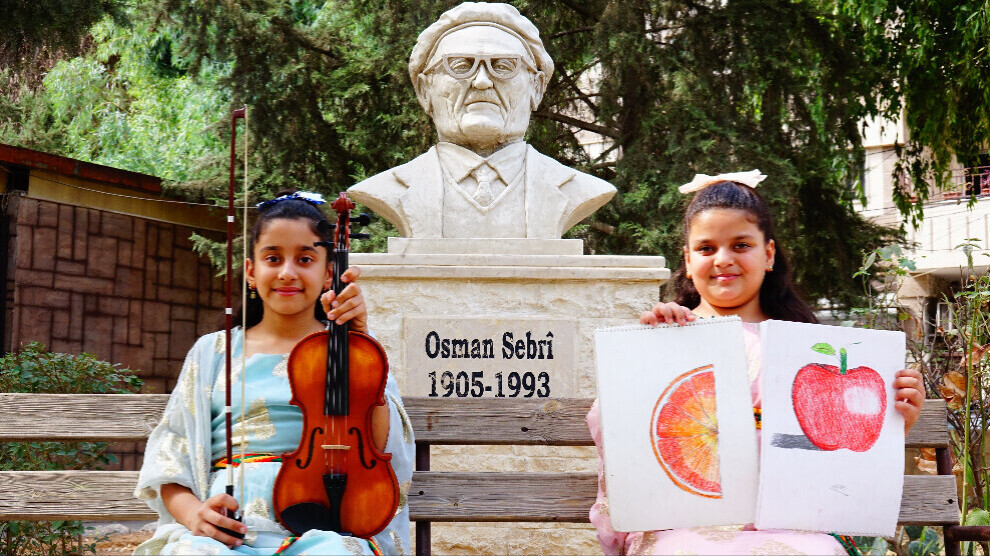
Among these children, the two sisters Hefro and Nudem Ayoub stand out. They grew up in Qamishlo and their childhood blossomed under these transformations. Over the years, their lives became linked to the Kurdish language and art, and each of them chose a path through which to express herself and her ambitions, while they share a commitment to their language and culture.
Hefro and Nudem Ayoub read in their mother tongue and spend part of their time learning arts and developing their talents. While Nudem chose the violin and music as her path, Hefro found her passion in drawing.
"I Don't Want a War to Break Out Because of Language"
Nudem Ayoub is 11 years old and studies in the fifth grade of primary school. Since the pre-school stage, she has been learning the Kurdish language, which she sees as an essential part of her daily life.
She says: "For me, learning the mother tongue is not difficult, because we have always been used to speaking it. The beautiful thing is that we speak Kurdish at home and at school too. We want every person to receive their education in their mother tongue. I don't want a war to break out because of language, so I wish everyone could study in their own language."
Alongside her studies, Nudem Ayoub has been learning to play the violin for three years and has become a member of the Rojava Orchestra, which has been working for years to train a new generation of musicians.
She recounts how her relationship with the violin began: "I loved the violin from the beginning, but my mother suggested I go for training on it. I said to myself: let me try at first, and when I played it I loved it very much. Anyone who learns to play the violin will love it very much."
Nudem Ayoub's artistic life does not stop at the limits of training, as after returning from school she is keen to go to violin practice. She believes that listening and focusing help in learning quickly, saying that whoever listens well and is intelligent can learn to play quickly.
"The Violin Is My Friend"
Nudem Ayoub is linked to the violin by a relationship that goes beyond the limits of learning and training. She describes it as her friend and says she loves it very much. She also participates in singing within the "Waad" band.
She explained that the orchestra plays pieces in the Kurmanji dialect, and that participating in concerts gives her a special feeling. "They are beautiful moments, because we sing songs in our language and play musical pieces. And more beautiful than that is that I am not alone, as my friends are also around me. The Kurdish language is our existence."
Between study, music, and singing, Nudem Ayoub draws the features of her future dream. Despite her love for the violin, she does not see herself as a musician in the future, but aspires to study medicine and work as a doctor treating patients. "I am also learning to play the violin, but when I grow up I want to study medicine and become a doctor who treats patients."
The Phone Between Benefit and Harm
Like many children, Nudem Ayoub uses the phone, but she says her mother sets her a daily time ranging between 30 minutes and an hour. She believes that excessive use of the phone may cause harm, especially to the eyes and eyesight, and can also expose children to content that does not suit them.
However, Nudem Ayoub does not view the phone as absolutely harmful, as she uses it to search for musical instruments and culture and to follow everything related to them. "We use it to search for musical instruments and culture and follow what is related to them." For her, language is inseparable from her identity and existence, and she confirms that the Kurdish language represents for her her existence and the existence of her mother as well.
Her Dream Is to Become a Painter
As for her sister Hefro Ayoub, who is 10 years old, she studies in the fourth grade, but she has chosen for herself a different artistic path. While Nudem found her world in music, Hefro found her world in drawing, and she dreams of becoming a great painter in the future.
She says that drawing fruits is what she loves most, and therefore these subjects form a large part of her drawings. After the end of her school day, she goes at six in the evening to a course to learn drawing, where she meets other children from the neighborhood and they share in practicing their hobby.
She describes her experience, saying: "There are many children from the neighborhood in the educational course. We draw pictures together and show them to each other. And it is not limited to that, but we also discuss how we can draw our paintings more beautifully."
For Hefro Ayoub, drawing is not limited to practicing a hobby, but represents a path toward a bigger dream. She wants to develop her skills and gradually move from drawing on paper to drawing on canvases. "When I grow up I want to become a great painter. And when I am able to draw pictures successfully on papers, I will then also start drawing on canvases."