
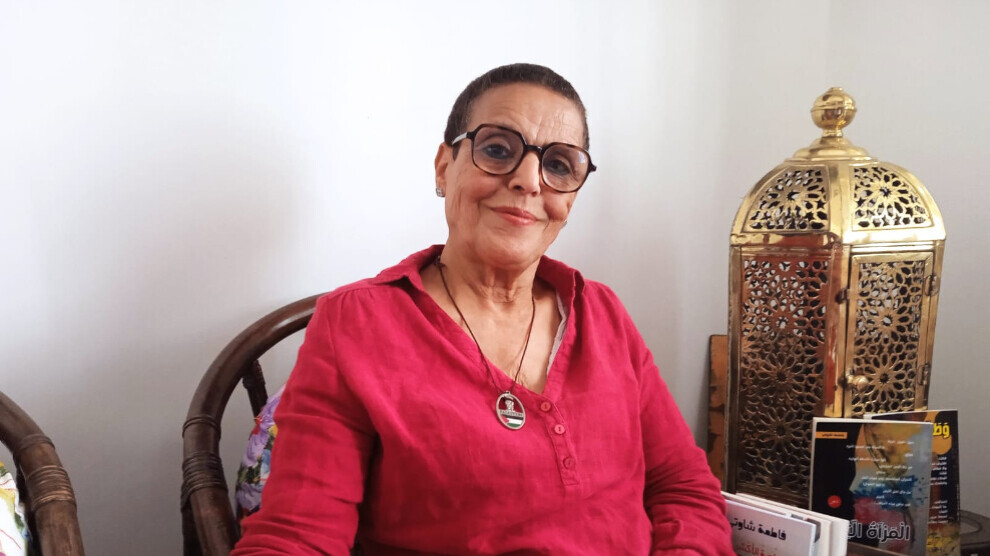
Fatima Chaouti: Feminist Writing as a Space to Combat Violence and Exclusion
Today, women’s writing is an act of resistance confronting cultural hegemony and discrimination, exposing stereotypes’ fragility. It is a space for liberation, reshaping consciousness, and declaring a female presence that regects exclusion.
HANAN HARAT
Morocco_Women’s issues trancend geographical borders and narrow identities,falling within a global human struggle against violence, discrimination, and exclusion. From this standpoint, Moroccan writer Fatima Chaouti advocates for writing that stans with women wherever they are, considering literature a tool for documentation, exposure, and resistance, not merely an aesthetic practice isolated from reality.
To explore the responsibility of writing in confronting violations against women in war and conflict zones, and the challenges still facing women writers within the cultural scene, our agency conducted the following interview with Moroccan writer Fatima Chaouti:
Why did you choose to make writing a tool to confront cultural domestication and male hegemony? How do you view the challenges facing bold women's voices within today's cultural scene?
My choice of writing was never spontaneous or automatic; it was a conscious and deliberate choice. When I write, I invoke multiple references that have shaped my intellectual and creative path, including philosophical, literary, and human rights references, especially feminist human rights references.
I write against domestication and subservience, and against the patriarchal mentality that still influences women's representations and roles within society. I see that much writing does not stem from a genuine awareness of the specificity of women's experience nor from an understanding of the forms of exclusion women face, so writing becomes a space for accountability and resistance more than a mere aesthetic practice.
However, writing that opposes domestication is not always accepted, especially within conservative societies. Therefore, women writers sometimes resort to symbolism and artistic displacement to express their positions, confronting a reality that sometimes still views women as objects of consumption rather than thinking subjects.
The irony is that patriarchal consciousness is not carried by men alone; some women may also internalise it. Thus, the struggle for liberation sometimes begins from within, by questioning the very perceptions that women themselves reproduce.
Hence, I see that cultural struggle is no less important than human rights struggle, because male hegemony often hides within the cultural field itself, including some discourses that claim to defend women.
Much feminist writing is accused of exaggeration or of importing concepts from outside the local context. How do you respond to this argument?
It is true that the West has an enlightening role through acculturation and civilisational cross‑pollination, but this does not mean that women's writing in Morocco or the region as a whole is merely a reflection of the West or a form of Westernisation.
Moroccan women derive their visions from their social and cultural reality, from the broader public scene to which they belong. To say that they cannot express themselves except by reproducing others' ideas is an attempt to reproduce the image of the subservient woman — an image I completely reject.
Conversely, one cannot deny the importance of acculturation and civilisational interaction, especially in an open world due to the digital revolution, where it has become impossible to speak of isolated cultures. Therefore, we benefit from global experiences, but we reproduce them according to our local conditions, giving them a special identity rather than leaving them as mere imported ideas.
In my view, the relationship with the other is not alienation but a mutual cultural dialogue. Those who deny this interaction practise a kind of cultural illiteracy.
In your view, is there a difference between writing about women and writing from a genuine feminist consciousness?
I distinguish between writing about women as a subject matter, and writing from within a feminist consciousness that understands the complexities of women's experience and its social, cultural, and legal contexts. It is not enough for a woman to be the subject of a text for it to be considered feminist writing in the critical sense; any writer, male or female, can address women's issues without starting from a rights‑based perspective or a real understanding of the structure of discrimination affecting their lives and trajectories.
In many cases, women are presented in literary or artistic texts as ready‑made images or stereotypical models, without questioning the references that produce those images. A woman may write about women without necessarily reflecting a critical feminist consciousness, just as some "sympathetic" discourse may reproduce the very patriarchal perceptions even while believing it is doing justice to women. Therefore, the issue is not about the biological sex of the writer, but about the perspective from which the representation is constructed.
How do you view the situation of women in light of wars, conflicts, and social and political transformations in the world?
In my view, the women's question is not merely local or national; it is a universal human issue. Therefore, I have written about women in many countries, about the violations they suffer in different places around the world, whether in Iran, Afghanistan, Pakistan, Iraq, Palestine, or other countries where women face multiplied challenges.
Palestinian women, for example, live in extremely harsh conditions due to war and occupation. Generally, women in armed conflict zones face complex forms of violence, not limited to social or cultural violence, but also including the effects of wars, conflicts, displacement, and loss of security and stability.
Whether in Lebanon, Iraq, Syria, Yemen, Morocco, or other parts of the world, women face multiple forms of violence, even in countries not experiencing direct war, because the effects of crises, conflicts, and social imbalances extend to everyone. One cannot ignore the suffering of many women in Africa from civil war violence, famines, economic exploitation, human trafficking, and other forms of violations.
Some regions have witnessed the rise of extremist groups that directly targeted women, as happened with Boko Haram and other organisations that practised systematic violence against women, to the point of considering women the cause of problems and seeking to subjugate them or eliminate their presence in the public sphere. In such contexts, rape and sexual violence become dangerous weapons of war used against women, girls, and children.
Therefore, I believe that the situation of women in Morocco cannot be separated from the situation of women in the world. There are many common denominators between the forms of violence women suffer, even if contexts and circumstances differ. However, women's suffering multiplies especially in war and conflict zones, where multiple forms of political, social, cultural, and economic violence intersect.
The issue is not limited to women in war zones; there is also the suffering of female prisoners, detainees, migrants, and refugees, who in turn face multiple forms of violence and discrimination. Thus, the responsibility of literature lies in taking a clear stance against racism, discrimination, violence, rape, and all forms of violations affecting women.
How do you employ writing as a tool for documentation, exposure, opposition, and defence of women's issues globally?
In my writings, I have endeavoured to address the suffering of women around the world, whether Arab, European, or others, because I believe that solidarity with women should not stop at geographical borders, national identities, or religious affiliations.
My vision is not a narrow local one; it is a humanistic vision that considers that any woman subjected to violence, whatever its form or location, affects all women. Verbal, moral, physical, or sexual violence, as well as femicides, are not isolated events; they express deeper structures of discrimination and exclusion that must be confronted and exposed.
Hence, I believe that the task of writing is not limited to empathy or symbolic support; it also includes exposing, opposing, documenting, and condemning violations.
Cultural belonging should not be a criterion for looking at women's suffering. What matters is the human being — the woman — who is subjected to violence, wherever she is. Thus, writing is called upon to be a witness and a resistor, conveying what happens behind closed doors and giving a voice to the voiceless.
How do you experience the act of writing today as a space for liberation from constraints and stereotypes, especially given the prejudices or difficulties a woman writer may face within the cultural scene?
I believe that writing is an act of liberation par excellence; it liberates the self from the barbed wires that surround it, from the demeaning gaze imposed upon it, from the fear of the other, and from the dominance of prevailing ideas and ready‑made judgments. The woman writer still faces a great deal of prejudice, as ready‑made moral accusations and labels are attached to her whenever she chooses to be independent in her thought or bold in her writing.
Unfortunately, there is still a view that considers any liberated woman writer as suspect or as a deviation from prevailing values — a form of frustration and symbolic pressure exerted on creative women. However, despite the persistence of these perceptions, I believe that women should not abandon their pioneering role, not only as women performing traditional roles, but as intellectuals and creators capable of confronting patterns of thought that seek to limit their creative and cultural freedom, and prevent them from demanding more achievements and rights.
It is not easy for a woman to aspire to an advanced cultural position in a reality that still carries many manifestations of discrimination.
Moreover, the cultural scene is not free from relations of dependency, networks of interests, and symbolic kinships that make access to the cultural space more complex for women. This situation pushes many of them into self‑withdrawal and isolation rather than active participation, which does not serve women's presence or their causes.
Therefore, I see the need to confront this form of cultural violence that seeks to monopolise the cultural field and exclude women from it, by treating them as if they are incapable of producing knowledge or contributing to the cultural movement within their societies, whereas women possess the same awareness, ability, and competence that make them essential actors in building the cultural scene.
What message would you like to send today to the new generation of women who choose writing as a space for expression, protest, and self‑defence?
The responsibility of rising generations is to carry this message and continue this path, but within a liberating, democratic, humanistic, rights‑based, and universal framework, far from all forms of discrimination between the woman writer and the man writer.
Writing is an invitation to liberation. Writing that stems from a feminist rights‑based perspective represents an essential step in a broader and more comprehensive liberation process. Therefore, I hope that women's writing will be writing for light, not for darkness — writing that resists marginalisation, combats exclusion, and defends the values of enlightenment, justice, and equality.
It is not about seeking to reach the status men have achieved due to historical accumulations and certain objective circumstances; it is about women reaching their natural and deserved place within society, culture, and creativity. This will only be achieved through the combined efforts of women, strengthening cooperation and solidarity among women writers and creators, and working to draw a clear roadmap that expresses women's situations and aspirations through writing.