
Women’s Revolution… Freedom Embodied in Reality
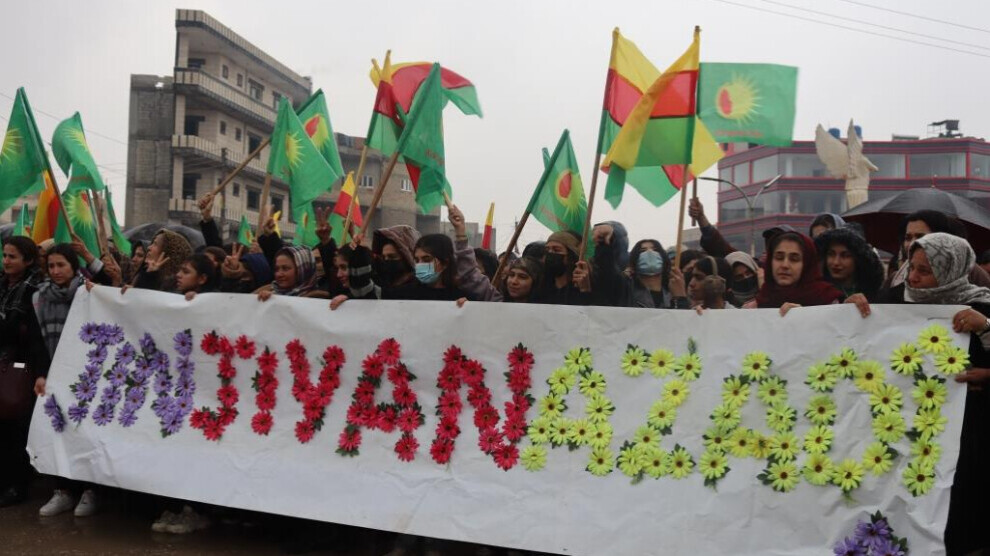
Article by a member of the Jineolojî Academy – Banyan Magosa
Revolution is often seen merely as a change in power. However, history shows us that if life itself does not change with a change in power, then revolution is nothing more than a form of domination under another name. For this reason, the women’s revolution transcends traditional definitions of revolution, because its goal is not power, but life itself.
The women’s revolution seeks to bring about radical transformations in the fields of economy, politics, knowledge production, family, and sexuality—areas from which women have been systematically excluded throughout history. In this sense, women’s liberation is not an ideological fantasy, but a real process of emancipation. A large portion of the gains achieved today in the name of women’s liberation are limited to structural reforms: quota systems, legal equality, and certain representation rights. Yet these achievements remain fragile as long as they are confined within a male-dominated system. In fact, women’s rights are often the first to be violated in times of war, crisis, or authoritarianism. This reality demonstrates that women’s liberation can only be secured through a revolutionary social transformation, not merely through reforms.
Where did women’s significant achievements emerge from? To understand these achievements, we must look at lived and practical experiences rather than abstract theories. The experience of the Kurdish women’s liberation movement stands as a clear example in this regard.
Women’s Will in Politics
Through structures such as the co-chair system—which does not merely rely on quotas or symbolic representation—women have become direct actors in decision-making mechanisms. Thanks to this system, politics has shifted from male monopoly to a collective and social arena. Women’s participation has not been limited to representation alone, but has extended to administrative and leadership positions.
Women’s Economy and Cooperatives
In contrast to the competitive and exploitative investment structure of capitalist economies, cooperatives established under women’s leadership are based on participation, solidarity, and collective production. These structures have created an alternative economic space that frees women from unpaid domestic labor and the instability of the labor market. For the first time, women have been able to make economic decisions according to their own will.
Self-Defense
The concept of self-defense is one of the most prominent achievements of the women’s revolution. Women have embraced their right to self-defense not only as an individual responsibility but also as a social one. This approach has transformed women from beings in need of protection into active agents defending their own lives.
Transformation in Family and Social Relations
The family was viewed as one of the oldest institutions of women’s oppression. Instead of glorifying it, its democratization was pursued. Forced marriage, polygamy, and traditions restricting women’s bodies were rejected, and new ways of living were developed based on equality and freedom in relationships between women and men. The goal of this transformation was the liberation of both women and men, becoming a fundamental project of women’s movements within the revolution.
Achievements in Knowledge and Education
With the development of women’s science, women have become active producers of knowledge rather than merely its subjects. Efforts have begun to socially rewrite women’s history through academies, research centers, and educational activities.
“Women’s Science” as the Scientific Foundation of the Women’s Revolution
Women’s science (Jineology) is a field of knowledge that not only advocates for women’s revolution but also provides it with a scientific foundation. It uncovers realities ignored by positivist social sciences dominated by men. By analyzing women’s historical roles, their position in society, and the mechanisms of their oppression, women’s science reveals the possibilities of a free life. In this sense, it is not an alternative to the feminist movement, but rather a resource that nourishes, deepens, and establishes a universal foundation for freedom. It holds the capacity to unite the diverse experiences of women—from Africa to Latin America, and from the Middle East to Asia—within a shared perspective of liberation.
The women’s revolution is not a utopia postponed to the future; it is a tangible social transformation taking place in Rojava today. Its achievements are not limited to laws alone, but are reflected in life itself. The women’s revolution liberates the individual and transforms society at the same time. By transforming society, it rebuilds humanity. For this very reason, the women’s revolution is not merely a “women’s issue,” but a matter of human liberation.