
Women’s Action Union Launches a Charter to Support Parity and Protect Morroccan Women Within Political Parties
Women’s Action Union in Casablance launches charter for equality and equal opportunities in parties,protecting women from political violence,with reporting mechanisms,and boosting their presence in decision-making before elections.
HANAN HART
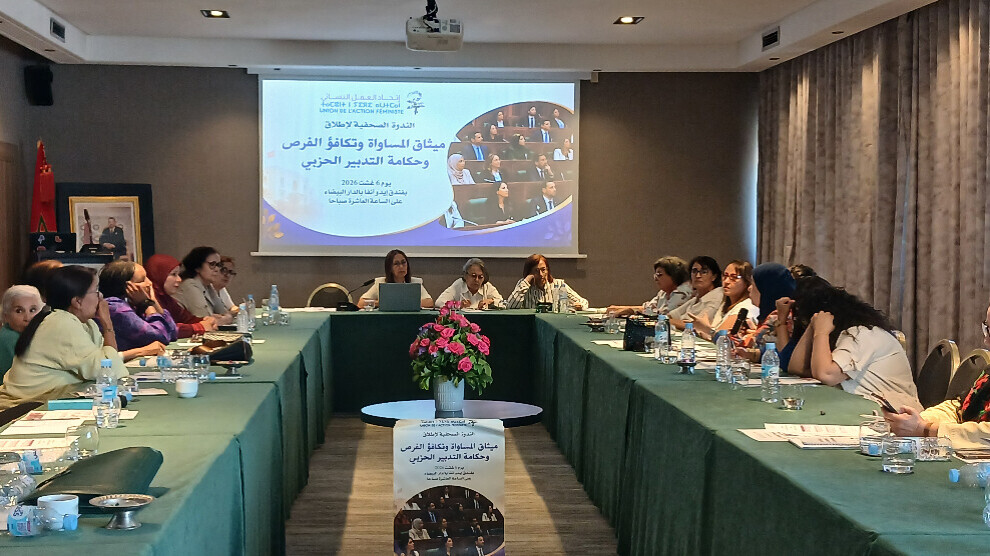
Morocco_Participants in the press conference highlighted the challenges still facing Moroccan women within political parties,foremost among them the difficulty of accessing decision-making positions,weak equal opportunities in granting nominations,and the persisitence of political and digital violence.
The Women’s Acton Union launched yesterday, Thursday,August 6,in Casablanca,Morocco,the “Charter for Equality,Equal Opportunities,and Governance of Part Management”_a civil initiative calling on political parties to adopt the principles of equality and parity within their organizational structures,and to adopt mechanisms to protect women from political violence and strengthen their presence in decision-making positions, in the context of preparation for the upcoming elections.
The charter was presented during a press conference attended by parliamentarians, elected officials, women party activists, and human rights activists, where they discussed the reality of women's political participation and the challenges that still limit their access to decision-making centers, despite the constitutional and legislative gains achieved by the women's movement over the past decades.
"The New Charter Protects Women from Political and Digital Violence"
Aisha Al-Hayyan, President of the Women's Action Union, stated that this initiative falls within the framework of the Union's efforts to strengthen women's political rights, and to move from advocating for equality to establishing practical mechanisms that ensure its implementation within political parties. She added that the charter came in response to a number of constraints still facing women, foremost among them manifestations of discrimination and political violence, whether within parties or during electoral campaigns.
She explained that the document includes a set of principles calling on parties to integrate them into their internal regulations, so that equality and equal opportunities become a guiding foundation for their work, ensuring women's participation on an equal footing with men at various levels of responsibility.
She emphasized that the charter is not limited to the declaration of principles but proposes practical mechanisms for monitoring and follow-up, including the establishment of oversight and monitoring mechanisms, and the launch of digital platforms to receive complaints from women subjected to political violence, ensuring their protection and support during and after electoral campaigns.
She added that digital violence has become one of the most prominent obstacles to women's political participation, with the growth of smear campaigns, threats, and online harassment targeting women politicians. She called on parties to provide reporting and protection mechanisms, and to take necessary measures whether the source of violence is from within or outside the party, while legally and institutionally supporting victims.
She considered that the charter constitutes a step toward filling part of the gap that still exists at the level of party practice, given the limited impact of electoral laws in achieving equality and parity. She affirmed that the initiative aims to urge parties to align their practices with the provisions of the 2011 Constitution and Morocco's international commitments in the field of women's rights.
"Women's Political Participation Must Be Strengthened"
For her part, Zahra Al-Wardi, a member of the Women's Action Union, explained that the preparation of the charter was the result of a consultative process that included regional meetings with women party activists, parliamentarians, councilors, and local elected officials, resulting in a shared vision on the necessary reforms to strengthen women's political participation.
She added that the charter calls for ensuring equal opportunities in granting party nominations, adopting transparent and fair criteria in selecting candidates, and achieving equality in financial support and campaign funding, enabling women to contest elections under fair conditions.
She noted that the document also calls for supporting women before, during, and after elections through training and capacity building, so that their participation is not limited to candidacy but extends to reaching decision-making positions within parliament and elected councils, and assuming responsibilities in standing committees and leadership positions.
"Women's Struggle Contributed to Achieving Important Gains"
Other interventions emphasized that political violence against women is no longer limited to direct assaults but also includes digital violence, smear campaigns, and blackmail—practices that affect women's continuity in political work and drive many to refrain from taking on responsibility.
Participants also raised the issue of the "culture of silence" within some parties, considering that the absence of safe mechanisms for reporting violence or discrimination makes a number of women activists hesitant to reveal the violations they experience, which limits their political participation and weakens their chances of reaching decision-making positions.
The charter includes a committee to monitor the implementation of parties' commitments, along with mechanisms to monitor respect for the principles of equality and parity, and calls for the adoption of gender-responsive budgets and the allocation of resources for training, qualification, and capacity building for women within party organizations.
Participants considered that the women's struggle has contributed to achieving important gains at the legislative level, but translating these gains into actual practices within parties still faces challenges, despite more than a decade having passed since the 2011 Constitution, which enshrined the principle of parity.
At the conclusion of the press conference, participants called on various political parties to engage positively with the charter and adopt it within their internal regulations, considering that its success will be measured by the extent to which its principles are transformed into tangible measures that ensure women's participation in political life on the basis of equality, and provide them with a safe environment for party work and electoral engagement.