
Thousands of Students Deprived of Education Following the Recent Military Escalation on Kobani
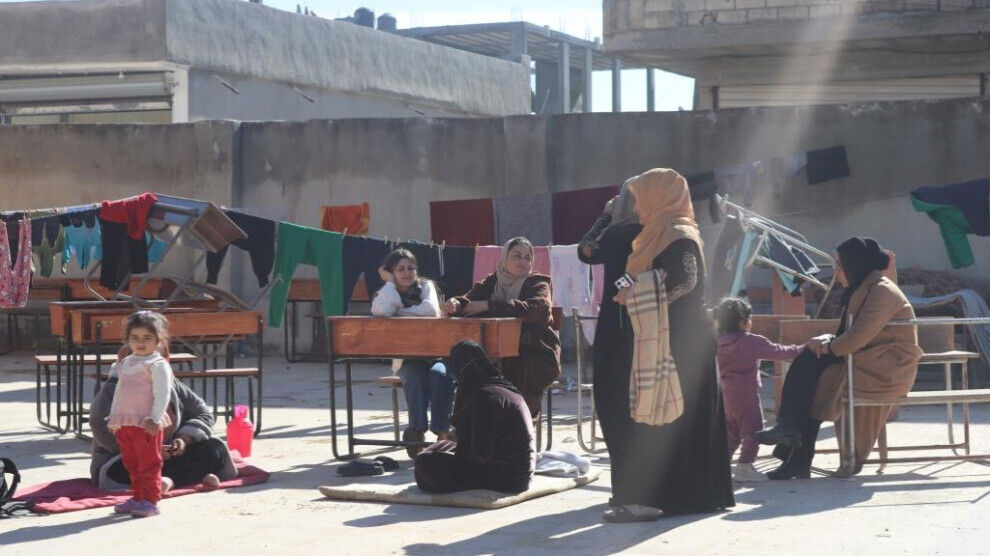
Recent attacks by Hay’at Tahrir al-Sham in North and East Syria closed 572 schools in the Euphrates Canton, displacing families and turning schools into shelters.
Silva Al-Ibrahim
Kobani – The Co-Chair of the School Administration in the city of Kobani, Aziza Ismail, warned that the delay in implementing the January agreement regarding the return of displaced people to their homes will deprive students of completing the second semester of the academic year.
Since January 6, Kurds in the Sheikh Maqsoud and Ashrafieh neighborhoods have been subjected to attacks by jihadists from Hay’at Tahrir al-Sham, backed by the Turkish occupation. The attacks escalated and expanded to areas in North and East Syria, beginning with a breach of the Deir Hafer agreement by the jihadists, culminating in a tight siege imposed on the city of Kobani on January 18.
This led to the displacement of thousands of Kurdish families from Raqqa and Tabqa, as well as displaced people from Afrin and Tel Abyad who had been living in camps. They headed to the city of Kobani and took refuge in schools and commercial shops.
572 Schools Closed
The recent attacks on the Euphrates Canton caused a wave of displacement and the suspension of the educational process. According to Aziza Ismail, the latest offensive has negatively affected education, depriving 72,000 male and female students at the primary, preparatory, and secondary levels of schooling, distributed across 572 schools in the canton. Due to the population pressure in the city following the displacement wave, 18 schools in Kobani and its countryside have been turned into shelters for displaced families.
This escalation coincided with the mid-year school break. Students had taken their first semester exams on January 15, and the second semester was scheduled to begin on January 25. However, the attacks and the displacement wave prevented students from returning to their classrooms, and 4,100 education workers were unable to perform their duties in schools and educational institutions.
Aziza Ismail pointed out that “the presence of displaced people in schools under difficult humanitarian conditions restricts our ability to continue the educational process, resulting in many negative repercussions on students’ psychological, educational, and social well-being, in addition to creating a state of emptiness while all students remain in their homes.”
She called for the swift implementation of the provisions of the agreement signed between the Syrian Democratic Forces and the Syrian Interim Government to enable displaced people to return to their homes and cities, so that schools can reopen to students. She warned that delaying the implementation of the agreement would prevent students from continuing the second semester.
“Schools Are for Education, Not for Shelter”
“Schools are for education, not shelters,” said the child Shiraz Mohammad Hasso, who was displaced with her family from Tel Al-Samen camp, which housed displaced people from the city of Tel Abyad (Gire Spi). She now lives with her family in one of Kobani’s schools. The child is a model of childhood hopes left unfulfilled and dreams shattered by war at an early age, under bombardment and along the paths of displacement and shelter centers.
She spoke about the tragic reality of childhood in the region: “We are living a tragic reality under displacement conditions. I spent my childhood in camps and shelter centers. This time, we were displaced from Tel Al-Samen camp and headed to Kobani to escape the war.”
Shiraz Mohammad Hasso, a third-grade primary school student who was unable to complete her education because of the war, said: “Schools were built for education, not for housing. We left our homes and our education behind, and now we live in schools.”
The child called for returning to her city, Tel Abyad (Gire Spi), to live in peace and complete her education in stable and safe conditions