
The Prohibition of Narrating Women’s Deaths… A Silent Resistance Exposing the Violence of the System
The report on unidentified bodies of protesting women in Kahrizak, Iran, reveals deaths denied narration or mourning—an erasure that begins in the streets and persists in collective memory.
Shila Qasim Khani
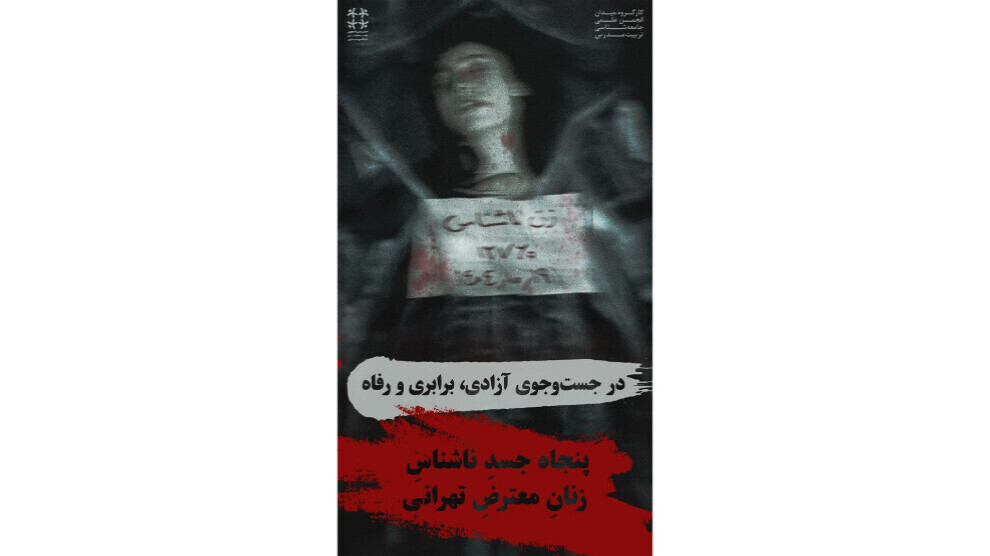
News Center – The field report issued by the Student Scientific Association at Tarbiat Modares University on the condition of the unidentified bodies of women in Kahrizak goes beyond being mere news; it becomes a document of a profound social shock.
According to the report, fifty bodies of protesting women from Tehran are still lying in Kahrizak unidentified. The explicit reference to “protesting women” cannot be considered a mere statistical coincidence. In societies subjected to totalitarian authority, the female body becomes a symbolic battlefield that carries the meanings of freedom, rebellion, and life—and for that very reason it becomes the target of doubled violence.
Concealing Identity as a Political Method of Erasing Memory
The fact that the murdered women remain unidentified means that they are physically removed from the street and then symbolically erased from the collective memory. In the recent protests, the woman’s body was not merely a protesting body; it was a body that destabilized and unsettled “the existing order”—an order that for decades has been built on controlling how women are seen, heard, and how they live.
Thus, the death of a protesting woman is not reduced to the loss of an individual; it embodies a structural attempt to return her to a state of silence—the silence she had already broken through her presence in public space, creating a crack in the discourse of power.
When we speak of “unidentified bodies of protesting women,” we are not facing an administrative error or a passing coincidence. Rather, we are confronting a deliberate practice: the concealment of identity as a political–gendered mechanism. Even after death, the female body is treated as more dangerous than the male body, because it continues to carry what the authority fears most: the possibility of giving meaning to liberation.
The Administration of Death and Inequality in Grievability
In the dominant discourse, the male body—even after death—remains a bearer of a political narrative. The family of a murdered man often reclaims his name at any cost, so that he may be classified as “killed,” “victim,” or “martyr.”
The female body, however, because of its association with notions of “morality” and “privacy,” is deprived of this possibility.
When a woman is killed, the political narrative is disrupted. Her family is forced into silence under compounded pressures: “reputation,” social judgment, security threats, and the hidden blame of society. This silence is not a choice; it is structural coercion.
The murdered protesting woman is a body that must not be seen, must not be named, and must not be mourned. Concealing her identity is the final form of this erasure, because forgetting her appears less costly for the authorities.
From Michel Foucault’s perspective, we are facing a form of biopower that controls not only human life but also death. The female body after death enters a cold administrative cycle: registration, storage, suspension. Yet this administration is not neutral; the female body is excluded from the political sphere and reduced to a mere “case.” If a woman’s death is politically narrated, it shakes the entire gender order—and this is precisely what is meant to be controlled.
Giorgio Agamben calls this condition the reduction of the human being to “bare life.” Within this framework, the body of the protesting woman becomes neither a citizen, nor a rights-bearing subject, nor even worthy of public mourning. She was alive; now she is merely a “corpse”—a corpse that must be kept somewhere without being allowed to enter historical narrative.
As the report states:
“The unidentified body is the most important narrator that, amid the transformation of our lives into numbers, has not yet been reduced to a number.”
This sentence produces a profound inversion: while the official narrative speaks through statistics and cold reports, the association’s report suggests that the nameless body, in its silence, exposes the lie of the existing system.
Kahrizak and the Geography of Disappearance
Kahrizak is not merely a geographical location; it is an institutional memory of state violence, a dividing point between death and politics. When it is said that these women “are still in Kahrizak,” this is in fact an announcement that the case is not closed, that the deaths remain ambiguous, and that social mourning is suspended. A society that cannot mourn either explodes or sinks into total numbness.
Why is the female body considered so dangerous? Because the woman’s body—especially in moments of protest—carries desire, voice, gaze, and a dominant presence in public space. If the death of this body is named and narrated, it becomes a collective demand and may reveal hidden forms of violence, including sexual violence and structural control over the body.
Here Judith Butler’s concept of “grievable lives” becomes crucial: political power predetermines which lives deserve public mourning and which can be disposed of without a name or ceremony. Mourning is not natural; it is a political and discursive construction.
In this context, the protesting female body—especially when it violates gender norms—is often excluded from the sphere of mourning. Yet precisely because it is deprived of mourning, this unknown body becomes a discursive rupture that cannot be fully denied or absorbed into the official narrative.
A Global Pattern of Disappearances in the Face of the System
Global experiences show that this pattern recurs—from women who disappeared under the dictatorships of Latin America to women under regional repression. In Argentina, the “Mothers of the Plaza de Mayo” initially searched for their sons, but it later became clear that the number of missing girls was much higher. In civil wars and major repressive contexts, women are often forcibly disappeared—not merely killed—because disappearance is an extreme form of control over the body that cannot easily be described.
What is most terrifying about the unidentified female body is not her killing, but the fact that no one dares to search for her. This is not due to a lack of familial love, but to the cruelty of a system that has spread fear into the home, shame into society, and exclusion into women’s lives. Here, the authority does not only kill the body; it suffocates any prior possibility of claiming it. The unidentified female corpse is the product of structural violence, social judgment, and imposed silence.
Conclusion
Ultimately, the issue is not only the death of women, but which bodies are allowed to remain in the collective memory. The unknown female body stands as a witness to this fundamental discrimination—a body removed to preserve the system, yet this very removal reveals the nature of that system.
The female body remains, even after death, a field of struggle. The resistance of the bodies in Kahrizak signals the ultimate defeat of the silence imposed by power.