
Syriac Women Protect Their Community and Defend Their Achievements in the Rojava Revolution.
Women of the Syriac community in Rojava continue to strengthen their political, social, and economic presence, working to safeguard community rights and preserve the gains achieved for women
ASMAA MOHAMMAD
Qamishlo – Syriac women in Rojava have emerged as an essential and active component of society, not only on the social and cultural levels, but also in political participation and decision-making. Today, Syriac women have become an integral part of councils and institutions that make crucial decisions affecting the life and future of their community.
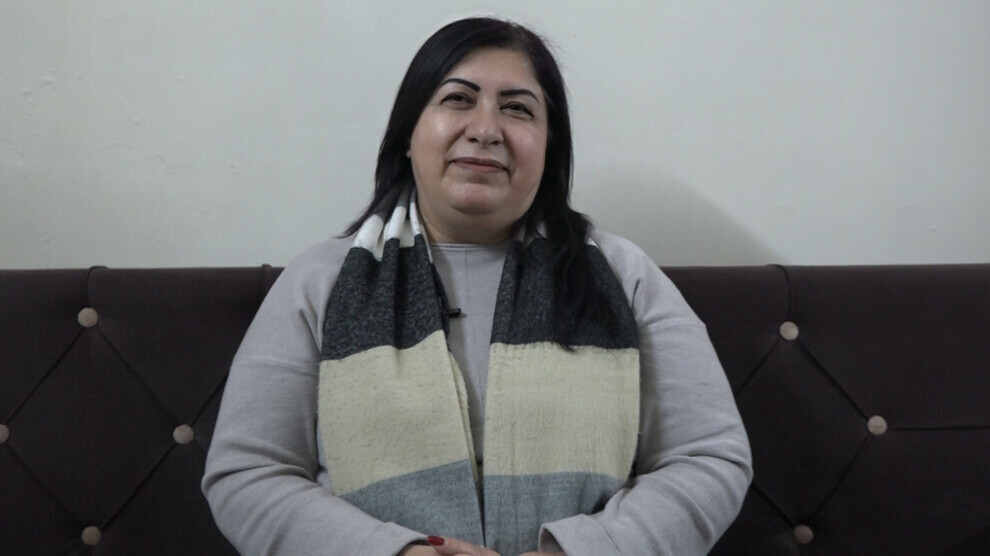
The Syriac Women’s Union serves as a strong platform that enables women to express and demand their rights at various levels. Sabah Shabo, a member of the Union, explained in an exclusive interview with our agency that this stage represents the culmination of a long struggle by Syriac women to protect their achievements and expand women’s participation in both local and political spheres.
She stated that throughout the years, Syriac women have always been at the forefront of demanding their rights and the rights of their communities. She emphasized that one of the most difficult challenges women faced was political and social marginalization, as women were excluded from decision-making positions, and their voices were barely heard in political discussions—whether at the local, community, or even economic participation levels.
One of the most important achievements realized today is the continued presence of women in political councils and party institutions, making them active partners in shaping policies and safeguarding both their people’s rights and their personal and social rights. This, she described as a “major qualitative leap” for Syriac women in the region, reflecting the magnitude of the struggle women undertook to reach this level of political and social influence.
Women Are an Integral Part of the Social and Political Fabric
Today, Syriac women do not demand rights only for themselves as individuals; they consistently stand for the rights of the entire community. A woman is an inseparable part of her people’s social and political fabric. “When the people obtain their political and social rights, women implicitly obtain their political rights as well.” This understanding has made the role of Syriac women central in all fields—political, economic, social, and cultural alike.
Sabah Shabo explained that the Syriac Women’s Union, through its social and political institutions, works to empower women and enhance their participation in all areas. The Union focuses on awareness programs that include political, social, cultural, and historical education. These programs provide women with broad space to understand their role and status, and to strengthen their ability to confront political, social, and cultural challenges they may face within society.
Today, thanks to the Rojava Revolution, Syriac women are actively present on political platforms, in administrative forums, and in party councils. They directly participate in making crucial decisions—an achievement that Sabah Shabo described as “historic and unprecedented in the region.” It reflects the profound change Syriac women have brought to society and decision-making fields, proving that they are no longer merely recipients of decisions, but decision-makers themselves, participants in drafting public policies, and advocates for their rights and the rights of the local community.
Despite these achievements, the challenge of traditional patriarchal mentality remains, which she described as the greatest obstacle facing Syriac women in exercising their political and social roles. In addition, societal perceptions that confined women to child-rearing and household management posed significant barriers. However, Syriac women have proven their ability to overcome these obstacles.
She also highlighted the military participation of Syriac women in defending their land and hard-won rights. Some have sacrificed their lives to preserve these rights: “The blood of the female martyrs has mingled among all components without distinction.”
Solidarity Is a Real and Unbreakable Strength
This solidarity and unity among Syriac women, alongside women from other communities, represents “a real strength that cannot be broken.” She compared this solidarity to “different colored pens that, when combined, form a complete and beautiful painting that no one can dismantle or weaken.” She affirmed that women’s will is firm and resilient, like a deeply rooted tree capable of withstanding any political or social storm, because it is grounded in its land and community, drawing strength from its history of struggle and from the sacrifices women have made for their rights and the rights of society as a whole.
She further stressed that the Union has always been a genuine platform for supporting women’s political empowerment, highlighting women’s role in decision-making, organizing workshops and training programs, and strengthening political, cultural, and social awareness among women to ensure their effective and continuous participation. “All these programs and initiatives form the foundation for sustaining women’s struggle in preserving the achievements realized in the Women’s Revolution in Rojava, and for ensuring their presence and influence in the near and distant future alike.”
In conclusion, Syriac Women’s Union member Sabah Shabo emphasized that Syriac women today are decision-makers and guardians of achievements. They continue their struggle to claim their rights and the rights of their people, remaining an active force in society and a fundamental pillar in protecting political, social, and legal gains—while preserving women’s solidarity and social cohesion, which guarantee the continuity and protection of the feminist struggle.