
Sudan on the Brink of Famine… Two-Thirds of the Population in Urgent Need of Aid.
Sudan faces one of the world’s worst humanitarian crises in 2026, as conflict, displacement, food insecurity and collapsing health services threaten millions amid declining funding.
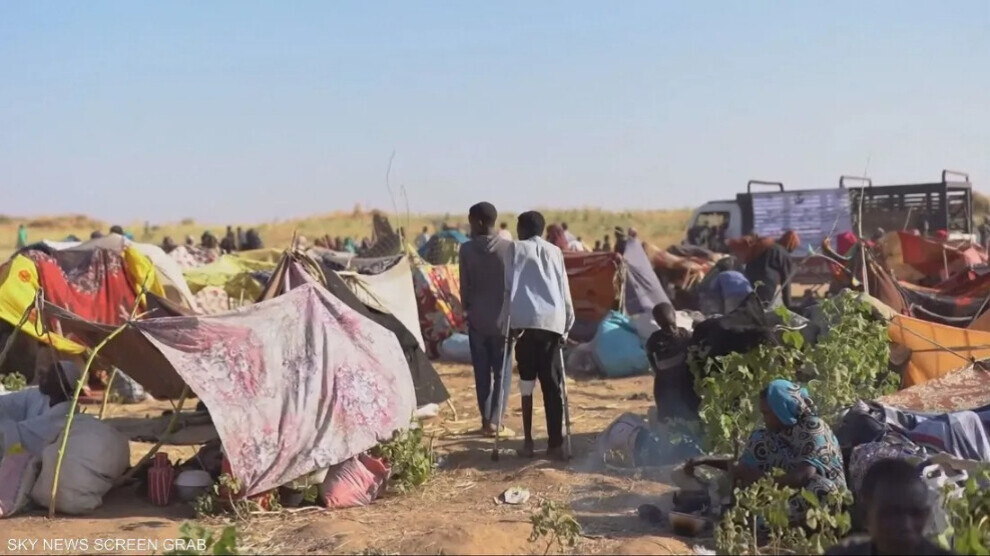
News Center — As conflict persists and humanitarian conditions deteriorate, there are no encouraging signs of tangible improvement in Sudan in 2026. On the contrary, the conflict is likely to continue, and the humanitarian crisis is expected to deepen further in the absence of realistic political solutions on the ground.
The United Nations–affiliated Integrated Food Security Phase Classification (IPC) reported on Thursday, February 5, that approximately 33.7 million people—equivalent to two-thirds of Sudan’s population—will require humanitarian assistance this year, signaling a severe collapse in food security levels.
New areas in North Darfur, including Um Baru and Kernoi, have crossed the famine threshold, recording acute malnutrition rates exceeding 50 percent, double the internationally recognized threshold for declaring famine.
Ongoing fighting has displaced around 9.6 million people internally, while more than 21 million face high levels of acute food insecurity due to attacks on markets and supply routes and the disruption of distribution chains.
Estimates indicate that cases of acute malnutrition could reach 4.2 million this year, with 20 additional areas at risk of sliding into famine.
The crisis extends beyond food shortages. More than one-third of health facilities have ceased operations due to complex security conditions and a lack of international funding, severely limiting the ability of humanitarian organizations to respond to growing needs.
The United Nations has called for an immediate cessation of hostilities, protection of civilians, and the securing of safe and sustained humanitarian access, alongside the unconditional and rapid delivery of life-saving assistance and adequate funding for humanitarian sectors.
On the international front, the United Kingdom imposed new sanctions last night on leaders from both the Sudanese Armed Forces and the Rapid Support Forces (RSF). Meanwhile, the U.S. president announced that Washington is making intensive efforts to end the conflict, with a comprehensive peace plan to be presented to the UN Security Council in the near future.
For his part, the Sudanese Prime Minister urged the international community to support a government-led peace initiative based on a comprehensive ceasefire, the disarmament of the Rapid Support Forces, and a Sudanese–Sudanese dialogue aimed at reconciliation and social integration. He emphasized that Sudan urgently needs international support to avert a humanitarian catastrophe threatening millions of lives.
It is worth noting that since the outbreak of conflict between the Sudanese Armed Forces and the Rapid Support Forces in April 2023, all political initiatives have failed to halt or de-escalate the fighting. Meanwhile, the international quartet—the United States, Saudi Arabia, the United Arab Emirates, and Egypt—has lost its ability to act as an acceptable mediator due to the perceived bias of some of its members. This failure has turned regional mediation tracks into part of the crisis rather than a solution.
According to UN reports, more than 11 million people are displaced inside and outside Sudan. Experts describe the situation as a “countdown to catastrophe,” as continued fighting and political deadlock place Sudan at the center of the world’s worst humanitarian crisis today