
Rimziya Mohammed: The Experience of Women in North and East Syria Has Established a New Model of Participation and Leadership
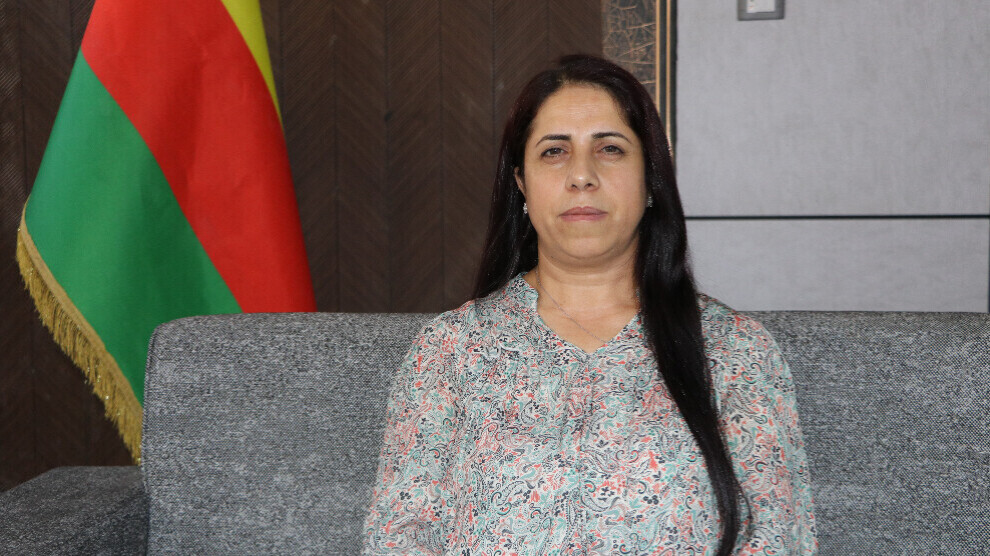
Rimziya Mohammed, Co-chair of the Democratic Society Movement (Tev-Dem), affirmed that the organization was the fundamental pillar for women's empowerment and the continuation of their struggle for rights and active participation.
NAGHAM JAJAN
Qamishlo — Amid the war, suffering, and transformations sweeping across Syria, the experience of women in North and East Syria has emerged as one of the most prominent fruits of the revolution over the past years.
During the years of the Rojava Revolution, spanning since July 2012, women have managed to overcome decades of marginalization and exclusion, building a new organizational and societal model. They have also cemented their presence as essential partners in decision-making and community management, transitioning their role from a position of subordination to one of agency and influence.
In this context, Rimziya Mohammed, Co-chair of the Democratic Society Movement (TEV-DEM), spoke about the experience of women's organization in North and East Syria and its significance.
She stated that the journey of women's struggle in Rojava and Syria as a whole has been ongoing since the founding of the Kurdistan Freedom Movement to the present day, affirming that organization is the foundation that enables women to protect themselves, develop their personalities, build their knowledge, and strengthen their presence in various spheres of life.
She added that the establishment of the Star Congress marked "a pivotal milestone in women's journey," while the Autonomous Administration provided women with broad opportunities to prove themselves and participate in public life. She explained that the co-presidency system was among the most prominent of these steps, granting women the right to actual participation in decision-making and proving to a society that had long underestimated them their ability to bear responsibility.
Our interlocutor also considered that the Rojava Revolution provided a historic opportunity for women to organize and reclaim their rights, and that the Star Congress has become a framework that brings together strength, organization, and confidence, and a fundamental launchpad for the struggle of women in Rojava and Syria. She noted that what she described as an "achievement" was not realized without great sacrifices, explaining that women paid a heavy price to organize their ranks.
She explained that the Ba'ath regime continuously targeted militant women and organizations, arresting them and throwing them into prisons, yet "it was unable to break their will," as they would return to continue their struggle after release. "The nation-state fears women's organization, and therefore continues to target them constantly."
She affirmed that the authoritarian mentality still refuses to recognize women's role in various fields, pointing out that the Syrian constitution to this day does not genuinely guarantee women's rights. "Systems based on conservative religious thought see no place for women in politics or decision-making positions, but confine their role to the home."
Rimziya Mohammed directed an appeal to all women in Syria to strengthen their struggle and organization, stating that a woman who succeeds in raising her children on values and ethics is also capable of succeeding in politics and administration. She noted that authoritarian systems are once again seeking to exclude women and weaken their role, but women, as she affirms, "possess the strength, will, and ability to continue the struggle against these policies."
She concluded by saying that women's organization today faces serious risks due to prevailing policies and mentalities, calling on women worldwide to take a unified stance and demonstrate their will in confronting these approaches.