
Radhia Jerbi: What Is Happening in Some Syrian Regions Is a Crime Against Humanity
Radhia Jerbi, President of the Tunisian National Union of Women, condemned the violations committed against women in the regions of northern and eastern Syria.
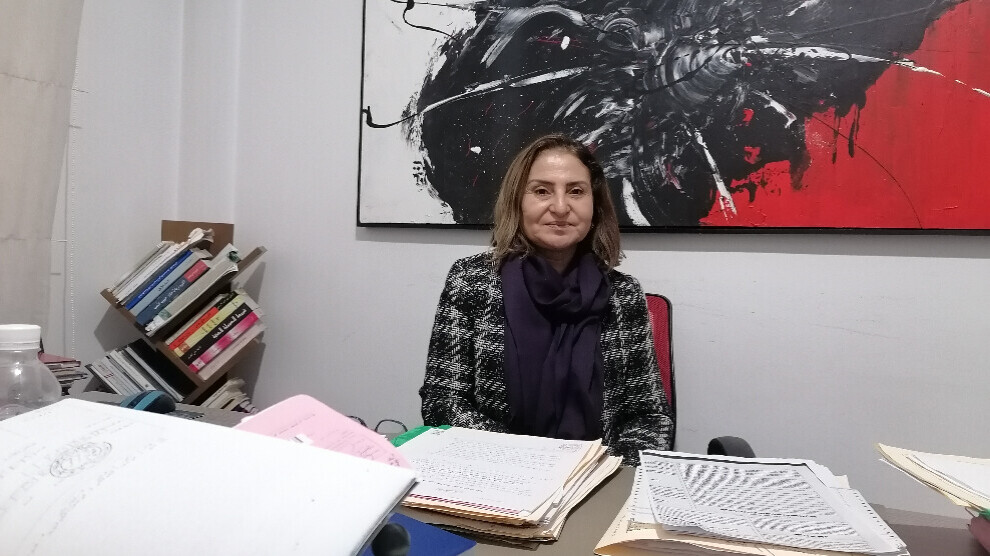
NAZIHA BOUSSAIDI
Tunis — As crimes continue to be committed against the Kurdish people, especially women and children, and as international silence persists regarding all forms of injustice they are subjected to on their land by jihadists of Hayat Tahrir al-Sham, feminist voices rejecting these violations and calling for women’s unity are rising.
In this context, Radhia Jerbi, President of the Tunisian National Union of Women and Vice President of the International Council of Women’s Federations, stated:
“As a human rights advocate, I follow what is happening in some regions of the world. Moreover, as part of my responsibilities within the International Council, I am concerned with human rights issues. Accordingly, the violations occurring in some Syrian regions, as well as in Sudan, Libya, and other parts of the world such as Afghanistan and Iran, are crimes against humanity. They constitute a blatant assault on the human rights of women and a flagrant violation of all international conventions that protect and guarantee women’s human rights, including their right to dignity, citizenship, and to be treated humanely like other citizens.”
She pointed out that “forced displacement carried out by occupying forces against Palestinians is also occurring in other regions that are not occupied, simply because women there belong to the same religion, or do not share the same skin color or language. As a result, they are subjected to serious violations, including forced displacement, expulsion from their homes, stripping them of their clothes, and sometimes assaulting their bodies and dignity, raping them, torturing their children, and abducting some of them.”
Jerbi emphasized that “almost all heinous crimes against humanity are being committed in regions that are supposedly Muslim-majority areas, even though Islam, unfortunately, rejects and condemns these acts, just as international conventions do.”
International Laws No Longer Guarantee Protection
Radhia Jerbi declared her solidarity and support for the Kurdish people in Rojava, saying:
“It is painful today, in the twenty-first century—a century characterized by globalization, rapid information flow, and fast communication between people regardless of geographical boundaries, along with increased awareness of rights—to see that these rights are still being violated. We see people subjected to injustice, their rights erased, and their voices silenced.”
She explained that “international laws are no longer sufficient to guarantee protection for women in particular, and for children and vulnerable groups in general. We have seen repeatedly that these laws are applied with double standards and depend on the identity of the victim to determine whether support is granted or not.” She considered that “we are living in an international situation in which the role of international institutions and organizations has declined in many fields, including human rights issues.”
She concluded by saying:
“Women’s rights continue to be violated, and I insistently say that I, along with all free women and all women who believe that rights do not belong to a specific state, gender, or border, affirm that these rights must be protected. All efforts must unite to stand with every oppressed person and every right. Therefore, I stand with all women in Syria, Sudan, Afghanistan, and anywhere in the world. We are all in strong solidarity with them, and through women’s and human rights organizations, we strive to raise their voices loudly and expose crimes so they are not confined to a narrow geographical scope and so women do not feel that they are alone.”
The Scale of Violence and Violations Cannot Be Forgotten
Radhia Jerbi stressed that “no one can forget the scale of violence and violations suffered by Yazidi, Armenian, and Kurdish women, and what they endured at the hands of ISIS. Media outlets broadcast horrific images of women being sold in slave markets, chained, in scenes reminiscent of the Middle Ages.”
She recalled her participation with Kurdish women in one event, saying:
“I attended a women’s conference where Kurdish women spoke about the extent of the suffering they endure and their aspirations for democracy, freedom, and living like other women in Syria and Iraq.” She emphasized that “after the near eradication of ISIS and the existence of international control over this organization, it is unacceptable for these women to become victims once again of inhumane practices.”
She affirmed that history will remember the Yazidi women, as alongside their resistance and insistence on survival, they are among those who suffered some of the gravest injustices—no different from those endured by Palestinian women at the hands of Israeli forces.
“We once again say that it is our duty, everywhere in the world, to stand with women, to show solidarity with them, and to expose these practices so that women do not feel alone, and so their voices rise high enough to be heard by free people around the world and by all those who believe in these rights and struggle to defend them.”