
Memoirs of a Migrant Girl
Rohiv Qasim’s diaries carry what years can’t erase: living pains, a childhood that crossed migration before school. On her writing lines, migration paths appear clearer than dreams; the road wrote.
BRÎVAN ÎNATÎ
Derik — Some pens release imagination onto the pages; they build cities not yet seen, draw journeys not yet lived, and weave joys that reside in the dreams of tomorrow, and hopes searching for their place between the lines. But there are other pens that choose to write the truth as it was lived — the truth that remained hidden in the corners of memory. No matter how long time passes, the pains that have not been forgotten, the incomplete joy, the homes left behind, the journeys that never end, and a childhood that crossed migration unwillingly, remain an ever‑present witness.
Rohiv's diaries belong to this latter kind: the kind that writes to bear witness, not to embellish.
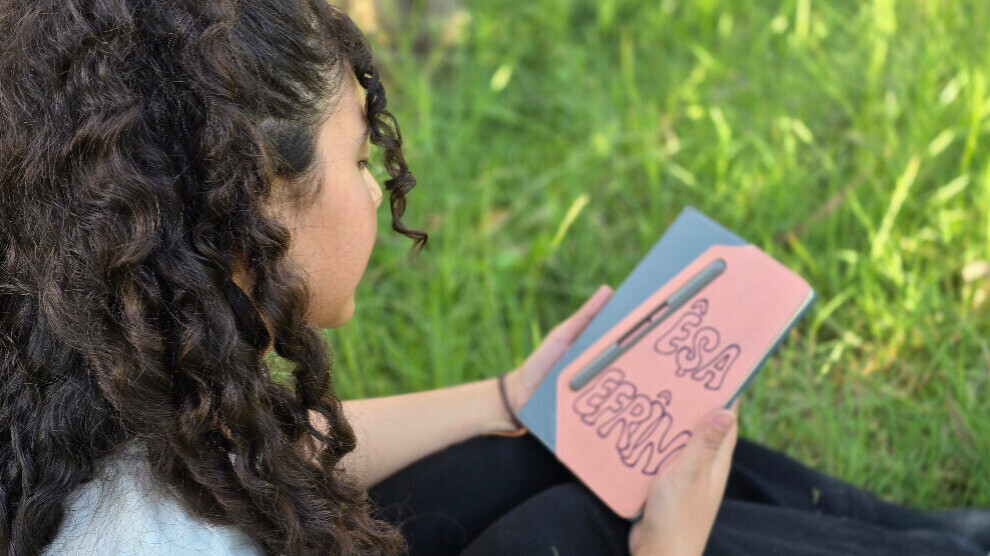
On the lines of her writing, the paths of migration appear clearer than the features of her childhood. On the pages of her diaries, scattered remnants of small memories, a toy she saved from one migration, a notebook and pen she snatched from another migration, the cities she moved between, and long years of loss hidden between the pages. Every detail in them bears witness to a childhood that crossed the road not to grow up, but to survive.
Rohiv Qasim's story begins in the same way as the stories of many children of migration. Rohiv, a daughter of the city of Afrin in Rojava, is now fourteen years old; fourteen years during which she carried six attempts of migration, as if the road was the destiny of her childhood.
With the outbreak of the conflict in Syria, her family, who were living in Aleppo, was forced to cross into Turkey. When the situation calmed down a little, they returned to Afrin, but they returned burdened with years of loss. However, the journey of migration had not yet ended.
On March 18, 2018, when the Turkish occupation launched its attacks on Afrin, Rohiv was six years old. Those days are still stuck in her memory: incomplete images, confused sounds, but one thing never faded: the corridor where everyone was running, gathering what they could carry, and the little toy she clutched to her chest as if it were the last thing left of her childhood.
The Migration from Afrin
When Rohiv and her family were forced to migrate to Shahba, she had not yet learned to read and write. Her first letters were directly linked to the years of migration; the words she learned, the sentences she wrote for the first time, were those she recorded in her diary. The trembling letters at her beginnings bear witness to a girl growing up on endless roads.
In simple sentences, but saturated with the honesty of experience, she wrote about her migration from Afrin: "Within three days we arrived at the village of Sokhank. Then we went to another village. We stayed in one of the houses. There was no door and no window. Under the house was just earth. On the roof there was nothing. Rain would fall on us and we would get wet. The sounds of bombardment were very close to us. Then we went to the village of Ziyara. There we found a house with three rooms. We stayed in it with ten families."
Rohiv Qasim speaks about her migration from Afrin, saying: "I did not understand what was happening; all I saw was that everyone was gathering their belongings, so I also held onto my toy. Even until we reached Shahba, that toy remained with me."
Shahba... The Place Where She Completed Her Education
After a period of settling in Shahba, schools began to reopen, and Rohiv, like other children, took her first steps in learning. In her memory, there was a clear wish: "I must learn to read and write quickly." There were sentences she wanted to build on the pages of her diary, and hopes she wanted to draw on the lines.
While Rohiv was living in Shahba hoping to return to Afrin, she saw before her the features of a new migration advancing with steady steps. She wrote in her diary that the heaviest thing she experienced was not the first migration, but the one that began from Shahba; the migration that left not only a house behind, but uprooted her friendships and cut off her road to school.
With feelings overflowing with pain, she recorded in her diary: "At five o'clock in the morning we left the village. My father and grandmother were at work, and they eventually caught up with us. We remained on the road for a whole day. That night, our neighbour wanted to visit her family, but she was martyred on the road. She had two small children. At eight o'clock in the morning, armed groups entered the village."
Her words are short, but they carry a weight beyond her age, and bear witness to a girl who learned early that migration is not a single road, but a series of repeated losses.
This time, Rohiv did not take her toys with her; she took her notebooks and pens when she fled from the terrible fear of the attacks and headed to Tabqa.
As the pages turned, the cities changed too. Shahba… Tabqa… Derik… Each city becomes a new date added to Rohiv's pages. And each date is another home left behind, another street, another life…
Words Hidden Between the Lines of the Diary
As Rohiv grew older, her writing became more beautiful. But there was always a line repeated among the sentences of her diary; a line written under the title "The Pain of Afrin," carrying within it a hope not yet fulfilled. With a child's eyes, Rohiv leaves space for her imagination to create a free and beautiful future for her to live. And that future is "the return."
Rohiv wrote her request for return and freedom in these words in her diary: "Enough injustice and persecution against us Kurds, enough loss of martyrs and prisoners, enough sadness and tears for our Kurdish mothers."
Rohiv speaks of her longing: "What I miss most is my friend. She is in Afrin. I also miss school. Nine years have passed since I left Afrin. Many things there are no longer present in my memory, but I want to return and for everything to be as beautiful as it was. I want children to continue their education and not be deprived of it, because education brings a beautiful future for a person. And I will continue writing."
She says that her only wish after returning to Afrin is to continue writing her diary and expanding it, and she also wishes to complete her education in the Kurdish language. "I love studying and I have great curiosity about it. I want to write all these difficult and beautiful days together, so that they remain in history. Thousands of children from Afrin did not live their childhood, because they were always on the roads of migration and in the heart of war."
The day our agency conducted the interview with Rohiv was itself the day of return. She was eagerly awaiting the journey. After long years, the girl who grew up on the roads of migration returned to Afrin. The alleys where she left her childhood may no longer be the same, and the city that remained in her memory may be different from the city she now stands before. But after all those years, she has reached the longings she hid between the pages of her diary, which she preserved on every migration journey she passed through.
Rohiv's diary is not just a story of a girl. It is lines and sentences that reveal the face of war that cannot be hidden by numbers. It is the tale of those uprooted from their places, of children forced to grow up with migration, of those who spent their years clinging to the hope of return.
Rohiv Qasim's diary, which she concluded with her final sentence, "I am waiting for the return, because when I return to Afrin, I will go under the olive tree and see my friends" — now she is completing it in Afrin, under that very olive tree.