
Yazidi women, recalling genocide, fear ISIS return and tragedy's repeat
Amid regional security shifts and changing control of prisons, Yazidis, especially women, fear a repeat of 2014's mass killings and enslavement.
Asma Mohammed
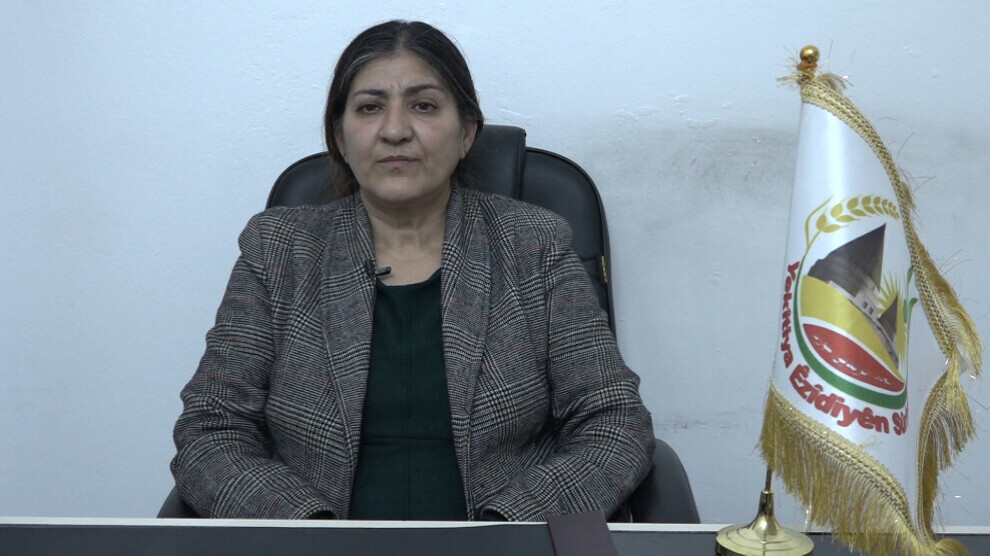
Qamishlo - Suad Haso, an administrator in the Yazidi Women's House, warned of the danger of current threats to the Yazidi community and the possibility of a repeat of the genocide scenario, affirming that Yazidi women still retain the memory of pain and suffering, and that any security or political change in Shengal and Rojava necessitates vigilance and continuous protection for civilians, women, and children.
The regions of Shengal and Rojava are currently going through a critical period in their history, where security threats intertwine with the painful memory of the Yazidi people, who suffered from the most horrific forms of genocide and forced displacement at the hands of ISIS in 2014. Those events not only left their mark on the body but also obliterated psychological and social security, making every political change or recent military move evoke in the hearts of the population a sense of immediate danger.
The Yazidi Woman: Between the Memory of Genocide and the Role of Protection
The Yazidi woman, who was the primary victim of kidnapping and enslavement, has transformed into a symbol of steadfastness and resistance. However, she still lives with fears related to protecting herself, her children, and her community from any repetition of past atrocities. In this context, the Yazidi people closely follow any military movements, political statements, or changes in the management of camps and prisons, realizing that any weakness in protection or disregard for threats could open the door to a repeat of the genocide scenario.
The memory of 2014 is still alive, and experience has proven that the community's inability to defend itself or manage its own security affairs was a major factor in the occurrence of victims and the exposure of women and children to direct danger. Today, with the resurgence of ISIS and the emergence of indicators of escalating tensions in Rojava and Iraq, the Yazidis realize that the threat is not just a possibility, but a reality that must be confronted with firmness and continuous protection, while emphasizing the role of Yazidi women as an active force in preserving the cohesion of society and protecting it from any new wave of violence.
Escalating Threats Revive the Nightmares of Genocide
Suad Haso, an administrator in the Yazidi Women's Council in the city of Qamishlo, said that the recent threats targeting the Shengal regions brought back to mind the scenes of the catastrophe that befell the Yazidis over a decade ago. She pointed out that the political and military statements issued in the region have caused widespread concern among the residents, especially women who still live today under the weight of the psychological trauma left by the genocide, the effects of which have extended to entire generations of the community.
She added that these statements have reopened a wound that has not yet healed, as every member of the community feels that any disregard for threats or underestimation of them could reopen the doors to death, forced displacement, and kidnapping, which exacerbates the residents' feeling of insecurity.
She explained that the escalation of tensions in Rojava for months, along with military movements in Iraq, has created a general climate of instability, which multiplies the Yazidi community's fears that these conditions could turn into a suitable environment for the return of ISIS cells or the reorganization of its ranks. She clarified that the continued talk of the resurgence of ISIS and the appearance of any signs of its activity, in addition to political and regional disputes, increases the Yazidis' feeling of helplessness in the face of a direct existential threat.
She explained that the handing over of prisons containing ISIS elements to the interim Syrian government, coupled with talk of transferring thousands of families associated with them, has led to a real state of panic among Yazidis in Shengal and Makhmour, because any security disintegration or leniency in managing this file could open the door to a new wave of violence. She affirmed that the Yazidi community cannot forget what it suffered in 2014: mass killing, the kidnapping of thousands of women and children, and turning them into sex slaves or forced fighters. "The memory of these events is still present in every corner of the lives of Yazidis, and any new threat places women and children at the forefront of danger."
She explained that the passage of eleven years since the genocide has not erased its effects but has made the community more sensitive to any sign of danger. She added that the residents' demand to surrender their weapons while threats persist makes them feel that they might be left without protection again, which brings back to mind the moments when previous protection collapsed and forces withdrew as ISIS swept through the region.
She said that the people of Shengal, after the liberation of their region, established local protection forces to protect their homes and families, and that these forces represent for them a guarantee of survival, not just a military formation, because experience has proven that the absence of self-protection was one of the causes of the first catastrophe. She explained that these forces, which include fighters from the sons of Shengal themselves, work to monitor and secure the area and protect civilians, including women and children, to ensure that the scenario of violence and genocide is not repeated.
Between Renewed Threats and Determination to Protect Existence
Suad Haso explained that the Yazidi community has also faced repeated targeting over the past years, which has cemented a conviction among the population that their existence is still threatened, and that any attempt to break their will or strip them of their means of defense could reopen the door to genocide. She pointed out that the threat does not only affect them but threatens the balance of the entire region, because the Yazidi community forms part of a diverse fabric of components, and any collapse of its security means shaking the stability of the surrounding area.
She clarified that the Yazidis call upon the international community and human rights organizations to move to prevent any new threat and to work to hold those responsible for past crimes accountable. She affirmed that constitutional recognition of their rights and ensuring their protection constitutes an essential step to prevent the return of extremist organizations. "The international community must work to ensure that no loophole is left that ISIS could exploit to reproduce violence, and that supporting the rights of local components forms an impenetrable dam against any new wave of violence."
She added that any disregard for the concerns of this component could lead to a new humanitarian catastrophe, stressing the necessity for all peoples to stand alongside the Yazidis, because targeting them not only threatens them but also threatens coexistence and stability in the entire region. She affirmed that Yazidi women, thanks to their experiences and past trials, have developed the capacity for leadership and resistance. They are coordinating efforts to defend the community and firmly articulate demands for justice, which makes any external support vital for the region's stability.
The administrator at the Yazidi Women's House, Suad Haso, concluded her remarks by emphasizing that the Yazidi woman, despite the tragedies she has lived through, has today become stronger, more organized, and more determined to protect her community. She called for collective action to prevent a repeat of the genocide and to block any attempt to revive terrorism. "Shengal will remain the land of its people, and the will to survive that withstood the massacre is also capable of facing any future threat, provided that protection and justice are available together, with the necessity of the participation of the international and local community in supporting efforts to defend rights and maintain security.