
Sidar Karaşilik: The Framework Law Serves as a Key That Paves the Way for Enacting New Legislation
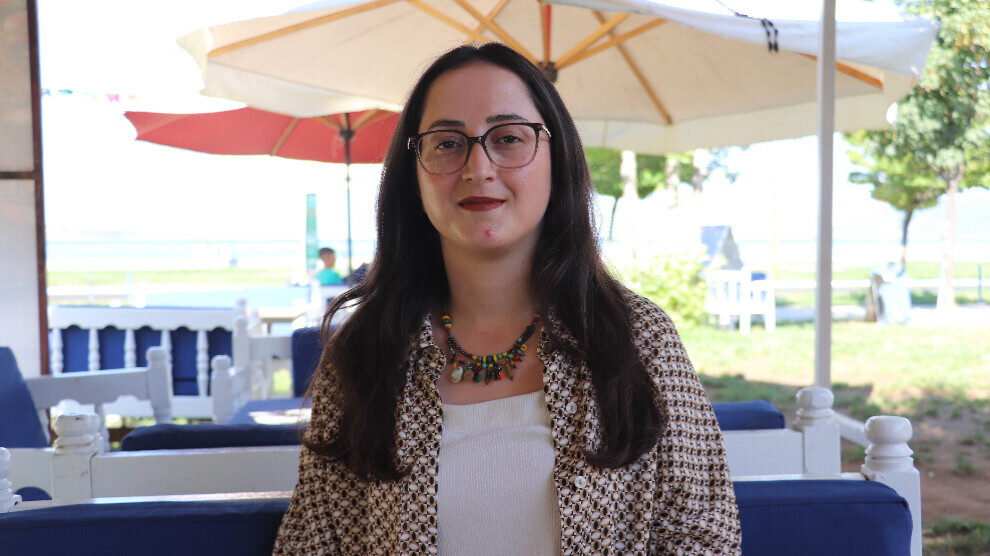
Sidar Karaşilik affirmed the "Framework Law" project represents a historic step toward placing the Kurdish issue on a legal foundation, despite its shortcomings, calling for the completion of legislation, the expansion of political, societal participation
MEMEHAN HELBIN ZAYDAN
Bitlis — The provisions of the framework law, prepared within the context of the "peace and democratic society" process, have been shared with the public. This 12-article law continues to spark ongoing debates regarding its positive aspects and shortcomings, and is expected to be presented to the General Assembly (Parliament) this week.
In response, Sidar Karaşilik, co-chair of the Peoples' Equality and Democracy Party (DEM Parti) in Bitlis Province, affirmed that when considering the scale of destruction caused by the neglect and suppression of the Kurdish issue in Turkey and North Kurdistan by the Turkish state, the law appears to have many shortcomings in addressing this. However, the Kurdish side simultaneously views it as an important step because it opens horizons for enacting new legislation.
She also noted the responsibilities that fall upon political parties and civil society organizations to formulate more comprehensive laws.
"A Key to a New Phase"
Sidar Karaşilik pointed out that the "peace and democratic society" process, ongoing for a year and a half, has witnessed historic developments during this period.
She explained that the Kurdish public is awaiting concrete steps. "The steps that would provide legal guarantees and should have been brought to parliament were not being taken under any circumstances. Ultimately, the draft law reached parliament and was reflected in the media, and we in turn examined this draft. As is known, peace initiatives in conflicts that have persisted for decades are not easy, nor can the peace steps that will be activated as a result of a 50-year armed struggle be encapsulated in a single draft law. Of course, we see the law as important, and we believe that the law issued carries the quality of a key that will open the door to a new phase."
"A Beginning Law, But Incomplete"
Sidar Karaşilik drew attention to the law's shortcomings. "There are regulations concerning the execution of sentences (prisons), but they do not cover these problems as a whole. We are talking about a national and social issue dating back a century, and the resolution of this issue is not limited to the legal regulation of problems arising after periods of conflict."
She explained that "there is a Kurdish issue, and there is a sociological, economic, and cultural problem. The law's content lacks many matters related to the Kurdish issue, democracy, and statutory decrees (KHK). It is very much a beginning law, a foundational law, and from this perspective we attach importance to it. Another reason for our interest is that the Kurdish issue, which has extended for a century, has been moved to a legal ground."
"A Historic Turning Point in Addressing the Kurdish Issue on the Legal Level"
Sidar Karaşilik described this development as "a historic turning point in terms of addressing the Kurdish issue on the legal level," and recalled that some laws previously discussed for enactment contained within their structure "recognition, provision of information, and remorse."
She noted that the recent law emerges as a collective law resulting from a specific struggle. "We can say that the law, despite its shortcomings, gains importance for us as a beginning. We have stated that the Kurdish issue is the source of many problems concerning democracy, justice, and the entire Turkish people. Steps taken toward the Kurdish issue will also bring democracy and justice. Since the process began, we have been trying to involve all of society's dynamics, because this issue does not concern only the Kurdish people. At the root of Turkey's social problems lies the Kurdish issue. At this point, the will that will resolve the greatest crisis concerns the rest of Turkey's peoples. In this context, we have exerted and continue to exert our utmost effort to expand the ground of struggle."
"All Dynamics of Society Must Participate in the Struggle"
Sidar Karaşilik affirmed that social struggle is an essential condition for overcoming the law's shortcomings and enacting new comprehensive legislation, noting that responsibility falls upon many parties, including the Kurdish political movement. "Many people who have spoken or expressed their views in one way or another on rights violations directed against Kurds and resulting from the Kurdish issue have faced injustice and inequality. The statutory decrees (KHK) are a concrete reality in this regard—there are many people who were dismissed from their jobs under these decrees simply because they wanted peace and expressed their opinions. In order to expand the emerging process, establish it on solid foundations, and build lasting peace, justice, and democracy, all dynamics of society must participate in this struggle."
"The Struggle Has Not Ended, It Has Merely Transformed"
Sidar Karaşilik recalled that recent years have seen sharp ruptures, particularly among the Kurdish people. "Over the past year and a half, there has been emotional rupture among the people, along with curiosity and questions about 'what is happening?' We did not reach these days easily; we reached them as a result of the struggle we waged. We see this as an important gain. Our people should know that we are the winning side. But the struggle has not ended yet; it has merely transformed and taken a new form. Our greatest consolation is that there are no more deaths, because our people have paid the greatest price. We still have mothers who do not know where their children's bodies are, who do not know their children's fate. In this path, we will knock on all their doors one by one, and we want to ask for their forgiveness and consent."
The struggle for the resolution of the Kurdish issue and ensuring lasting peace is not solely the responsibility of the Kurdish public and Kurdish political parties, as she says. "It is necessary for everyone to adapt to the spirit of the new phase. In this regard, a great responsibility falls upon civil society organizations and other political parties. For the past month, the Republican People's Party (CHP) front has been experiencing political tremors, which is causing the agenda to shift slightly. If the Kurdish issue, which is the biggest problem in this country, is resolved, it will also open the door to solving other problems."
"The New Phase Requires a New Spirit of Construction"
Sidar Karaşilik affirmed that the country is moving toward a new phase after long periods of conflict. "We will continue our struggle to ensure that the current law pioneers and paves the way for other laws. We in the Peoples' Equality and Democracy Party have been explaining for a year and a half that the struggle has evolved into new dimensions. We are emerging from old molds, and we have aspirations and efforts that allow the people to participate and make them fundamental actors in politics and local democracy."
From this perspective, she believes the new phase requires new construction and a new spirit. "We must first convince ourselves of the spirit of this new phase. By accepting that an era has been closed and a new era has begun, and that this new phase is the phase of democratic politics, we will engage in a struggle in which the people are the primary actors."
Sidar Karaşilik concluded her remarks by saying: "We embrace this beginning, and we continue the struggle with determination to complete the shortcomings and build peace alongside democracy, justice, and equality."