
Sabahat Tunjel: The Framework Law is Just a Beginning and the Struggle Will Continue
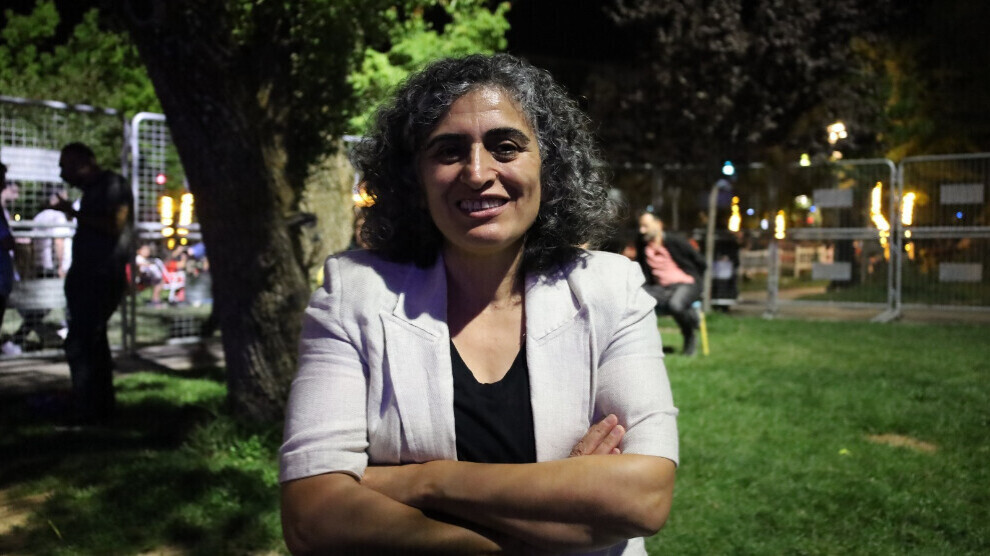
Sabahat Tunjel,an activist in TJA,affirmed the framework law represents an important beginning,but its failure to include leader Öcalan consitiutes its greatest shortcoming,emphasizing the necessity of completing this phase through democratic struggle.
MEMEHAN HELBIN ZEYDAN
Wan — The draft law on "Strengthening National Solidarity and Social Integration," prepared within the framework of the peace and democratic society process, has received approval from the majority of General Assembly members. The scope of this legal regulation, assessed as a "beginning law," remains a subject of ongoing debate and discussion. While the exclusion of leader Abdullah Öcalan from the law's scope is cited as one of its most significant shortcomings, discussions also center on how to manage the path of struggle in the coming phase.
In her interview with our agency on this subject, Sabahat Tunjel, an activist in the Free Women's Movement (TJA), explained that the framework law is an important first step toward a democratic solution, but its shortcomings and gaps must be completed through social struggle.
She describes the framework law as a beginning law, not one that fully resolves the issue or provides a complete definition of the Kurdish issue. "This law is a framework law that opens the door to a democratic and peaceful solution to the Kurdish issue. The end of armed struggle holds great importance in terms of opening space for democratic politics. It also gains importance in demonstrating an approach that seeks to solve the problem for the first time through political means and on a parliamentary ground."
"Any Law That Does Not Include Mr. Öcalan Is Certainly an Incomplete Law"
Sabahat Tunjel drew attention to previous laws passed in parliament, recalling the many efforts made during the "Oslo" process in 2009, and the dialogue and negotiation processes that took place between 2013 and 2015. "In those periods, Law No. 6551 was also enacted, but this current law has a different dimension. It is essentially important as a beginning that allows the transition to democratic politics and taking the necessary steps for a democratic and peaceful solution to the Kurdish issue. However, it is not a law that solves our problems or brings democracy; it contains many shortcomings. The greatest shortcoming is that it does not include Mr. Abdullah Öcalan, as it excludes the period before June 2005. This is the main point of criticism. The Kurdish people define Mr. Öcalan's freedom as their own freedom; therefore, any law that hinders Mr. Öcalan's freedom or excludes him is certainly an incomplete law."
While emphasizing that the exclusion of leader Abdullah Öcalan from the law's scope represents the greatest gap, she affirms that the law provides a ground for struggle. "Mr. Öcalan's efforts and endeavors on the path to freedom for the Kurdish people are not only aimed at transforming the Kurdish political movement, but also seek to push the state to take a step toward transformation."
She explains: "The law consists of 12 articles aimed at laying down arms and opening the door to political work. There is nothing within these articles regarding democratic transformation, freedoms, mother tongue education, or recognition of Kurdish identity; the law does not carry such a mission."
She believes that if genuine peace is to be achieved in Turkey, and if it will open the way to resolving the Kurdish issue, then "all these matters must be discussed in the coming phase." She notes that "in global experiences, legal steps are taken first, truth, justice, and confrontation are ensured, and the state affirms its abandonment of its old policy in this regard, and then arms are laid down. In our case, things have proceeded in reverse; arms are first required to be laid down, and then we try to discuss these issues. However, this is not just a matter for today."
"Youth, Community, and Women's Movements Must Engage More Deeply in the Process"
Sabahat Tunjel considers that the greatest shortcoming in this process lies in the insufficient involvement of society. She affirmed that civil society organizations, unions, and the women's movement have not played their full role in the process. "Part of this is due to the state, and another part stems from the weakness of civil society organizations, democratic mass organizations, and socialist movements in Turkey. There may be many reasons; but this situation provides sufficient opportunities for the women's and youth movements, as well as for civil society organizations and democratic mass organizations."
She affirmed that "the silence of arms also provides space to discuss all social problems, inequalities, and the economic crisis in Turkey. While we discuss the resolution of the Kurdish issue, we will simultaneously discuss how to remove the problems, crises, and defects left by the lack of resolution. The coming phase is a journey that requires civil society organizations and women's and youth movements to be more effective and active. Alongside this, civil society organizations and human rights organizations have a very important role in the phase of translating the process into practical implementation."
"The Women's Movement Can Form a Monitoring Body"
She emphasized that civil society organizations have a significant role in monitoring the law's implementation phase—to identify problems that may arise, verify whether it is being implemented, and work to remove shortcomings and obstacles. "A monitoring body will be established within parliament, but this is not enough. Perhaps a civil monitoring body can be formed from human rights organizations and bar associations, parallel to or in communication with the parliamentary body. The women's movement is discussing this among themselves; the women's movement can form its own monitoring body. I believe this is important for the process to proceed healthily and for it to be translated into actual implementation."
"The Responsibility Falls on All of Us"
Sabahat Tunjel reaffirmed that the coming phase is a new beginning. "It is a process shaped by 50 years of struggle, effort, accumulation, and experience. The experiences we have drawn from the past carry the responsibility of leading our people, women, and youth toward freedom through new experiences, struggles, paths, and methods. In this regard, responsibility falls on everyone."
The Free Women's Movement (TJA) activist Sabahat Tunjel concluded her remarks by stating: "We should not be in a position of merely waiting for steps from the authorities or the state. On the contrary, we should look at things from a position where one builds their own future. In this phase, we and the Kurdish people need more organized work, resistance, seriousness, and solidarity. On one hand, Kurdish national unity must be achieved; on the other hand, building a strong alliance and dialogue with the peoples of Turkey is important for the success of the process."