
Perıvan Behcıcı: The Framwork Law Must Be Expanded with a Women’s Perspective
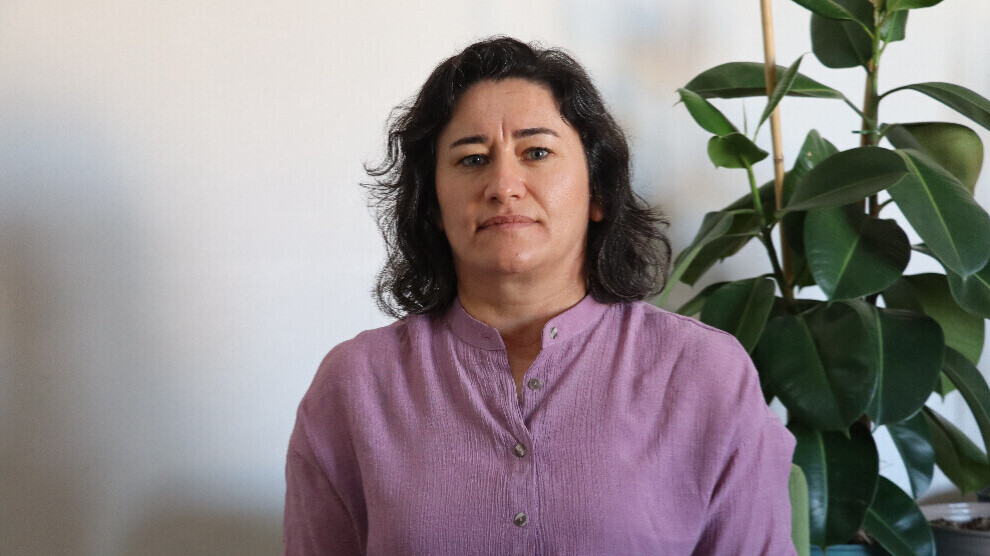
DBP Women’s Council spokesperson Perivan Behicic: The framework law is an important beginning,but must be expanded with a women’s perspective to ensure women’s rights,equal representation,and democratic guarantees for lasting peace.
AKIN STERK
Amed — Within the scope of the peace and democratic society process, debate continues regarding the proposed law on "Strengthening National Solidarity and Social Integration," which has been prepared and passed through the parliamentary Justice Committee, pending its discussion in the General Assembly.
In response, Perivan Behcici, spokesperson for the Women's Council of the Democratic Regions Party (DBP), affirmed that the framework law submitted to the Turkish parliament represents an important beginning, but must be reorganized to guarantee women's rights, equal representation, and democratic gains.
For more details on this process, our agency conducted the following interview with Perivan Behcici, spokesperson for the DBP Women's Council:
How do you assess the framework law submitted to parliament? In your view, does this proposal represent a genuine beginning for the democratic solution to the Kurdish issue and lasting peace, or is it an incomplete first step?
In fact, the discussion of the Kurdish people and the Kurdish issue today in parliament, after years of denial, and taking a step toward resolution, is very important for us. We see that addressing the issue of a people who have been denied, ignored, and whose will has been confiscated in every sense, once again within parliament, is of great value.
When evaluating this matter, we also find the efforts of the Kurdish people's leader Abdullah Öcalan, who has taken on a significant role and task in this process, to be of great value. Leader Öcalan has been trying for 27 years to establish a comprehensive framework for achieving lasting peace and guaranteeing the rights of society and all peoples. We too, for months and on every platform, have expressed the need for concrete steps to be taken as soon as possible and for this law to be submitted to parliament. We see this first step taken as important and valuable.
Leader Abdullah Öcalan conveys messages of historical importance in every negotiation and every meeting he holds with delegations; he evaluates current developments from a historical perspective. In his last meeting, he used the phrase "one step on a thousand-kilometer road" regarding this process.
In light of a long history of denial and cultural assimilation, establishing a legal framework for the Kurdish issue represents an important development. The regions where Kurds live have been ignored for many years, and society in every sense has become a target of special war policies. Regarding the issue of a people subjected to all this denial, the state's beginning today to establish a legal framework is important. At the same time, it must not be overlooked that women who have struggled for thousands of years on these lands are foundational actors in this process.
For this reason, we find the step taken important, but we also say it is not sufficient, and we believe the shortcomings will be completed through joint struggle and democratic negotiations.
The proposed law largely focuses on disarmament and legal procedures... In your view, where should headings such as democratic transformation, women's rights, local democracy, and equal citizenship stand in this law?
We do not approach this issue solely through disarmament. What is truly important is why arms emerged in the first place; no one willingly wants to carry a weapon and defend themselves. We must speak of the conditions that forced people to do so.
Our goal is to build a democratic society with no weapons, and Kurdish people's leader Abdullah Öcalan has been struggling for this for years. Today, the reason for discussing the elimination of weapons must also be evaluated within this framework; because the Kurdish people have come to need legal guarantees, and it is necessary to make legal arrangements that guarantee the rights of a people whose will has been ignored for many years. For this reason, merely silencing or abandoning arms is not enough. The real question is: How will these people live from now on? How will they integrate with society, and how will they conduct their democratic politics?
When we evaluate the framework law, one of the fundamental points we find lacking is the insufficient inclusion of women's struggle. The absence of arrangements regarding mother tongue, cultural rights, and women's gains is also a significant shortcoming. But as leader Abdullah Öcalan also expressed, this is a first step, and after taking the first step, the struggle will continue, and other democratic gains will be obtained through this struggle.
From our perspective, one of the fundamental shortcomings is the lack of constitutional and legal guarantees for women. Women want to take their place freely in social life, practice democratic politics, and organize. To achieve this, legal arrangements guaranteeing their rights are needed. For this reason, we believe the framework law should be strengthened with a women's perspective.
The Democratic Regions Party states that leader Öcalan is one of the fundamental actors in the process and that his working conditions must be regulated... How do you see the role he should assume in the process for a lasting solution? And what legal and political steps should be taken in this regard?
I can say the following on behalf of women: throughout history, in every period of denial, war, and conflict, the primary target has been women's will, bodies, and ideas. If peace and a democratic society are to be built today, the first condition for this is that women themselves believe in it. Leader Öcalan's perspective has been decisive in the growth of women's struggle, and in women reconnecting with their identity and consciousness.
We speak today of a history spanning 12,000 years. Throughout this long history, women's will has been marginalized and denied in political, social, and every sphere of life. For this reason, as women, we do not see Abdullah Öcalan's physical freedom as separate from our own freedom.
Women want the ability to discuss directly with leader Abdullah Öcalan under free working conditions, exchange views with him, and develop the process alongside women who defend women's rights and democracy. For this reason, we will never compromise on the demand for physical freedom.
Indeed, two days ago, the Free Women's Movement (TJA) issued a statement on this matter. All women's institutions and structures participating in the women's struggle, foremost among them the "Mothers of Peace," have expressed the demand for leader Öcalan's physical freedom to this day, and will continue to express it. Therefore, as women, we recognize the responsibility required by our leading role.
When we look broadly, we find that the framework law's passage through the parliamentary Justice Committee is important, but we believe the aspects that remain incomplete will be completed through struggle. This will be one of the primary goals of the women's work in the Democratic Regions Party (DBP), the Women's Council, and other political parties.
In peace processes around the world, women's roles have been crucial in negotiation and decision-making mechanisms. Can women in this process in Turkey and North Kurdistan be sufficiently foundational actors?
The fact that a people denied for centuries—especially women—has raised its voice and reached this point today is the result of a great struggle, and this must be evaluated as such.
If this matter is being discussed in parliament today, topping the media agenda, being debated on television, and becoming one of the main headlines of Turkey's agenda, behind it lies years of struggle. At the same time, we see that the process that began after February 27 has resonated not only in Turkey but also with international public opinion. For this reason, we find this process important.
However, it must also be clearly stated: the current proposed law will remain incomplete unless it guarantees the rights of women and children. For us, this is one of the fundamental headings we will continue to struggle for.
Women must take their place in the councils and committees to be formed in the coming period, and in line with the principle of equal representation, women's will must be directly reflected in these mechanisms. This holds great importance for achieving democratic and social equality.
Today, we still face a serious situation of inequality. The women's struggle has gained important momentum, but making these gains permanent will be possible through obtaining legal guarantees, and the path to this lies in implementing legal arrangements that guarantee women's rights and equal representation.
If the law passes parliament, what legal and political steps do you see as necessary to prioritize in order to socialize the democratic solution in the next phase?
This law will come into effect after the National Security Council (MGK) decision, but the real process begins at that time; because to truly activate democratic politics, a ground must be created that enables those in exile, those in prisons, the Kurdish people, and especially women, to practice politics freely.
In the next phase, there are fundamental demands of the Kurdish people such as the right to education and the right to self-governance. For example, the practice of appointing "trustees" continues, and this is one of the most important obstacles to democratic politics.
Recently, we also attach importance to the statements made by Devlet Bahçeli. His remarks in the direction of "Let Ahmed return to his work, Öcalan to the right to hope, and Demirtaş to his home" are certainly noteworthy. But what is important is the transformation of these statements into practical implementation. For this reason, we still see the current picture as incomplete. The primary goal in the coming period should be for everyone to be able to practice democratic politics while feeling safe.
Until today, there has been a concept of the state that violates even its own constitution, laws, and fundamental human rights. If there is a genuine goal of reintegration with society, the state must first change this concept. The state mentality's acceptance of this transformation and taking appropriate steps holds great importance.
People have struggled for many years paying heavy prices. If a legal ground guaranteeing their rights is not formed today, it will not be possible for them to come and practice democratic politics. This was one of the main reasons for preferring different methods of struggle until today.
We believe the headings that remain incomplete will be completed through struggle. The discussion of the Kurdish issue today for the first time in parliament on a democratic ground and within a legal framework is itself a historical development. From this perspective, we attach importance to the process.
For these laws to be enacted and the democratic transformation process to advance, I believe that all democratic institutions and democratic forces, foremost among them the Democratic Regions Party (DBP), will assume a much greater responsibility in the coming period.
One of our primary goals in the coming period will be to neutralize the negative language being formed against this law and against the model proposed by Kurdish people's leader Abdullah Öcalan, and to expand social support.
We trust our people; because the point reached today has been achieved through paying heavy prices. For this reason, we believe our people will embrace their own will, their own leader, and their own rights. We have various plans to ensure society participates more strongly in this process, and we will share these plans with the public in the coming days. Our struggle will also continue in this direction with all determination.