
Hediay Youssef: Peace in Turkey will Reflect on the Future of Syria and the Whole of Kurdistan
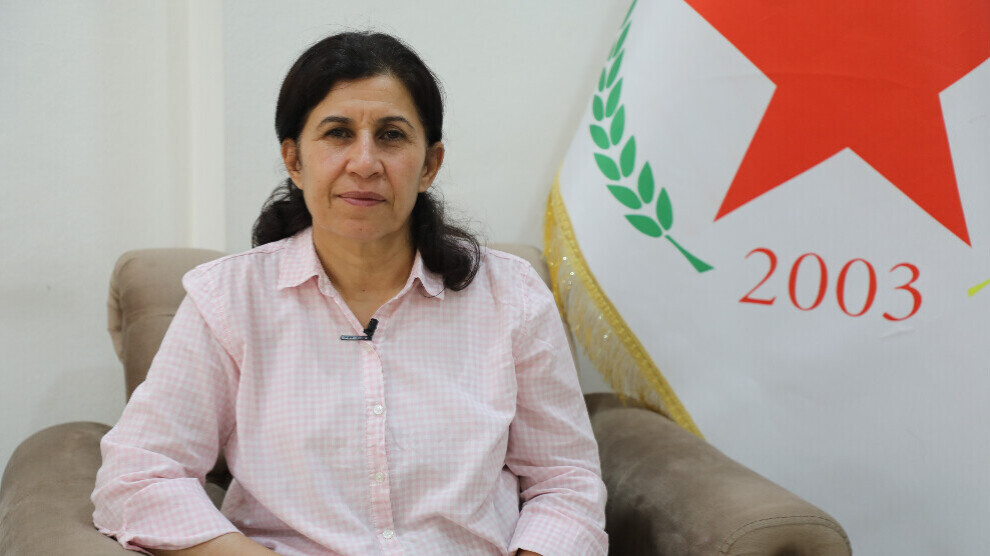
PYD official Hediya Youssef affirmed that Turkey’s peace process success requires concrete political and leal steps,which positively impact Rojava and Syria.
RONEIDA HAJI
Al-Hassakah_The peace and democratic society process in Turkey is passing through a critical phase. Following the calls and steps initiated by leader Abdullah Öcalan to resolve the Kurdish issue through peaceful and political means, the relationship between the Kurdish liberation movement, the Turkish state, and political forces has entered a new stage.
In this context, the framework law has emerged as one of the fundamental pillars of the process, amid debates on the necessity of moving beyond previous methods and expanding guarantees and legal mechanisms to advance the path forward.
In contrast, the law still contains gaps and shortcomings, most notably the legal status of leader Abdullah Öcalan, the rights of detainees and political prisoners, and the guarantee of political participation.
The Peace Process and the New Phase
In this context, Hediya Youssef, a member of the Presidential Council of the Democratic Union Party (PYD), stated that the Kurdish people have been waging a struggle for their freedom for 52 years, based on a modern philosophy, affirming that this struggle has led to the consolidation of Kurdish existence as a political and social reality that can no longer be denied.
She explained that the political, social, organizational, and military Kurdish presence has become a major force on the scene. "In order for the Kurdish people's struggle to move to a more effective phase in terms of results, leader Abdullah Öcalan initiated a new peace and democratic society initiative on February 27, 2025, and defined the new method of struggle. Within this framework, armed struggle was halted, and the liberation movement and the PKK dissolved themselves."
She added that this step opened the way for a new strategy in which the struggle moved from armed action to political and peaceful means, aiming to push society and the state toward democratic transformation and the building of a new political presence.
She affirmed that Turkey's failure to build strategic relations with the Kurds would cost it significant losses, given the growing influence of regional powers and centers in the Middle East, making progress on the peace and democratic society path a political necessity.
"Turkey Must Take Serious and Concrete Steps"
Hediya Youssef emphasized that the continuation of the process in a calm and productive manner requires Turkey to take serious and concrete steps, in parallel with the steps taken by the PKK to halt armed struggle and dissolve itself, and with a number of its fighters and leaders destroying their weapons and declaring their commitment to peace.
She noted that some positive steps have already been achieved, including changes in leader Öcalan's status on İmralı, the formation of normalization committees, dialogue with Qandil, in addition to meetings of the İmralı delegation with various Turkish political parties, representatives of society, prominent figures, and state officials. She considered that these steps have helped open the field for new political movement, affirming that "these positive steps have a positive impact on Rojava as well as other parts of Kurdistan."
"Öcalan's Status Must Be Defined in the Law"
Hediya Youssef explained that there are some basic steps that Turkey must implement, including the legal issue. "The law has reached its final stages. After the president's approval, it should be fully enacted. However, there is a state of discontent within Kurdish society toward this law. Leader Öcalan is the main negotiator in this process, and therefore his status should have been defined in the law, and his situation should also have been included as a fundamental point in this law."
She noted a clause in the law concerning crimes, which applies from 2005 onward, saying this approach is narrow. In her opinion, the law should have established strong trust, because there are tens of thousands of fighters from this movement who joined before 2005, in addition to thousands of detainees demanding freedom in Turkish prisons. "Removing such a clause could open the way for advancing the process."
"A Place Must Be Allocated for Liberation Movement Leaders in the Law"
To expand the participation and integration of all liberation movement leaders, and for them to have a role within both Turkish and Kurdish societies, Hediya Youssef affirms that a place should be allocated for them in this law. "This is also a very serious shortcoming in this law. These shortcomings can lead to a prolongation of the law's implementation, and prolonging the process is not in Turkey's interest. Conspiratorial forces are active in the region, and regional powers and influence centers are advancing. These forces do not want stability to prevail in Turkey, nor do they want a friendly relationship between Turks and Kurds, nor for them to advance as free citizens. If Turkey supports this law and develops a strategy of brotherhood among peoples, Turkey will become a very strong state, because this process can end a war that has lasted 52 years."
"The Impact of the Peace Process on Turkey's Economy and Politics"
Ending the 52-year war will have an impact on the economy, domestic politics, diplomacy, preparedness, and development in Turkey. "This process can have a positive impact on Turkey and Kurdistan in many areas, establish stability, and open the way for new developments and horizons. Turkey is a country of 86 million people, while the Kurdish population exceeds 20 million. This can have a significant impact on Turkey's position. If Turkey issues complementary laws to the current law in the future, and takes into account the vision of the liberation movement, freedom-seeking figures, and society, the process will advance quickly, close the door to conspiracies and wars, and open the field for achieving peaceful goals."
She added: "Turkey should also change its discourse language. The language that says 'terrorism has ended' cannot advance the new process. Kurdish society also sees Turkey as a fascist state, because for a hundred years it has waged wars and killings against the Kurdish people, so the language of this phase must also change."
"The Kurdish People Demand Öcalan's Physical Freedom"
Hediya Youssef explained that Kurdish society has been struggling for 27 years for leader Abdullah Öcalan's physical freedom. "Democratic figures, freedom seekers, and human rights defenders around the world also demand this status for Kurdish leader Abdullah Öcalan, and Turkey must take this demand into consideration."
She believes that Öcalan's status represents a red line for Kurdish society, which seeks his physical liberation. "In Rojava as well, Öcalan's physical freedom has become a subject of discussion. In this framework, the issue of his status in the law is important for the Kurdish people. The people of Rojava, with all their components, follow this law and ask questions about all its articles, because they see him as the founder of the democratic nation project, and they accept and support him."
"The Impact of Turkey's Policy on the Situation in Syria"
Hediya Youssef believes that Turkish intervention is one of the main factors in the continuation of instability in Syria, noting that rising violence, the spread of Salafist ideas, and the fragmentation of Syrian society, along with the wars Rojava has witnessed, are largely linked to Turkish policy. She warned that the continued complication of the Syrian situation does not serve Turkey, affirming that strengthening Syria's sovereignty cannot be achieved through the dismantling of its society, because the resulting vacuum allows other forces to expand their influence.
In contrast, she considered that progress in Turkey's peace process will directly reflect on Rojava and Syria, explaining that the path has contributed to halting war and opening the field for greater dialogue. She added that the entry of the legal framework into force may push toward a change in Turkish policy, accelerate the reaching of solutions between Rojava and Damascus, and open the field for strengthening relations between Kurds and Arabs.
"Conspiratorial Forces Want to Create Chaos Between Kurds and Arabs"
Hediya Youssef warned of attempts by some regional and international powers to exploit ethnic tensions to incite chaos and deepen divisions between Kurds and Arabs, and between Kurds and Turks, considering that progress in Turkey's peace process can open the way for strengthening relations between components and democratizing Syria.
She pointed to attempts to complicate the situation in Syria and Rojava and provoke the Kurdish and Arab street, citing the attack on displaced persons' convoys from Serê Kaniyê. She called for caution against policies aimed at inflaming ethnic sentiments and spoiling relations between Kurds and Damascus.
She affirmed that pushing the region toward a war between Kurds and Arabs serves neither side, calling for the adoption of peaceful solutions and avoiding traps that could lead to civil war or undermine the peace process in Turkey, noting that consolidating brotherhood among peoples would support stability and strengthen opportunities for a political solution in Syria.
"We Are Confident in Our Leadership"
In concluding her remarks, Hediya Youssef, a member of the Presidential Council of the Democratic Union Party (PYD), affirmed that they trust their leadership and believe this process will succeed. She called on Kurdish society to remain vigilant in all areas to ensure the success of this process, and never to lose their sense of defense and protection. "These are historic moments that require great effort from society, and society should follow this phase with great awareness and responsibility."