
Women of Daraya unite ranks in the “Truth Tent” to reveal the fate of the missing
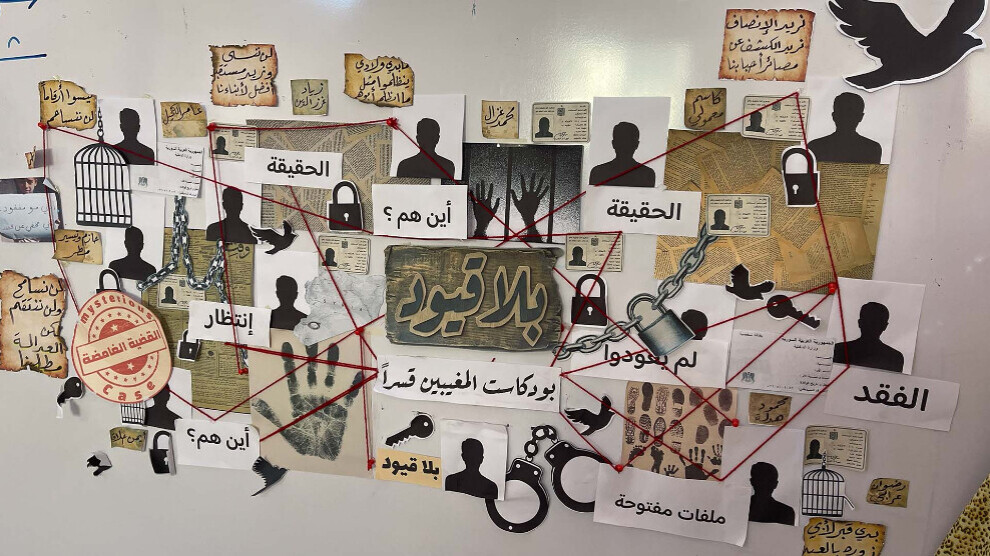
After the Baathist regime's fall left their loved ones' fate unknown, Daraya women launched the "Truth Tent" initiative to organize families' efforts, confront shock and burdens, reveal truth, and keep the missing issue present.
JULANAR AL-ALI
DAMASCUS— From the position of waiting imposed by the disappearance of their sons, husbands, and relatives, women in Daraya in the Damascus countryside in Syria began searching for a way to follow up on the fate of the missing and demand that the truth be revealed. After the fall of the Assad regime and the opening of prisons without many families finding answers about the fate of their loved ones, a group of women decided to organize the efforts of families in a rights movement that gathers their demands and enables them to act collectively.
In April 2025, the women began preparing to launch the "Truth Tent" in Daraya, benefiting from similar initiatives that appeared in other Syrian areas. A group of them took on forming a founding team and communicating with the families of the missing and inviting them to participate, while Shifa Jumblatt, who was a volunteer in the civil administration, took on a fundamental role in reaching the residents and organizing the first meetings.
Shifa Jumblatt tells our agency that the idea of the tent came in response to a state of shock and loss that women experienced after the fall of the regime, with the continued absence of their sons, husbands, and relatives.
For many women in Daraya, the search for the missing intertwined with daily burdens imposed by the absence of family members, as women found themselves responsible for supporting their children and managing household affairs, in a city where the face of war is still gnawing at its features, and where families are unable to repair their homes or restore their previous lives.
It turned out that the women waited for the relevant authorities to pay attention to their situations, whether the government or the transitional justice and missing persons bodies, but their feeling that no one was asking about their suffering pushed them to think about what they could do themselves. She pointed out that communication with the families of the missing began from the network of relationships she built during her volunteering in the civil administration, where she worked in the field of statistics and met a large number of the city's residents.
Shifa Jumblatt had a volunteer team comprising about one hundred girls and women, ranging in age from 18 to 50, and a large proportion of them belong to families that have missing or disappeared persons. From this team, she chose five women to form the founding group that took on organizing the initiative, stressing the need for the tent to include women from different social and educational backgrounds; among them rights activists and educated women, and others trying to launch private projects without possessing certificates or professional experience, in addition to women who had never engaged in public work, and others whose families were accustomed to keeping them at home, especially after the disappearance of their husbands. This was necessary from her point of view so that women could represent different experiences, and so that each of them would find a space to participate, regardless of her experience or social circumstances.
Families at the forefront of the movement
Since the first meetings, the women agreed that the "Truth Tent" would be a space led by the families themselves, and that these families would determine their demands and priorities, while the role of the founding team was limited to organizing meetings, expanding participation, providing support and coordination between families, and working to convey their demands to the relevant authorities.
Shifa Jumblatt explains that each woman on the team began communicating with five families from her surroundings and inviting them to an introductory meeting, which was attended by about thirty families. The initiative then spread through relationships between neighbors and relatives, until the number of families joining the tent reached about two hundred families, while the number of families the team communicated with reached about three hundred, according to her estimates.
When the tent becomes an unavailable place
Although the initiative bears the name "Truth Tent," the women in Daraya were unable to erect an actual tent in a public place, as happened in other Syrian areas. Regarding this, Shifa Jumblatt explains that the nature of the local community made women gathering in streets and public spaces subject to criticism, which pushed the team to search for a safe place that allows families to meet without women being subjected to harassment or social judgments. The team searched for an independent space not linked to the home of one of the families, so that a particular family would not bear the responsibility of hosting the meetings, or the movement would appear to be affiliated with it. The women also tried to use the cultural center in the city, but the required fees were high and did not suit the available capabilities of the initiative.
In the end, the meetings began in the kindergarten where Shifa Jumblatt works, and it still hosts most of the group's meetings. She explains that the choice of place came after attempts to find a suitable space that ensures the continuation of meetings and preserves the privacy of the participants.
These details place women before an additional challenge during their work on the issue, as participation in a public movement sometimes collides with social expectations that define for women the places of their presence and the nature of their movements. Nevertheless, the women in the founding team remained preoccupied with expanding the participation of families and preserving their role in determining the course of the movement. Shifa Jumblatt affirms that their task is to support families and strengthen their ability to move, while the issue of the missing and the demands to reveal their fate remain a collective responsibility of their owners.
In Daraya, the "Truth Tent" bears the name of a space that the women were unable to erect in the street, but the meetings hosted by the kindergarten have turned into a place where families gather, share the questions that still have no answers, and through which women work to keep the issue of the missing present in the public sphere.