
Unemployed Tunisian Women Lead the Front lines in the “Battle for Work and Dignity”
Amid blocked employment prospects and lost years of waiting, unemployed Tunisian women ignited an unprecedented protest movement, breaking social restrictions to lead marches and sit-ins, proving exceptional women’s leadership beyond expectations.
NAZIHA BOUSAIDI
TUNISIA– The cup of patience of unemployed Tunisian women has overflowed as they await the right to be appointed and obtain a job, among them those who have passed the age of forty. There is no time left in life for more waiting to enjoy the fruit of long years of study.
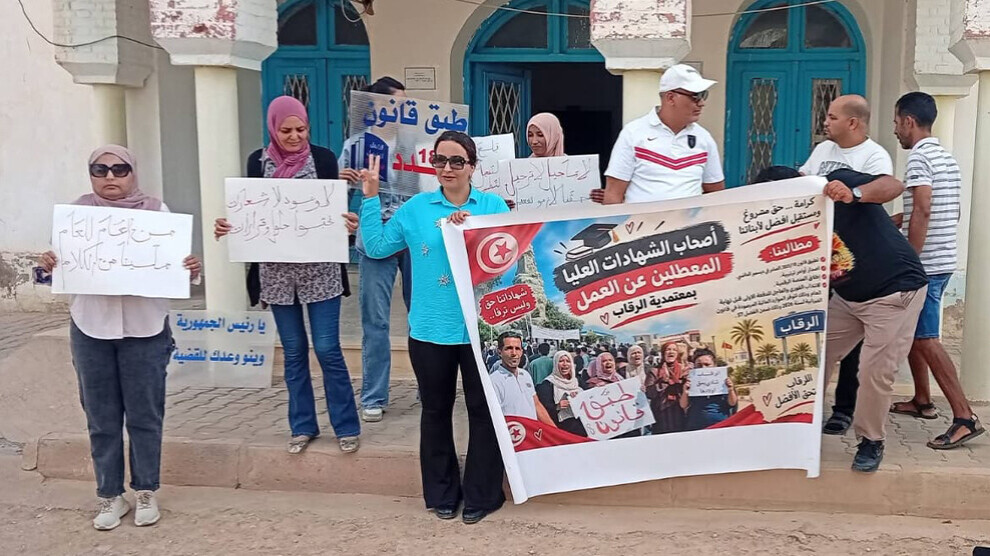
This massive accumulation of years of anger over a life passing in waiting for a dream that has become impossible made them come out in huge numbers in all marches and protest stands, leading the front rows and raising the slogan "Work, Freedom, Dignity, National."
The remarkable emergence of unemployed women and their leadership of the protest movement exceeded all expectations in Tunisia. Indeed, their participation reaches one hundred percent in many movements.
Free Women of the Squares
Many names led the protest movements and raised their voices loudly to demand work and the right to appointment. They were given the title "Free Women of the Squares," among them Najwa Al-Kouki, Sakina Shamekhi, Sara Al-Trabelsi, Shirin Ghanmi, Nuha Ouled Nasser, Naima Dhifallah, and others.
Unemployed women in Tunisia bear the hardships of struggle under the sun's heat and repeated stands in front of institutions, reaching participation in long marches of up to 400 km in defense of their right to work and a dignified life. Despite the feelings of oppression and disappointment experienced by some leaders such as Naima Dhifallah after returning without achieving demands, the protesters' steadfastness continues through ongoing protest stands to this day in several areas such as Gafsa, Jendouba, Menzel Bouzaiane, Kairouan, and El Kef.
Activist Sakina Al-Shamekhi attributes the numerical superiority of unemployed women in the protests in Kairouan and the capital to the Tunisian woman's distinction in struggle and her high awareness of the importance of the academic certificate as a gain for the future; women represent the largest proportion of university graduates at a rate ranging between 60% and 70%, which explains their broad turnout to lead the movement demanding the right to work.
She explains that males' engagement in work such as construction and trade to avoid unemployment prevents them from protesting, while young women lack these fragile opportunities; which makes them more available to participate in popular movements, to the point that sometimes there may be only one man among every 20 women.
She noted that the unemployed woman faces economic violence, and also faces the patriarchal mentality entrenched especially in conservative societies that allow a girl to go out for education and study or work but prevent her from participating in protests.
She explained that despite this, many women challenge these restrictions through various means, such as leaving homes secretly or disguising themselves to participate in regional movements, despite the difficulty of joining national protests due to their long distances.
Sakina Al-Shamekhi concluded by saying that participation in protests is subjected to security harassment, bullying, mockery, and many personal and psychological challenges.
The Credibility of the Feminist Movement
For her part, civil society activist Hayat Al-Attar confirmed that broad women's participation included agricultural and factory workers and those environmentally affected, alongside unemployed women, driven by the conviction that rights are wrested and not given, to the point that three generations (mother, daughter, granddaughter) are present in the same movement despite the stigmatization and violence they face. She noted that this weighty presence, in quantity and quality, was clearly embodied in the protest of unemployed women in front of the Ministry of Women on the occasion of its national day.
She explained that women's field participation broke the stereotypical image and brought about a qualitative leap by turning into leadership at the front rows and an effective pressure force to improve their conditions. She praised the struggles of unemployed women that reached the point of spending the night in the street in front of the municipal theater in the capital, and bearing various forms of violence and security restrictions.
Afaf Amami, the official spokesperson of the National Association of Unemployed Higher Education Graduates, said: "When paths narrow and unemployment lengthens, we find the Tunisian woman in the first rows confronting, struggling, and demanding her right, because the woman who is accustomed not to remain silent about her right cannot today accept to be a victim of marginalization and exclusion."
She explained that protesters lead daily movements and sit-ins in various regions such as Sidi Bouzid, Regueb, Jendouba, El Kef, the capital Tunis, and Hammam Gabes; denouncing marginalization and adhering to the right to a dignified life.
She concluded by saying that the unemployed woman is not just a number in life, but is a voice demanding its right to work and dignity in its homeland and the future that awaits it, and she is present at the forefront raising loudly the slogan "Work, Freedom, Dignity, National," which has lost neither its luster nor its meaning.
Afaf Amami concluded her interview by emphasizing that the unemployed woman today, thanks to her awareness and strong personality, possesses the full courage to demand her rights; refusing to remain on the margins of society or to give up her inherent right to dignity and a dignified life.