
Thousands of resignations threaten Syrian coast schools: female teachers face transfer risks and lost job security
Female teachers on Syria's coast face fateful challenges threatening their professional and living stability after arbitrary transfers and new contract conditions, caught between security risks, financial burdens, and forced resignation.
MASSA SULTAN
LATTAKIA— Between years of work in the education sector and decisions of transfer and assignment that impose choices beyond their living and family capacity, female teachers from the Syrian coast find themselves facing a difficult equation: continue in a profession they have carried as a mission, or abandon it under the weight of security, economic, administrative, and social conditions?
Education for female teachers on the Syrian coast in particular, and in the world in general, is a professional path associated with forming generations and contributing to building society, in addition to being a job for obtaining a monthly income and family financial stability. Female teachers have spent years in schools and continued to perform their duties despite the political, economic, and security transformations the country has recently witnessed.
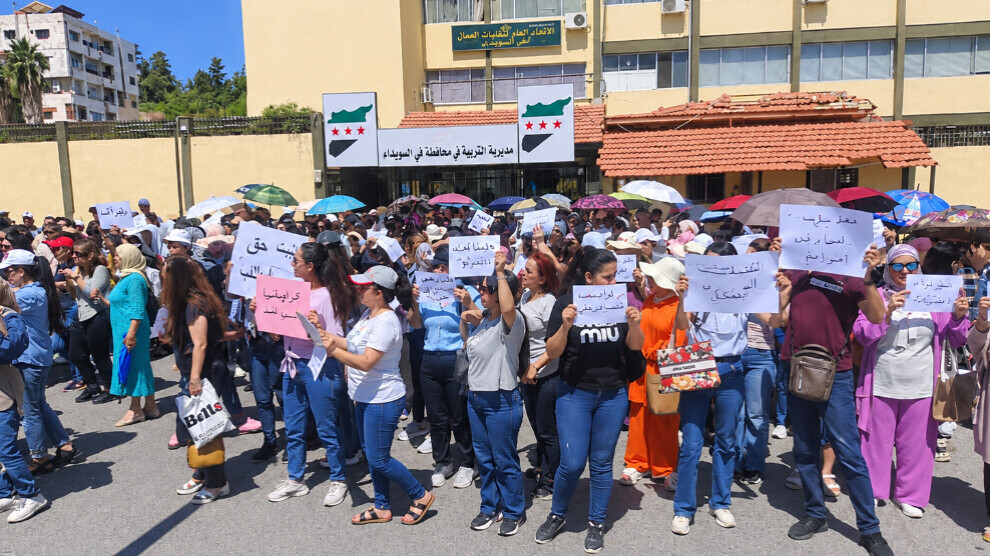
But a new phase of professional challenges places the future of a number of these female teachers before growing questions, after decisions related to canceling the determination of work centers and renewing contracts with arbitrary conditions, and redistributing educational cadres, and what accompanied some of them, according to female teachers' testimonies, of difficulties in movement, security fears, and financial burdens that pushed some of them to think about leaving the profession.
In a development that reflects the scale of the crisis, there are about thousands of female teachers in Latakia, Tartus, Homs, and the Hama countryside who have submitted their resignations after their objections to decisions transferring them to distant areas in different cities extending to remote countryside were rejected, amid threats and insults against female teachers of a sectarian nature in the assignment areas, in addition to difficulties of movement and family and living conditions without taking into account the situation of married female teachers.
These developments raise questions about the extent to which administrative decisions take into account the circumstances of working women, and the extent to which their right to a safe work environment that preserves their dignity and professional stability is guaranteed.
Working women facing social and patriarchal restrictions
The reality of female teachers cannot be viewed in isolation from the social conditions surrounding working women in Syria, nor from the discourses that seek to confine their role to traditional roles, or to question their right to professional and economic participation.
A woman working in education performs a life function and contributes to shaping the consciousness of generations and building the future, in addition to being an active element in supporting her family and thus advancing socially, and establishing her economic and social independence.
The danger of these challenges increases when threats or insults of a discriminatory nature are coupled with weak protection and response to complaints, and the securing of a fertile security environment for knowledge and the foundations of human building, which places women before additional burdens that exceed the nature of their work and professional responsibilities.
The issue relates to a dispute over the workplace and the mechanisms of distributing cadres, going beyond that to evaluating the work of institutions that ensure that administrative decisions or social practices do not turn into obstacles depriving women of their right to safe and equal work.
Education facing cadre challenges... and women between need and safety
At a time when the Syrian educational system faces challenges related to infrastructure, the distribution of cadres, and the stability of the teaching and security process, the paradox emerges between the need to preserve educational expertise on the one hand, and the conditions that may push some female teachers to leave their jobs on the other.
The Minister of Education had indicated, during a presentation of the education reality before the People's Assembly in September 2026, that there are about 339,000 workers in the ministry, with a problem in the distribution of cadres between governorates, explaining that Latakia governorate includes about 9,500 permanently appointed teachers in surplus, and that the ministry intends to direct them to schools being opened in the northern countryside of Latakia governorate.
The minister also spoke about transferring more than 15,000 educational contracts in February 2025 to the basic residence areas temporarily, before extending the contracts according to actual need.
On July 28 last year, the ministry announced the conditions for renewing educational contracts, including linking renewal to the original contract location, actual need, available vacancy, and scientific specialization.
These data reveal that the file of female teachers cannot be separated from the problem of cadre distribution and administrative policies related to contracting and work centers. However, the application of these policies raises a fundamental question: Are the effects of transfer decisions on the living and security stability of female teachers studied, and are social conditions and family care responsibilities taken into account?
A female teacher who finds herself facing a long distance to reach her school, transportation costs exceeding her financial capacity, or fears related to her personal safety, becomes before harsh choices that may end with abandoning her source of income and professional experience.
These transformations go beyond the role of female teachers to reach female and male students, schools, and the local community, as the exit of experienced female teachers from the educational process may exacerbate problems of educational stability and affect the continuity and quality of education, especially in areas that need stable and qualified cadres.
Female teachers between adhering to the profession and losing the conditions for continuation
Behind administrative decisions and numbers related to educational cadres stand women, each with a different professional and family story, but they meet at one question: How can work continue under conditions that do not provide the minimum of stability and safety?
The experiences of working women say that economic independence is a matter linked to income and the ability to make decisions and participate effectively in society. Hence, pushing women to leave their work due to the absence of conditions of safety and professional justice raises a challenge that goes beyond the educational sector to the future of women's participation in public life.
Between the mission of education and the challenges facing female teachers on the Syrian coast, the question remains before the relevant authorities: How can an educational system that needs women's expertise be built, while some of them face conditions that may push them to leave the classrooms?
A female teacher who has spent years building generations deserves to have her experience, dignity, and right to work preserved, not to find herself forced to choose between her personal safety and her source of livelihood.