
Repression &Forced Marriage... The Taliban's Regulation Sparks Outrage Among Women and Human Rights Activists
The Taliban's promulgation of the new "Regulation on Separation Between Spouses" has raised growing concerns about the continuation of child marriage and the violation of women's and children's rights.
BAHARAN LAHIB
Afghanistan _ Marriage is not meraty a family bond but a decision that affects individuals’ future, health, and social status for years be based on the conscious consent and intellectual maturity of both parties’ conditions that are not met by children and adolescents.
The issue of child marriage in Afghanistan is not limited to the age of marriage alone but is also linked to problems such as dropping out of education, economic dependency, restricted life opportunities, and increased vulnerability of girls within the family and society. Many girls who marry at an early age themselves are forced to bear responsibilities for which they lack sufficient readiness.
In recent years, concerns about the legal and social status of girls in Afghanistan have escalated. Civil society activists and women's rights defenders warn that any measure weakening legal protections for children could have far-reaching effects on future generations and deepen the cycle of deprivation and marginalization.
On the other hand, opponents of child marriage argue that legislation should aim to protect the most vulnerable groups in society, not to reduce the safeguards available to them. In their view, guaranteeing children's rights and providing opportunities for growth, education, and free choice is a fundamental responsibility of any legal and social system.
Recently, the Taliban once again displayed its anti-woman approach to the world and the Afghan people by issuing a new law under the title "Regulation on Separation Between Spouses," which critics argue legitimizes child marriage. Voices of protest have risen from within and outside Afghanistan, with women and activists describing this step as a crime against women and children.
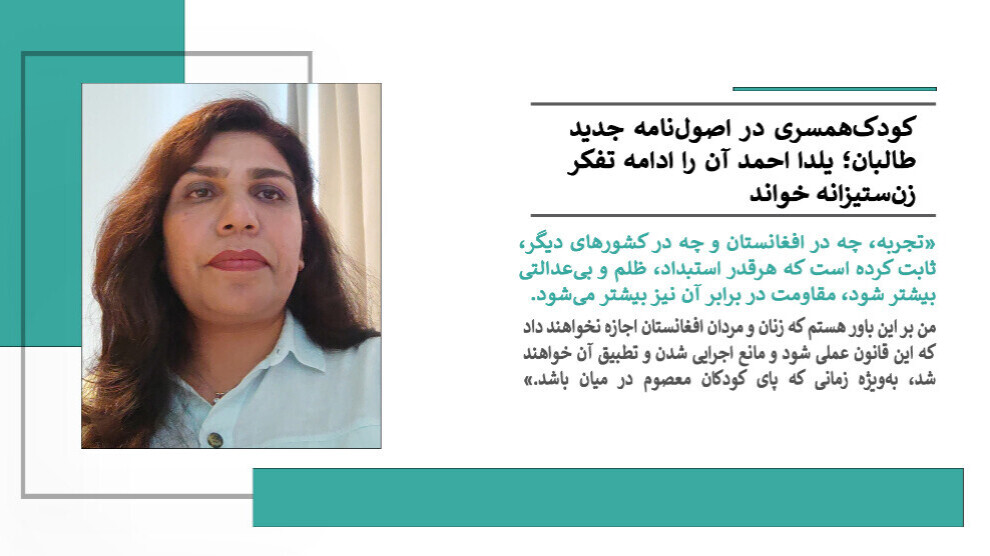
Psychologist and Afghan women's rights activist Yalda Ahmad condemned the regulation, which consists of 31 articles: "This law is nothing but an extension of the authoritarian and anti-woman ideas adopted by this group. Through its promulgation, the Taliban has once again revealed its mentality, which belongs to the dark ages."
She explained that alongside other provisions that diminish women's rights, this law also highlighted the issue of child marriage. "This time, the suffering of Afghan women has not been limited to themselves but has extended to include innocent children who have also become victims of this group's authoritarian ideas."
She believes that experiences in Afghanistan and other countries have proven that "increased authoritarianism, injustice, and lack of justice are always met with escalating resistance. I believe that women and men in Afghanistan will not allow this law to be implemented and will work to prevent its enforcement, especially when it concerns the fate of innocent children."