
Gagging teacher... How do we build a free generation capable of expressing its opinion?
Directives restricting Syrian teacher from criticizing curricula on personal accounts sparked controversy, with activist Heba Abu Ras warning this negatively affects students' critical thinking
ROCHELLE JUNIOR
AS-SWEIDA-The school is a fundamental space for building awareness and shaping the personality of generations, and the teacher's role in it is not limited to transmitting information and explainig lessons, but extends to developing critical thinking and teaching students how to express their opinions, discuss ideas,and correct mistakes. But how can a teacher entrench these values in his students if his own voice is restricted?
this question has returned to the forefront with the circulation of directives attributed to Syrian education directorates, including preventing teachers and school principals from publishing opinions or observations related to curricula and educational affairs through their personal accounts, with the threat of adminstrative accountability for violators. Apparently, the circulation of these instruction came following the controversy raised by the changes that affected the curricula, which opened the door to questions about the limits of the teacher's freedom to express his opinion and criticize educational content, and whether the goal is to regulate publishing or limit professional criticism.
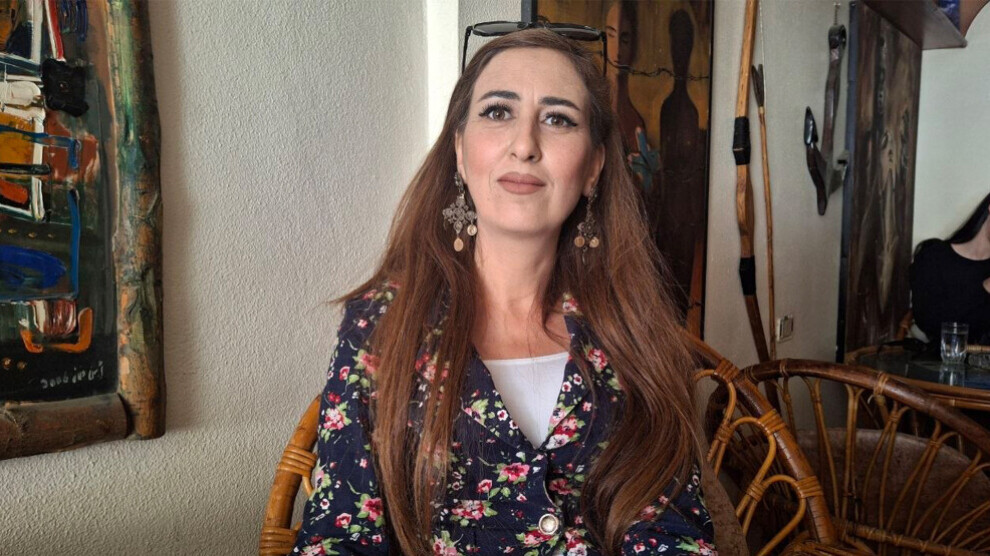
In this context, Heba Abu Ras, a former French language teacher and rights activist, raises questions about the teacher's role in building a conscious generation capable of thinking and expressing freely, affirming that restricting the teacher is not reflected no him alone, but its impact extends to the student who learns from him how to think and discuss information. She bases her position on Article 13 of the Syrian Constitutional Declaration, which guarantees freedom of opinion, expression, media,publishing, and the press, considering that silence does not correct mistakes, but allows them to accumulate and be transmitted from one generation to another.
The teacher is not merely a transmitter of information
Heba Abu Ras belives that the teachers role should not be limited to indoctrinating the information contained in the textbook, but must be a partner in building the student's awareness,and helping him understand, discuss, and analyze what he receives.
She affirms that the teacher needs a space of freedom that allows him to express his opinion on educational content, alert to information he sees as inaccurate, and raise observations that would develop the educational process. The teacher, by virtue of his direct contact with students and his experience inside the classroom, possesses practical knowledge of challenges that may not appear when preparing curricula from administrative offices.
She adds that the teacher's freedom to express his observations does not mean chaos or ignoring educational frameworks, but means providing space for professional discussion and exchange of opinions, in a way that serves the student's interest and improves the quality of education.
Restricting the teacher is reflected on the student
Heba Abu Ras warns that restricting the teacher in expressing his opinion may be directly reflected on students, as it is difficult to teach them critical thinking and freedom of discussion if they see their teacher unable to present his observations or discuss the information he provides.
she believes that adopting the indoctrination method and demanding the literal copying of information without discussion or analysis weakens the student's ability to think independently, and turns the teaching process into a process of memorization and recitation, instead of being a space for acquiring knowledge and forming opinion.
What about the teacher's right to criticize curricula?
The circulation of instructions that confine the publishing of educationa opinion and observations to official platforms raises questions about the dividing lines between organizing administrative work and restricting the teacher's freedom to express his opinion.
If the teacher notices an error in information contained in a textbook, or sees that a lesson needs review, what means are available to him to convey his observation? And can expressing a professional opinion or criticizing educational content turn into a reason for accountability?
Heba Abu Ras affirms that criticizing curricula should not be viewed as a hostile position or a departure from job duty, but as part of the teacher's professional responsibility, as long as it is based on objective observations and keenness on the students' interest.
Where do the powers of the education directorate end and the teacher's responsibility begin?
Heba Abu Ras points out the need to distinguish between the administrative and supervisory role of education directorates, and the educational and knowledge role that the teacher performs inside the classroom. She believes that the directorates' responsibility is to organize, follow up on, and supervise the educational process, while the teacher bears the responsibility of conveying knowledge and helping students understand and analyze it.
She affirms that the success of the educational process is not achieved by imposing instructions alone, but needs confidence in teachers, listening to their experiences and observations, and involving them in discussing decisions that affect their professional reality and the students they deal with daily.
A call for dialogue instead of gagging mouths
Heba Abu Ras calls on the Ministry of Education to open real communication channels with teachers, and listen to their criticisms and suggestions regarding curricula and educational decisions, instead of dealing with observations as a violation or threat.
She believes that developing education begins with recognizing that the teacher is not merely an executor of instructions, but an essential element in evaluating and improving the educational process, and that building a generation capable of thinking and expression needs an educational environment that allows questioning, discussion, and disagreement.