
Between Restriction and Resistance… Women’s Rights Defenders in Tunisia
Women’s rights defenders in Tunisia continue their struggle despite increasing restrictions and harassment, affirming their commitment to defending equality and dignity amid growing social and political pressures.
Zuhour Al-Mashriqi
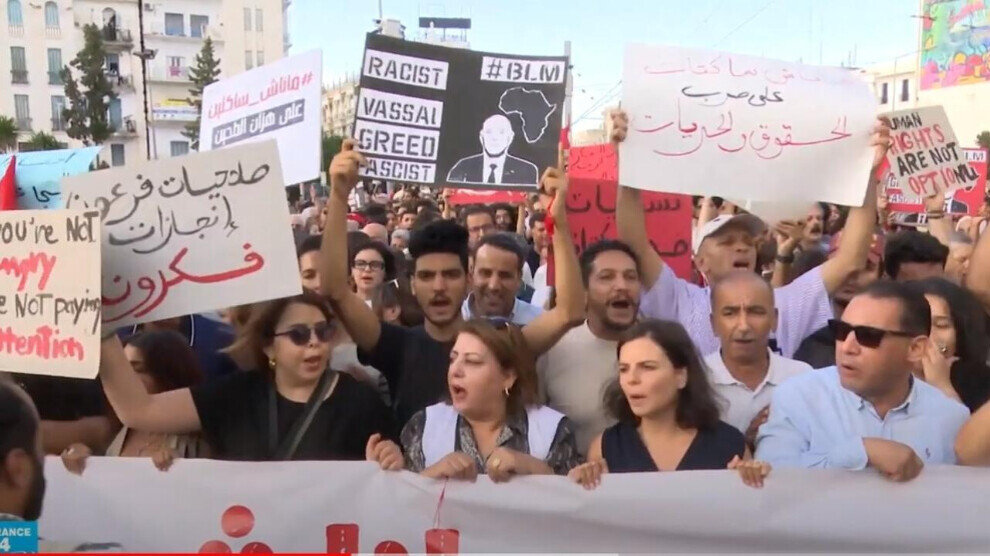
Tunisia-Amid threats, harassment, and attempts to silence voices, feminist activists continue to defend women’s rights and demand equality and dignity, challenging a reality that has become more difficult for civil society.
It is not easy to amplify the voices of women who are subjected to violence or detention, or those who have suffered marginalization and exclusion from the public sphere. The work of women’s rights defenders intersects with complex challenges, starting with a society that is conservative in some aspects and extending to what activists describe as restrictions affecting civil and human rights work. Nevertheless, feminist movements continue to raise their demands for protection from violence, fair political representation, and expanded spaces for freedom and participation.
Activists affirm that recent years have seen an escalation in pressure on some actors in the human rights field, including smear campaigns and intimidation. However, this has not prevented them from continuing their work toward a more just reality for women in Tunisia.
Harassment and Restrictions
Feminist activist Sabria Frikha stated that defending women’s rights involves a commitment burdened with social, economic, and political pressures amid regional and international tensions and local challenges. She noted that this commitment is moral, personal, and collective, and that anyone who believes in defending women must carry human rights values within and remain committed under all circumstances.
She added that women’s rights defenders in Tunisia, amid political pressures and arrests, play a dual role and endure social harassment in a conservative society, in addition to digital harassment on social media platforms, including insults, attacks, and verbal abuse that may sometimes escalate into physical violence. She continued: “Women defenders are living a reality that is far from ideal, but they remain steadfast in completing their mission of protecting women’s rights and preserving their dignity.”
She also pointed out that wars often directly affect women’s bodies, citing recent events in Gaza, Sudan, Syria, and Iran, including the bombing of a girls’ school that resulted in fatalities. She stressed that women are subjected to double oppression by patriarchal societies, regressive systems, and wars, adding: “We emphasize the need to intensify efforts, remain resilient, and strengthen feminist solidarity amid a significant regression in women’s rights.”
Frikha called for the provision of safe spaces for women and women’s rights defenders, urging victims of violence to break the barrier of fear and silence and report abuse: “Share your moments of vulnerability with us—we are here for you.”
Bearing the Pain
For her part, feminist activist Souad Bou Atour highlighted that being committed to women’s issues and carrying their pain is not easy, but rather a human and moral duty that must be fulfilled to preserve achieved gains. She considered that the threats facing feminists are compounded, as they are subjected to defamation, accusations of betrayal, and harassment that may extend to their families. Nevertheless, this will not prevent them from continuing the struggle to achieve full gender equality.
Regarding the impact of her feminist commitment on her personal life, she explained that she does not separate her activism from her private life, especially as she works as a listener to victims of violence within the Tunisian Association of Democratic Women, remaining close to women and their suffering.
She added: “The association provides supervision sessions for listeners who communicate daily with victims of violence, in order to prevent negative psychological impacts that may affect the listening process.”
Commitment and Resilience
In turn, human rights and feminist activist Mariem Guezani explained that violations against women’s rights defenders have become more intense, yet they continue their commitment with resilience despite the moral and psychological harassment they face, whether on social media or in public spaces, which have become increasingly restricted in an effort to intimidate them and limit their civil activism.
She added that feminists face daily threats and, in recent years, have been subjected to attacks from patriarchal mindsets via social media, aimed at pressuring them and preventing them from defending women’s rights, which such mindsets consider a “heresy,” while also distorting and marginalizing these struggles.
She also pointed out that women’s rights defenders in the region face compounded threats from patriarchal societies, authorities, and national and sectarian conflicts, most recently the war on Iran. She recalled the assassination of Iraqi activist Yanar Mohammed in front of her home in Baghdad, noting that violence and chaos primarily target women and progressive voices striving to defend their rights.
She concluded by stressing that the local and regional contexts require activists to strengthen cross-border solidarity and enhance coordination mechanisms to confront authoritarianism and stop violence and assassinations, which have become tools of intimidation and terror:
“As women, we must create safe spaces to defend our rights and our presence in the public sphere.”