
Women Defying Work Restrictions Through a Restaurant That Creates Jobs and Preserves Their Culture
In Bamyan, Afghanistan, two women opened a small restaurant to provide themselves with a source of income while creating job opportunities for other women.
BAHARAN LAHIB
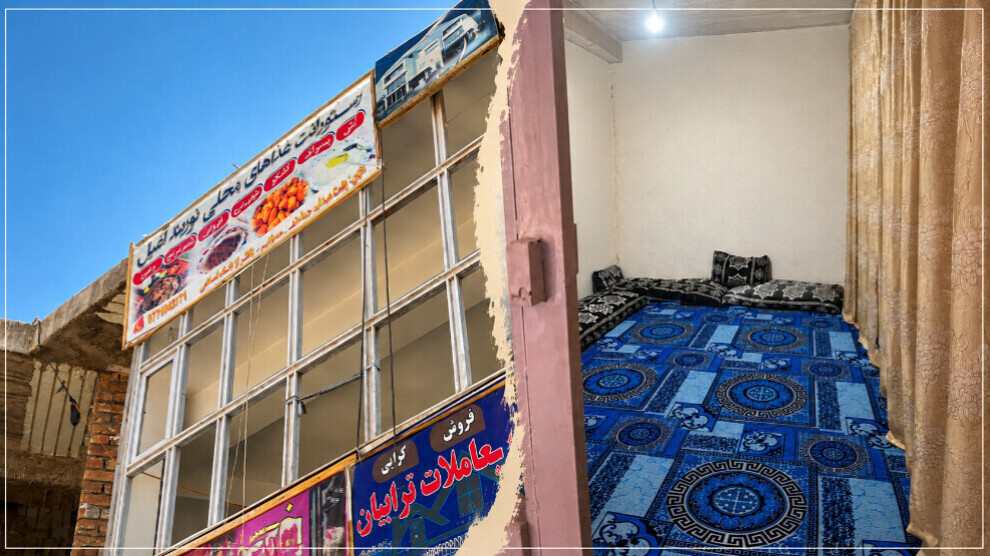
Bamyan — In the Bamyan market, among shops and small restaurants, there is a sign bearing the name of a restaurant that local residents said a number of women opened in a small basement, where they serve local dishes in Bamyan.
The restaurant was established with limited capital, and its three rooms were decorated with simple furniture and local décor inspired by Afghan culture. In one of the rooms, a number of customers were sitting, all of them men.
When we asked them why they were in this restaurant, they said there are many restaurants in the Bamyan market, but cleanliness, low prices, and the fact that the food is local are among the reasons that drive them to choose this place. One customer said: "We want to support these women who launched this initiative with their own efforts and determination."
In another part of the restaurant, there is a small and simple kitchen where most of the restaurant's work is done. Near the kitchen entrance, we met Masoumeh Sadeqi, who had finished her work and sat down to talk with us about the restaurant's activity.
"Nurband Aghil": A Restaurant with Three Goals
Masoumeh Sadeqi is one of the two women who founded the "Nurband Aghil" restaurant. She says the restaurant was established with the aim of providing a sustainable source of income for women, introducing Bamyan's culture and its local dishes, and creating job opportunities for other women. "In the current conditions in Afghanistan, work has become very difficult for women. We are mothers and we have children, and we cannot always work outside the home, but we need a source of income."
She explained that preserving Bamyan's local culture was also one of their main motives: "Our second goal is to introduce Bamyan's authentic culture and its dishes to people—that is, to keep Bamyan's authentic culture alive. As for the third goal, it is to provide job opportunities for other women."
The restaurant began with only two women, and now one cook and two trainee girls work in it. As for the name "Nurband Aghil," it is also derived from the local culture of Bamyan. Masoumeh Sadeqi explains that the name is taken from the Hazara language, and they chose it because the dishes served are local and because the place is designated for women.
They Do All the Work Themselves
The shortage of capital has forced the women who invested in the restaurant to do a large part of the work themselves—from cooking and cleaning to serving customers and accounting.
Nevertheless, this small place has managed to attract customers. According to Masoumeh Sadeqi, some see the restaurant's cleanliness and the quality of services provided by women as reasons for choosing this place. "Both women and men are our customers, but men are the majority. Men say that a restaurant where women work is clean and tidy."
An Attempt at Self‑Reliance
"Nurband Aghil" continues its activity at a time when women in Afghanistan, over the past five years, have faced widespread restrictions in the fields of education, work, and participation in public life.
Under these circumstances, small projects and self‑employment have become, for some women, among the few available ways to earn income. Recent reports also indicate that women's share of the Afghan labor market has sharply declined, and that imposed restrictions have made their access to job opportunities more difficult.
In Bamyan as well, some women are trying, by opening handicraft shops, sewing workshops, and production workshops, to provide income for themselves and other women.
These activities continue at a time when women entrepreneurs face various restrictions, including restrictions on movement and participation in some markets and exhibitions.
Masoumeh Sadeqi also believes that women should not stop trying under difficult economic conditions: "In these economic conditions, there are not enough work opportunities; therefore, we must be active and try to provide work or activity, whether for our families or for other women."
She believes that staying at home for long periods and unemployment can increase psychological pressure on women, and she encourages women to start any activity even with limited resources: "Even if you face difficulties, you should start some work and try to find for yourselves a path, an activity, or a hobby that keeps you occupied."
A Small Restaurant but a Hope for Continuing Work
"Nurband Aghil" is not a large or modern restaurant. It is a small basement with limited resources, opened by two women with modest capital, and each of them does a large part of its work herself.
Nevertheless, for its founders, the restaurant is not merely a place to sell food; it is an attempt to provide income, preserve Bamyan's food culture, and create job opportunities for other women. Before opening this restaurant, Masoumeh Sadeqi worked as a teacher and says she studied geology at university.
Now, with the decline in job opportunities available to women, she and her partner are trying, starting from a small basement in the Bamyan market, to forge a path to continue their economic activity and provide work for a number of other women.