
"Tadart” … A Project Linking Algerian Craft to the Local Economy
Through her project “Tadart,” which valorizes local products and food and craft heritage, Algerian Farah Bousaleh to link craftswomen with consumers and give local products a chance to reach a wider market.
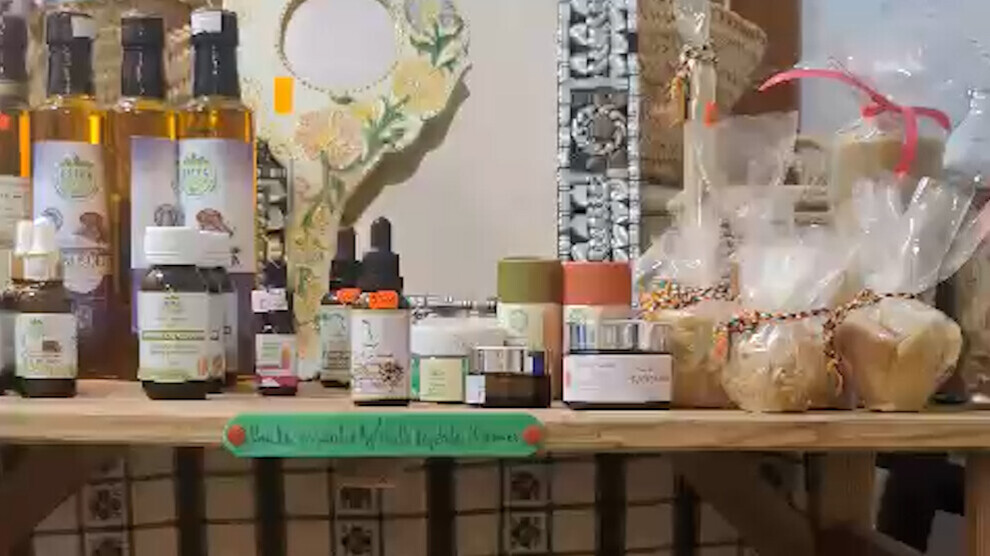
NAJWA RAHIM
Algeria_ From seeds to couscous, from production and processing to the valorization of food and craft heritage, Farah Bousaleh is building an experience that goes beyond the idea of a traditional commercial project. Through the “Tadart” space, she works to create a space where local products meet their makers,and where women’s skills transform from inherited knowledge into a source of value income, thus opening new doors for craftswomen from different regions of Algeria.
Farah Bousaleh’s story did not begin with the opening of the “Tadart” space, but was preceded years of experience, research, and fiedwork. The idea began about five years ago in the form of a project called "Oustadar," before gradually developing and finding its way to realization.
The idea was based on four interconnected circles: healthy production, healthy processing, responsible consumption, and then transferring this knowledge to others. But for her, it was not enough to talk about this way of life or practice it individually; it was necessary to find a place that brings these ideas together and makes them shareable. "I could not share this new way of life. There had to be a place. There had to be a space."
Thus the features of "Tadart" began to take shape, as a space carrying a vision that goes beyond buying and selling, based on production, processing, and preservation, and on introducing local products and the people behind them.
From Seed to Product
Throughout these years, Farah Bousaleh has not stopped collecting seeds, nor planting vegetables and processing the agricultural products available to her. She also experienced shared gardens, participated in workshops on sustainable agriculture and permaculture, and cooperated with associations and groups active in this field.
She explained that this experience allowed her to understand the different circles of the food chain, from seed and production to processing, preservation, and then consumption. But more importantly, it pushed her to think about how to make this cycle open to others, especially women who possess skills and knowledge related to land, food, and traditional crafts.
Women at the Heart of the Local Economy
In Farah Bousaleh's experience, local products are not treated as mere commodities placed on store shelves. Behind every product there is a story, and behind the story there is a woman or craftsman carrying knowledge acquired through years of practice, often passed down from family members and the local environment.
Hence comes one of the most important features of her experience: opening the field for craftswomen to present their products and reach a wider audience. She works with women from different fields, links the producer with the consumer, but also keenly speaks about how it is produced, processed, and preserved, and highlights the knowledge behind it. In this way, the space becomes a link between the producing woman, the consumer, and the market.
Couscous Is More Than Just Food
Couscous occupies a special place in this project. For Farah Bousaleh, it is not just a food product, but a heritage carrying within it much knowledge and techniques that many women still preserve. This is done through collecting and producing seeds and processing them into couscous, in addition to cooperating with other women who produce different types of couscous.
Some of the women she works with prepare couscous using herbs and aromatic plants, in variations that reflect the richness of Algerian food heritage and its diversity from one region to another.
A Network of Craftswomen
What makes Farah Bousaleh's experience remarkable is that it does not stop at one product or one region. Her ambition is directed toward building a network that allows women from different regions of Algeria to access a new space to display and valorize their products.
A craftswoman in a distant village or region does not always have the possibility of direct access to the consumer or to a wider market. Here, such initiatives can play the role of intermediary that links the two parties and gives local products a chance to reach a new audience.
But the value does not lie in marketing alone. Giving space to these products also means giving space to the women who carry this knowledge. This is what makes Farah Bousaleh's project closer to building a small economic and social system based on cooperation instead of isolated work, and on exchanging expertise instead of monopolizing it.
Circular Economy... When Everyone Works Together
Farah Bousaleh describes her model as part of the circular economy, where the journey of the product does not end when it is produced, but continues through processing, preservation, distribution, and consumption, with the involvement of as many women, craftsmen, and craftswomen as possible.
She says that the goal from the beginning was "to carry out the activity, but at the same time employ many women, craftsmen, and craftswomen." For her, craft is not just a final product, but a chain of knowledge, skills, and economic relationships.
Through this vision, Farah Bousaleh tries to make "Tadart" a space that gives this knowledge a chance to continue, while at the same time creating new opportunities for the women who possess it. In her experience, craft appears to be the starting point, but it is not the end.