
Severe Losses in Southern Lebanon and Women Struggle to Recover Their Livelihoods
Israeli attacks devastated southern Lebanon’s livestock, emptying barns and weakening milk and cheese production. Amid lost animals and declining incomes, women struggle to recover livelihoods and preserve remaining projects.
RANA JONY
LEBANON_The repercussions of the Israeli attacks were not limited to the destruction of homes and land in southern Lebanon but extended to lives tock wealth and the livelihoods of hundreds of families. Considering these women struggle to recover their projects in the face of devastating losses and economic challenges threatening the continuity of this sector.
The Israeli attacks did not leave a single head of sheep for Tawfiqa Al-Maaz, a daughter of the southern town of Majdel Selm, who lost her son while he was grazing livestock in the town of Burj Qallawiyah, near one of the international emergency forces centers. She also lost about a thousand heads of sheep and cows, alongside numbers of poultry; half of them died as a result of shelling and raids, while she was forced to sell what remained for less than a quarter of its value.
Before the attacks, Tawfiqa Al-Maaz lived from livestock production, and made fresh local yogurt from milk, which she sold in the local market, alongside cheeses. But the recent attacks toppled this resource, and changed the life of the woman who had depended on her farm to secure her family's needs.
She was not alone in this reality. The dairy and cheese industry formed a fundamental livelihood for a number of women in Majdel Selm. The town's production reached about a thousand buckets, before production capacity declined due to the losses of the attacks, with a single farm's production becoming about ten buckets per day, and sometimes less.
Tawfiqa Al-Maaz wanders in the empty livestock barn, and stops in front of the chicken coop that used to contain more than a hundred laying hens. She says: "The hens used to produce daily between 10 and 15 cartons of eggs, and I used to sell them in the market. But they all died as a result of the artillery shelling that hit the town."
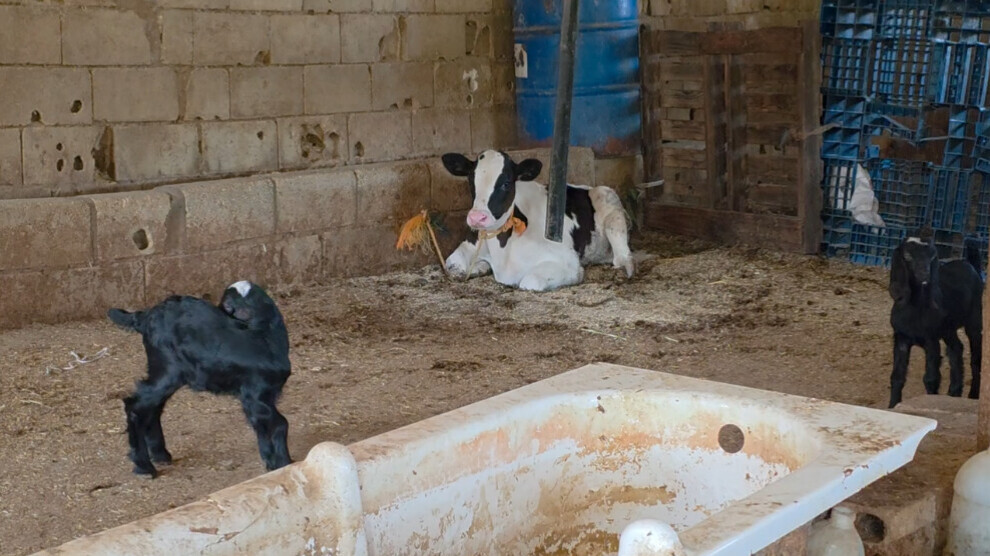
The traces of the previous life are still present in the place; the sheep pens and their bells, the hay left in one of the rooms, and the water basins that were used to water the herd. Everything is still in its place, except for the livestock that gave the farm its vitality and spirit.
Tawfiqa Al-Maaz concludes bitterly: "I no longer want to enter the house, nor even to pass by the place. I go out to the field and cry my sorrow and pain. My loss is great, and the economic conditions are extremely difficult, and I have a family that needs support."
A Declining Livestock Sector in the South
Only a few hundred sheep remain in the town, while the number of cows among breeders has declined, and the number of breeders has decreased from 63 to only seven. Tawfiqa was one of those who lost their herd and source of livelihood.
The Lebanese Ministry of Agriculture estimates livestock losses at more than half a billion dollars, according to the figures contained in the report, at a time when the repercussions of the attacks affected other productive sectors, including poultry, and were reflected in prices in the local market.
Less Production and an Attempt to Continue
Steps away from Tawfiqa's farm, Nahed Hamdan tries to preserve what remains of a family project that has formed her livelihood for years.
On the family's cow farm, only three cows remain out of 23 that formed the basis of production before the attacks. As for the dairy workshop, in which she used to make dairy products and cheeses and through which she fed the local market, it is still operating, but with much less capabilities and production.
From a production that reached about 35 buckets of yogurt daily, in addition to manufacturing cheeses and dairy products, it now produces only four buckets, according to demand.
Inside her workshop in Majdel Selm, the forty-year-old Nahed Hamdan continues her work, refusing to surrender to the losses that struck her project. She says: "The war had its heavy repercussions on our economy. We lost a lot, and we sold the cows for a quarter of the price. Today, with the rise in cow prices and the decline in production, it has become difficult for us to buy a cow, especially since its price has exceeded a thousand dollars."
She adds that the dairy and cheese industry is not just a profession, but a livelihood for her family and a means of holding on to the land. Nahed Hamdan heads early to her workshop, where she boils the milk and prepares it for making local yogurt, preserving the method she used to adopt in her production that used to exceed a hundred molds of cheese before the attacks. Today, production has declined to levels that are not enough for the industry to continue as it was.
The challenges are not limited to direct losses. The rise in the cost of feed, the decline in the ability to buy cows, and the loss of seasons and lands located within the affected areas and near the Yellow Line, are all factors that increase the difficulty of restoring production. The location of Majdel Selm at the edges of Wadi Al-Salouqi, and the exposure of its outskirts to artillery shelling, double the challenges facing breeders and farmers.
Support to Return the Sector to Production
In Majdel Selm, the attacks did not only empty farms and barns, but struck the livelihood of entire families, and hit a local industry that formed for years an essential part of the south's economy.
Between Tawfiqa Al-Maaz's empty farm and Nahed Hamdan's workshop struggling with modest production, the need remains urgent for support that returns cows to the barns, production to the markets, and hope to women who have not only lost their livelihood, but have lost part of their lives.
In southern Lebanon, reconstruction does not mean restoring houses alone, but also means saving livelihoods, and returning life to farms that were once a source of livelihood and stability for entire families.