
Palm-frond kufiya” — a traditional craft that provides income for rural women in Yemen
Handicrafts play an important role in improving the income of rural households, especially in light of the difficult economic conditions the region is experiencing.
Rahma Shanthour
Yemen — As the humanitarian crisis in Yemen continues to worsen, an old craft is emerging as a lifeline for dozens of rural families. Yemeni women are turning palm fronds into products that generate a modest income, helping them survive under harsh living conditions.
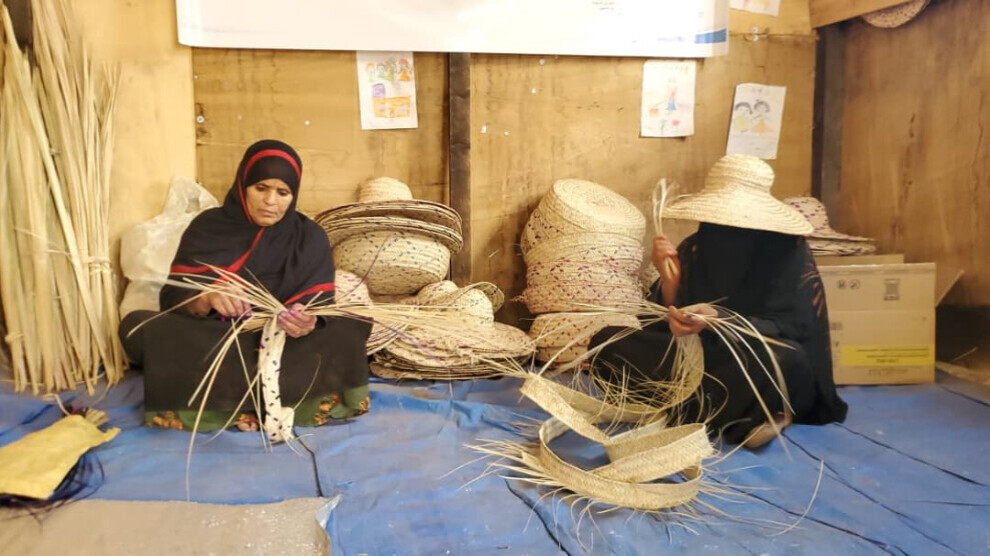
In Al-Ma’afer district, south of the Yemeni city of Taiz, the craft of making kufiyas from palm fronds is still alive despite changing circumstances and the hardships of conflict and displacement. Dozens of women rely on it as their main source of income to secure their families’ basic needs.
Safiya Ali Hassan (57) is one of these women. She inherited the profession in childhood, continued it after marriage, and, following her husband’s death, became the sole breadwinner for her family amid difficult economic conditions.
She says she began working in this craft when she was a young girl in her parents’ home and continued after marriage. Her husband used to bring palm fronds from the valley while she handled the weaving and sewing. After his death, she found herself forced to depend on this profession to provide a living for her children.
She explains that she makes kufiyas and mats from palm fronds and sells each piece at prices that barely cover essential needs such as flour, sugar, tea, and some household supplies.
“We console ourselves with this small income. If we sit without working, who will give us anything?” she says.
The production process involves weaving palm fronds into braids resembling hair plaits using palm leaf strips, which are then stitched together to form the final products, with simple decorations and colors added for a touch of beauty.
Palm leaf strips are the main material for making the kufiya. They are usually taken from palm fronds and sometimes from other plants such as the doum tree in coastal areas.
Safiya’s day begins in the early morning hours. She prepares breakfast for her children, then starts weaving. She usually completes two kufiyas a day — one from morning until noon and another from noon until the afternoon. She gathers what she produces during the week, sews the pieces together, and takes them to the market to sell.
But selling is not easy. She spends long hours in the market, from six in the morning until eleven, and sometimes returns with half her goods unsold due to weak demand.
She notes that demand for these products has declined: “People no longer look for these things as they used to.”
Part of a local identity and heritage
Despite the skill and creativity of rural women, this craft faces multiple challenges, most notably the shortage of raw materials and their rising costs at times, as well as the difficulty of accessing markets to promote and sell the products.
Safiya carries a harsh life story. After losing her parents at a young age, she lived with other families, herding sheep in exchange for food. There, she learned the craft from women in the grazing fields. The skill she acquired in childhood, she says, has become her only lifeline today.
With the outbreak of the conflict, she was displaced twice with her family — from their village to Al-Kadha, then to Al-Bireen, where she currently lives. Displacement, she adds, made life even harder, especially in obtaining palm fronds, the essential raw material for this craft.
She points out that the support of some humanitarian organizations in providing palm fronds helped women continue working after obtaining the material had become nearly impossible at certain times. She also mentioned that food aid, despite being limited and irregular, sometimes helps ease part of the living burden.
In addition, Safiya is keen to pass this craft on to young girls in her area. She teaches them gradually until they master the skill and become able to rely on it as a future source of income.
Despite economic challenges and declining market demand, Safiya and other women in rural Taiz continue to hold on to this traditional craft — not only as a source of livelihood, but also as part of a local identity and heritage that faces the risk of disappearance amid war and changing lifestyles.