
From Kermashan: A woman’s rise from domination to full economic freedom.
Elham Ahmadi’s experience breaks the chains of marital dependency, proving women’s economic independence is a social necessity. Her story shows that true freedom comes from self-determination and the courage to challenge the patriarchal system.
Nasim Ahmadi
Kermanshan — With her fingertips, she sculpts small statues, as if breathing life into clay to restore the pieces of herself scattered by hardship. A woman from Kermanshah, she displays her handmade sculptures on city sidewalks, where her figures of women catch the eyes of passersby—reflections of her own story carved into every piece.
Elham Ahmadi recounts her beginnings:
"I started this work two years ago. Because of financial hardship, I had no choice but to search for my own source of income. Since childhood, I’ve loved art, and the only path open to me was to pursue something creative that could give me independence. I chose sculpture because I can work from home when my daughter is not around, and my presence still gives her comfort. Sculpting is not difficult; it requires passion. Even though it doesn’t bring enough income, it was my way to keep going. I'm not satisfied with what I earn, but I have no choice except to adapt to reality."
For many women who have spent years living under a husband’s dominance in a confined space, choosing divorce or launching a personal project is a step surrounded by social taboos—one that few dare to take. Economic dependence on men forces many into unwanted marriages, because society still struggles to accept women as fully independent individuals. This financial dependence, compounded by cultural pressures, keeps women trapped in a cycle of silence and stagnation, where women’s independence is viewed as a threat to the patriarchal order.
Despite all restrictions, Elham Ahmadi managed to break through these traditional beliefs and redraw her life with a new vision. She emphasizes that “women must understand that marriage should not be an escape from hardship or financial insecurity. A woman must choose true independence within society. It is essential for her to have her own income or work—something that protects her future and guarantees her life.”
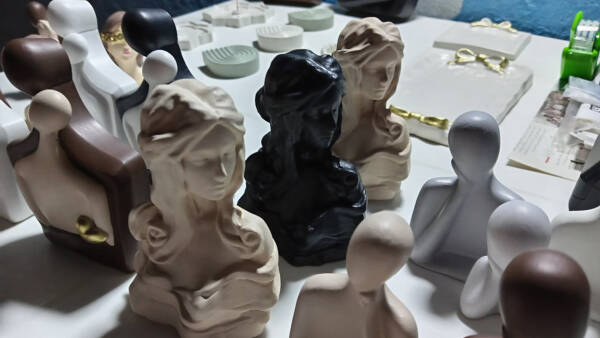
Economic independence… a fundamental condition for women’s liberation
Elham Ahmadi says:
“The difficult experiences I went through after marriage made me realize that financial independence is indispensable for women. A woman should never be held hostage by dependence on a man. Life may bring disagreements or a breakdown in understanding, and if a woman is not financially independent, she will be forced to stay in a relationship she no longer wants. That, in itself, is a real dilemma. This is why I believe every woman in our society must build her own financial independence—something that protects her from dependency and gives her the power to determine her own destiny.
Elham Ahmadi also spoke about the obstacles she faced while trying to obtain a divorce:
“When I decided to separate from my former husband and attended the pre-divorce counseling session, the psychologist told me, ‘Madam, what will you do after separation? You have no education, no money, and no stable financial situation.’ I replied, ‘I cannot live under the same roof with someone just for a piece of bread while being denied respect.’ That experience made me believe that a woman must put her humanity first, then think about her life and future.”
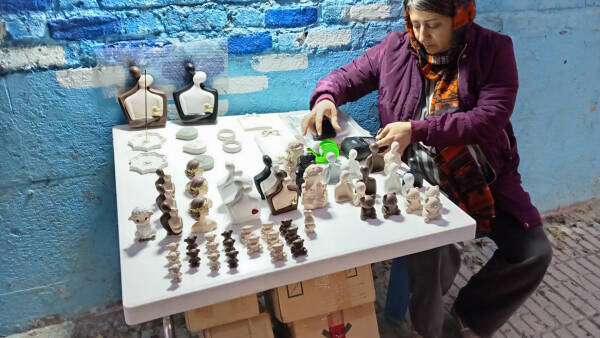
She pointed out another major challenge in her work: “When I display my products on the roadside, some male vendors do not want a woman working next to them. So I’m forced to choose a more isolated spot—but sales there are weak.”
These pressures have reduced her income. She adds:
“My products start at very low prices and increase slightly, but sales are limited; I might sell only a few pieces a day. And because I cannot afford to rent a shop, I have no choice but to set up a small table and chair on the roadside and work as a street vendor.”.

Elham Ahmadi’s experience shows that women’s economic independence is not merely a personal choice, but an urgent social necessity.
Despite family pressures, cultural constraints, and even male competition in her work environment, she managed to carve out her own path. And although she still faces many obstacles, she continues moving forward toward building a different future