
The Documentary Film "Honeyland"... Woman and Nature in the Face of Exploitation
The 2019 North Macedonian documentary Honeyland explores humanity's sensitive relationship with nature through sustainability and consumption, showing how environmental balance can be disturbed by ambition and economic fears.
News Center_The film Honeyland, directed by Tamara Kotevska and Ljubomir Stefanov, addresses the life of Hatidže Muratova, a beekeeper living in a remote mountain village in North Macedonia. In this village, which lacks electricity and water, Hatidže lives with her bedridden mother and depends for her livelihood on traditional beekeeping.
The film revolves around Hatidže Muratova's method of beekeeping. She does not consume all the honey she obtains from the bees, but leaves part of it in the hive so that the bees can continue their lives. This approach is expressed throughout the film by the principle of "half for me, half for the bees." Through this, the film emphasizes the necessity for humans to take into account the continuity and preservation of nature when benefiting from its resources.
However, this balance begins to change with the arrival of a family of nomadic pastoralists to the village where Hatidže Muratova lives. The family seeks to increase honey production and achieve greater income, so it begins by attempting to raise production without sufficiently taking into account the needs of the bees. Excessive honey collection and harming the bees' life cycle becomes one of the most prominent examples in the film of the conflict between human needs and the limits of nature.
Through this encounter, the film Honeyland does not tell merely a story about beekeeping, but also raises topics such as human ambition, sustainability, overconsumption, the use of natural resources, and the relationship between humans and nature.
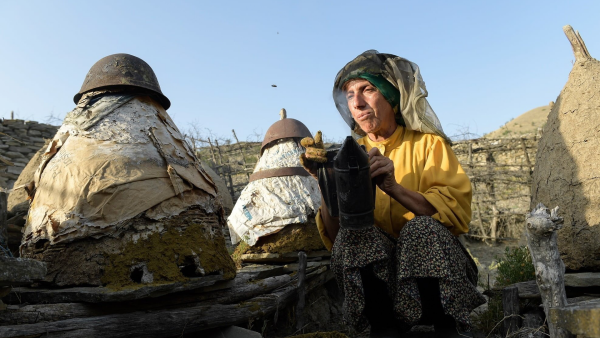
On the one hand, Hatidže lives by adapting to and respecting the rhythm of nature, and on the other hand, there is a family trying to make greater use of natural resources to meet its economic needs.
By placing these two different approaches against each other, the documentary draws attention to the fact that natural resources are not limitless. The imbalance between what humans take from nature and what they leave for it does not only lead to environmental consequences, but also has important effects on relations between people.
The film is also distinguished by its use of a regional Turkish dialect in North Macedonia. The filming of the work took about three years, and the film was then completed through the editing of approximately 400 hours of raw footage.
Honeyland was nominated at the ninety-second Academy Awards in the categories of Best International Feature Film and Best Documentary Feature, making it one of the works that received nominations in two different categories in the history of the Academy Awards.
The documentary shows that the relationship humans establish with nature is not merely an individual lifestyle, but is also an issue linked to environmental sustainability.