
What Awaits Rojava Aftr the January 29 Agreement and the Integration Path?
"Rojava's new phase, launched by the January 29 integration deal, sees Kurds striving to transform military and political gains into constitutional and local democratic rule."
ROJBIN DENIZ
News Center— The Kurds in Rojava have so far entered a path aimed at transforming the power they have accumulated and the gains they have achieved into a sustainable local political, constitutional, and democratic force. From this perspective, the transformation of the Syrian Democratic Forces, through the integration path, into part of the Syrian army does not mean the end of the Autonomous Administration experience or the abandonment of its gains; rather, it can constitute an entry point for consolidating this experience and its gains within the framework of Syria's unity. Therefore, understanding the current situation requires first returning to the path of developments that led to it.
The agreement signed on March 10, 2025, due to the continued influence of external forces, particularly the Turkish factor, along with policies imposed on the parties to serve different interests, gradually deviated from the implementation path. Mistrust between the two sides deepened until matters reached, in January 2026, the outbreak of attacks and clashes targeting Kurdish neighborhoods in Aleppo.
These field developments, according to this perspective, came within the context of a British-Turkish policy aimed at drawing the Kurds into a political path aligned with their interests. These policies contributed to disrupting the implementation of the agreement, creating field tensions, and weakening opportunities for dialogue. The primary goal was to change the balance of power on the ground, and thus reduce the advantage the Kurds held at the negotiating table.
From this standpoint, an attack was carried out in cooperation between armed groups inside Syria and external forces, aimed at weakening the Kurds and changing the power equation that formed the basis of their negotiating position. The attack also targeted, in its essence, the path adopted by the Kurds to achieve peace and reach a final solution to the Syrian issue, by attempting to turn their areas into a wide theater of conflict, akin to creating a "second Gaza." The attacks extended from Aleppo to Raqqa, Deir ez-Zor, and Tabqa, reaching the borders of Al-Hasakah, one of the most prominent centers of Kurdish presence.
The Role of the Peace and Democratic Society Paradigm
The role played by leader Abdullah Öcalan was critically important in this phase. The attack aimed at eliminating the Kurds in Rojava or erasing their gains would have severed the links between them and the Kurds of Turkey, particularly the forces that could play a role in Turkey's future, opening the door to a new and open Kurdish-Turkish war.
With this coinciding with the war with Iran, the danger of this confrontation expanding, with the participation of external forces, to encompass the entire region emerged, threatening to end the peace and democratic society path. And as regional power balances shifted in Turkey's favor, this possibility was not only a danger for the Kurds but also for Turkey.
In this context, leader Abdullah Öcalan's identification of the risks of escalation and their reaching Turkey's doors played an important role in stopping the attacks. The Kurdish people's uprising in defense of Rojava also constituted a decisive factor; the mobilization of millions of Kurds created a new equation that affected the balance of power, not only in the four countries but also in Europe and at the international level.
This widespread popular mobilization, which exceeded expectations, forced various parties to reconsider their calculations. With the clashes stopping at the borders of Al-Hasakah, the path returned to the political and diplomatic sphere, leading to the January 29 agreement.
The January 29 Agreement and What the Integration Path Produced
Therefore, the January 29 agreement should not be viewed merely as a ceasefire or a direct result of the military conflict, but as the beginning of a new political phase reshaped by field power balances, the Kurdish popular movement, and the calculations of regional powers.
With this agreement, the first step was reaching a ceasefire. In the second phase, a negotiation table was established, and various committees were formed to ensure the implementation of the integration path and the January 29 agreement.
Over approximately seven months, the path of integrating the Syrian Democratic Forces, which withdrew during the war from Raqqa, Deir ez-Zor, and other areas, was discussed. Within this framework, it was decided to integrate three of its brigades into the Al-Hasakah division, along with integrating the Kobani brigade into a division based in Aleppo.
Internal security forces were also attached to the Ministry of Interior, completing an important aspect of security integration. Additionally, the governor of Al-Hasakah was appointed based on a proposal from the Syrian Democratic Forces.
The integration path extended to public employees and public institutions, strengthening the link between the center and the local level. Despite the reorganization of some institutions' names and legal statuses, most continued their work according to existing structures.
The Economic Balance That Will Take Shape in Kurdish Geography
Agreements were also reached on a number of important economic files, including involving the Jazira Company in operating oil fields, opening border crossings within the next three months, establishing a joint mechanism for their management, with local forces—i.e., the Syrian Democratic Forces after completing their integration—taking responsibility for securing them.
A similar approach was followed regarding the airport, where repair and rehabilitation work continues in preparation for its reopening, to be later managed through a joint mechanism, with local forces tasked with securing it.
Agreement was also reached on ensuring Al-Hasakah governorate receives its share of economic resources at the Syrian level, along with adopting a special approach for the reconstruction and development of Rojava, given its important resources, such as oil, wheat, and cotton. This is particularly important given the significant damage inflicted on infrastructure and services as a result of decades of neglect and war.
Thus, the seven‑month process was not limited to military force integration but transformed into a broader restructuring and integration path encompassing security, administration, economic resources, crossings, the airport, and reconstruction.
What Was Discussed at the People's Palace in Damascus?
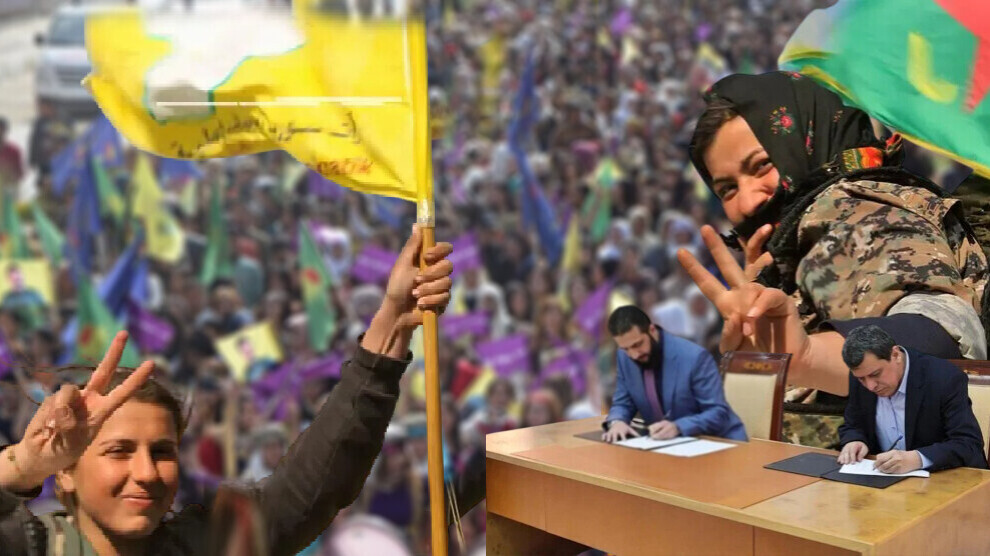
On August 26, the Kurdish delegation representing Rojava met at the People's Palace in Damascus to assess the outcomes of the January 29 agreement and the integration path. The delegation included Ilham Ahmed, Mazloum Abdi, Nourouz Ahmed, along with political, administrative, and military representatives, reflecting a direction to discuss the situation in Rojava in all its dimensions and reach final outcomes on outstanding files.
Mazloum Abdi had indicated this direction in his speech on the centenary of Qamishlo, where it was announced that the requirements of the January 29 agreement had been implemented by both sides, and that the files that moved to the integration path had been largely accomplished.
Thus, the Syrian Democratic Forces and the Autonomous Administration reorganized their structures on the basis of integration, and the Kurds reached a stage that allows them to participate in the political and administrative structure of the new Syria.
This outcome cannot be described as a complete victory for Damascus or a complete defeat for the Kurds. The attacks that began in January were a warning that Rojava was being pushed toward becoming "Gaza" and entering an escalating cycle of resistance and confrontation, but this scenario was ultimately avoided.
With the path moving toward integration, the Kurds were able to maintain their presence and gains within the new political structure of Syria. Hence, this outcome should be assessed not only in light of current developments but also within the context of the historical path of political, military, and social gains the Kurds accumulated in recent years. This historical reading is essential for understanding the next phase and potential developments more accurately.
Women Held Their Red Lines
The status of the Women's Protection Units (YPJ) was one of the most prominent defense files discussed during the meetings at the People's Palace. Initially, their integration into the internal security forces was proposed, but the YPJ categorically rejected this.
Thanks to their position and insistence on the ground, along with their diplomatic efforts, an approach was reached stipulating their joining the integration path while maintaining their own structure and identity. It appears that broad agreement was reached on their continuation as an operational force of approximately 1,500 fighters, affiliated with the Ministry of Interior, with details and implementation mechanisms discussed in subsequent meetings.
Preserving the YPJ as an independent and organized women's force is an important gain, not only militarily but also in the field of women's struggle. Their experience in confronting ISIS formed a practical model for self-defense and women's protection, and a source of inspiration and courage for women in the Middle East.
From this perspective, preserving their specific identity carries political and social importance, in addition to its defensive significance. It also represents, in the Syrian context, an important factor in confronting structures and forces that have adopted conservative policies toward women, confirming that women's organization can constitute an effective resistance force in this phase.
The Kurds Will Balance with Damascus, and Damascus Will Balance with the Kurds
It can be said that the approach that Israel and Britain have recently anticipated regarding the reshaping of the Middle East is based on pluralism, maintaining different centers of power alongside one another, and creating a new balance of power based on fragile balances.
In this framework, the effort through Hayʼat Tahrir al‑Sham to rebuild the Syrian state on the basis of political, constitutional, and local power balances can be viewed, by keeping Arab Sunnis, Kurds, Druze, Alawites, and democratic political actors within this framework, without placing them within any specific ideological line.
This situation can also be read as part of the political construction model that Britain envisions for the new Syria. Accordingly, the Kurds will be viewed as one of the key actors in the new Syrian state's strategy and power balances.
From this angle, granting Mazloum Abdi the position of Special Advisor within the Presidency institution, responsible for Kurdish affairs, can also be considered a notable development. Therefore, it is necessary to address the envisioned political model for the new Syria, in which British influence will play a decisive role, from a broader perspective.
The Kurdish Equation in the New Syria
The proposed advisory role for Mazloum Abdi also paves the way for the formation of a mechanism for Kurdish political representation. Defining this role as an advisory position directly responsible for Kurdish affairs can be read as a development that opens the way for addressing the Kurdish issue within the new political structure of Syria and within the framework of the state's future.
Securing the gains the Kurds have achieved through years of struggle and transferring them to the field of democratic politics represents an important threshold for the Kurds. Transferring actual military and field gains to a political, constitutional, and institutional ground also indicates a new phase in the Kurds' future within Syria.
On the other hand, the possibility that Britain and Israel may wish to keep the Kurds within the political structure in Damascus can be viewed as a means of achieving a balance with the structure centered around Hayʼat Tahrir al‑Sham. For Syria's repositioning as a strategic actor at the regional level, and managing this strategy through a structure centered exclusively on Arab Sunnis and Hayʼat Tahrir al‑Sham, could disrupt the existing balances in the region.
Ilham Ahmed May Be a Member of the New Constitution Drafting Committee
It is said that Ilham Ahmed's expected role also involves being a parliamentary member of the People's Assembly and assuming the position of Deputy Speaker of the Assembly. However, this position was not mentioned in the decree issued by Al‑Jolani regarding Mazloum Abdi. Nevertheless, local sources indicate that Ilham Ahmed's expected role is moving in this direction.
Earlier, the possibility of Ilham Ahmed assuming the position of Deputy Minister of Foreign Affairs had been circulated. However, the recent announcement that the constitution drafting process will be conducted through the People's Assembly strengthens the likelihood of Ilham Ahmed assuming the position of Deputy Speaker.
Such a development would mean the Kurds' direct participation in the process of drafting the new constitution. This represents an important development for the Kurds. Transferring the decrees issued so far to a constitutional framework, ensuring Kurds' rights to identity, language, and culture, strengthening local democracy, and Kurdish representation in Syria's political structure will be crucial in this path.
The Battle of Entering the Democratic Integration Path Begins
All these developments show that the Kurds in Syria are entering not only a military integration process but also a democratic integration path with political, constitutional, and social dimensions. Among the other important issues discussed during the meetings was the Kurds' right to use their mother tongue in education. Following the meeting, a decree was issued by the Ministry of Education recognizing Kurdish as a national language. Under the new regulation, Kurdish will be taught within the curriculum, alongside Arabic and English, in areas where Kurds are concentrated.
According to the decree, Kurdish will be allocated an average of three class sessions per week. Additionally, one weekly session will be allocated for social and cultural activities in Kurdish. It was also decided that the Kurdish language subject would be counted within the students' overall grade. Thus, Kurdish will not be treated merely as an elective or supplementary subject but as one of the core subjects within the curriculum.
Of course, this decision should be treated as part of a transitional phase. Embedding the decisions taken in the next phase within the new constitutional system will be an important step toward guaranteeing the right to the Kurdish language at both the legal and constitutional levels.
After these initial steps in the language field, broader recognition of the Kurds' right to use their mother tongue in education and guarantee of this right can be achieved through the political and social struggle that will take place in the next phase.
Securing Existence on a Constitutional and Institutional Basis
For the Kurds, the fundamental issue in this phase is securing their existence within a constitutional framework and becoming part of Syria. To achieve this, partnerships must be developed with Arabs, Druze, Alawites, Christians, and other democratic actors, and Kurdish politics must move from being an isolated regional structure to an influential actor within Syria's overall political balances.
Returning to the Autonomous Administration, it has accumulated over the years an important experience that constitutes a significant asset in this regard. The strategic shift appears precisely here: maintaining local administration while possessing the capacity for political and institutional influence at the center.
The equation that the Kurds seek to build in the new phase is based on an understanding in which the center recognizes the rights of the local level and accepts the Kurds within the political power equation. That is, the goal is to secure existence not only on the ground but also on a constitutional and institutional basis.
Another important point to pause at is that the developments in Rojava cannot be addressed in isolation from the peace and democratic society path developed through the initiative and struggle of leader Abdullah Öcalan in İmralı.
It appears that Öcalan's earlier approach, in which he said, "Rojava is a red line for me," finds confirmation in the course of political and diplomatic developments that have emerged in Rojava during the recent period.
The success of Turkish-Kurdish peace has the potential to radically rearrange the regional Kurdish equation on the basis of a new social model. Such a development would constitute a new beginning for transcending the view that treats Kurds merely as a security threat, and for ensuring the existence of Kurds in Turkey, Syria, Iran, and Iraq.
What Awaits Rojava Aftr the January 29 Agreement and the Integration Path?
"Rojava's new phase, launched by the January 29 integration deal, sees Kurds striving to transform military and political gains into constitutional and local democratic rule."
ROJBIN DENIZ
News Center— The Kurds in Rojava have so far entered a path aimed at transforming the power they have accumulated and the gains they have achieved into a sustainable local political, constitutional, and democratic force. From this perspective, the transformation of the Syrian Democratic Forces, through the integration path, into part of the Syrian army does not mean the end of the Autonomous Administration experience or the abandonment of its gains; rather, it can constitute an entry point for consolidating this experience and its gains within the framework of Syria's unity. Therefore, understanding the current situation requires first returning to the path of developments that led to it.
The agreement signed on March 10, 2025, due to the continued influence of external forces, particularly the Turkish factor, along with policies imposed on the parties to serve different interests, gradually deviated from the implementation path. Mistrust between the two sides deepened until matters reached, in January 2026, the outbreak of attacks and clashes targeting Kurdish neighborhoods in Aleppo.
These field developments, according to this perspective, came within the context of a British-Turkish policy aimed at drawing the Kurds into a political path aligned with their interests. These policies contributed to disrupting the implementation of the agreement, creating field tensions, and weakening opportunities for dialogue. The primary goal was to change the balance of power on the ground, and thus reduce the advantage the Kurds held at the negotiating table.
From this standpoint, an attack was carried out in cooperation between armed groups inside Syria and external forces, aimed at weakening the Kurds and changing the power equation that formed the basis of their negotiating position. The attack also targeted, in its essence, the path adopted by the Kurds to achieve peace and reach a final solution to the Syrian issue, by attempting to turn their areas into a wide theater of conflict, akin to creating a "second Gaza." The attacks extended from Aleppo to Raqqa, Deir ez-Zor, and Tabqa, reaching the borders of Al-Hasakah, one of the most prominent centers of Kurdish presence.
The Role of the Peace and Democratic Society Paradigm
The role played by leader Abdullah Öcalan was critically important in this phase. The attack aimed at eliminating the Kurds in Rojava or erasing their gains would have severed the links between them and the Kurds of Turkey, particularly the forces that could play a role in Turkey's future, opening the door to a new and open Kurdish-Turkish war.
With this coinciding with the war with Iran, the danger of this confrontation expanding, with the participation of external forces, to encompass the entire region emerged, threatening to end the peace and democratic society path. And as regional power balances shifted in Turkey's favor, this possibility was not only a danger for the Kurds but also for Turkey.
In this context, leader Abdullah Öcalan's identification of the risks of escalation and their reaching Turkey's doors played an important role in stopping the attacks. The Kurdish people's uprising in defense of Rojava also constituted a decisive factor; the mobilization of millions of Kurds created a new equation that affected the balance of power, not only in the four countries but also in Europe and at the international level.
This widespread popular mobilization, which exceeded expectations, forced various parties to reconsider their calculations. With the clashes stopping at the borders of Al-Hasakah, the path returned to the political and diplomatic sphere, leading to the January 29 agreement.
The January 29 Agreement and What the Integration Path Produced
Therefore, the January 29 agreement should not be viewed merely as a ceasefire or a direct result of the military conflict, but as the beginning of a new political phase reshaped by field power balances, the Kurdish popular movement, and the calculations of regional powers.
With this agreement, the first step was reaching a ceasefire. In the second phase, a negotiation table was established, and various committees were formed to ensure the implementation of the integration path and the January 29 agreement.
Over approximately seven months, the path of integrating the Syrian Democratic Forces, which withdrew during the war from Raqqa, Deir ez-Zor, and other areas, was discussed. Within this framework, it was decided to integrate three of its brigades into the Al-Hasakah division, along with integrating the Kobani brigade into a division based in Aleppo.
Internal security forces were also attached to the Ministry of Interior, completing an important aspect of security integration. Additionally, the governor of Al-Hasakah was appointed based on a proposal from the Syrian Democratic Forces.
The integration path extended to public employees and public institutions, strengthening the link between the center and the local level. Despite the reorganization of some institutions' names and legal statuses, most continued their work according to existing structures.
The Economic Balance That Will Take Shape in Kurdish Geography
Agreements were also reached on a number of important economic files, including involving the Jazira Company in operating oil fields, opening border crossings within the next three months, establishing a joint mechanism for their management, with local forces—i.e., the Syrian Democratic Forces after completing their integration—taking responsibility for securing them.
A similar approach was followed regarding the airport, where repair and rehabilitation work continues in preparation for its reopening, to be later managed through a joint mechanism, with local forces tasked with securing it.
Agreement was also reached on ensuring Al-Hasakah governorate receives its share of economic resources at the Syrian level, along with adopting a special approach for the reconstruction and development of Rojava, given its important resources, such as oil, wheat, and cotton. This is particularly important given the significant damage inflicted on infrastructure and services as a result of decades of neglect and war.
Thus, the seven‑month process was not limited to military force integration but transformed into a broader restructuring and integration path encompassing security, administration, economic resources, crossings, the airport, and reconstruction.
What Was Discussed at the People's Palace in Damascus?
On August 26, the Kurdish delegation representing Rojava met at the People's Palace in Damascus to assess the outcomes of the January 29 agreement and the integration path. The delegation included Ilham Ahmed, Mazloum Abdi, Nourouz Ahmed, along with political, administrative, and military representatives, reflecting a direction to discuss the situation in Rojava in all its dimensions and reach final outcomes on outstanding files.
Mazloum Abdi had indicated this direction in his speech on the centenary of Qamishlo, where it was announced that the requirements of the January 29 agreement had been implemented by both sides, and that the files that moved to the integration path had been largely accomplished.
Thus, the Syrian Democratic Forces and the Autonomous Administration reorganized their structures on the basis of integration, and the Kurds reached a stage that allows them to participate in the political and administrative structure of the new Syria.
This outcome cannot be described as a complete victory for Damascus or a complete defeat for the Kurds. The attacks that began in January were a warning that Rojava was being pushed toward becoming "Gaza" and entering an escalating cycle of resistance and confrontation, but this scenario was ultimately avoided.
With the path moving toward integration, the Kurds were able to maintain their presence and gains within the new political structure of Syria. Hence, this outcome should be assessed not only in light of current developments but also within the context of the historical path of political, military, and social gains the Kurds accumulated in recent years. This historical reading is essential for understanding the next phase and potential developments more accurately.
Women Held Their Red Lines
The status of the Women's Protection Units (YPJ) was one of the most prominent defense files discussed during the meetings at the People's Palace. Initially, their integration into the internal security forces was proposed, but the YPJ categorically rejected this.
Thanks to their position and insistence on the ground, along with their diplomatic efforts, an approach was reached stipulating their joining the integration path while maintaining their own structure and identity. It appears that broad agreement was reached on their continuation as an operational force of approximately 1,500 fighters, affiliated with the Ministry of Interior, with details and implementation mechanisms discussed in subsequent meetings.
Preserving the YPJ as an independent and organized women's force is an important gain, not only militarily but also in the field of women's struggle. Their experience in confronting ISIS formed a practical model for self-defense and women's protection, and a source of inspiration and courage for women in the Middle East.
From this perspective, preserving their specific identity carries political and social importance, in addition to its defensive significance. It also represents, in the Syrian context, an important factor in confronting structures and forces that have adopted conservative policies toward women, confirming that women's organization can constitute an effective resistance force in this phase.
The Kurds Will Balance with Damascus, and Damascus Will Balance with the Kurds
It can be said that the approach that Israel and Britain have recently anticipated regarding the reshaping of the Middle East is based on pluralism, maintaining different centers of power alongside one another, and creating a new balance of power based on fragile balances.
In this framework, the effort through Hayʼat Tahrir al‑Sham to rebuild the Syrian state on the basis of political, constitutional, and local power balances can be viewed, by keeping Arab Sunnis, Kurds, Druze, Alawites, and democratic political actors within this framework, without placing them within any specific ideological line.
This situation can also be read as part of the political construction model that Britain envisions for the new Syria. Accordingly, the Kurds will be viewed as one of the key actors in the new Syrian state's strategy and power balances.
From this angle, granting Mazloum Abdi the position of Special Advisor within the Presidency institution, responsible for Kurdish affairs, can also be considered a notable development. Therefore, it is necessary to address the envisioned political model for the new Syria, in which British influence will play a decisive role, from a broader perspective.
The Kurdish Equation in the New Syria
The proposed advisory role for Mazloum Abdi also paves the way for the formation of a mechanism for Kurdish political representation. Defining this role as an advisory position directly responsible for Kurdish affairs can be read as a development that opens the way for addressing the Kurdish issue within the new political structure of Syria and within the framework of the state's future.
Securing the gains the Kurds have achieved through years of struggle and transferring them to the field of democratic politics represents an important threshold for the Kurds. Transferring actual military and field gains to a political, constitutional, and institutional ground also indicates a new phase in the Kurds' future within Syria.
On the other hand, the possibility that Britain and Israel may wish to keep the Kurds within the political structure in Damascus can be viewed as a means of achieving a balance with the structure centered around Hayʼat Tahrir al‑Sham. For Syria's repositioning as a strategic actor at the regional level, and managing this strategy through a structure centered exclusively on Arab Sunnis and Hayʼat Tahrir al‑Sham, could disrupt the existing balances in the region.
Ilham Ahmed May Be a Member of the New Constitution Drafting Committee
It is said that Ilham Ahmed's expected role also involves being a parliamentary member of the People's Assembly and assuming the position of Deputy Speaker of the Assembly. However, this position was not mentioned in the decree issued by Al‑Jolani regarding Mazloum Abdi. Nevertheless, local sources indicate that Ilham Ahmed's expected role is moving in this direction.
Earlier, the possibility of Ilham Ahmed assuming the position of Deputy Minister of Foreign Affairs had been circulated. However, the recent announcement that the constitution drafting process will be conducted through the People's Assembly strengthens the likelihood of Ilham Ahmed assuming the position of Deputy Speaker.
Such a development would mean the Kurds' direct participation in the process of drafting the new constitution. This represents an important development for the Kurds. Transferring the decrees issued so far to a constitutional framework, ensuring Kurds' rights to identity, language, and culture, strengthening local democracy, and Kurdish representation in Syria's political structure will be crucial in this path.
The Battle of Entering the Democratic Integration Path Begins
All these developments show that the Kurds in Syria are entering not only a military integration process but also a democratic integration path with political, constitutional, and social dimensions. Among the other important issues discussed during the meetings was the Kurds' right to use their mother tongue in education. Following the meeting, a decree was issued by the Ministry of Education recognizing Kurdish as a national language. Under the new regulation, Kurdish will be taught within the curriculum, alongside Arabic and English, in areas where Kurds are concentrated.
According to the decree, Kurdish will be allocated an average of three class sessions per week. Additionally, one weekly session will be allocated for social and cultural activities in Kurdish. It was also decided that the Kurdish language subject would be counted within the students' overall grade. Thus, Kurdish will not be treated merely as an elective or supplementary subject but as one of the core subjects within the curriculum.
Of course, this decision should be treated as part of a transitional phase. Embedding the decisions taken in the next phase within the new constitutional system will be an important step toward guaranteeing the right to the Kurdish language at both the legal and constitutional levels.
After these initial steps in the language field, broader recognition of the Kurds' right to use their mother tongue in education and guarantee of this right can be achieved through the political and social struggle that will take place in the next phase.
Securing Existence on a Constitutional and Institutional Basis
For the Kurds, the fundamental issue in this phase is securing their existence within a constitutional framework and becoming part of Syria. To achieve this, partnerships must be developed with Arabs, Druze, Alawites, Christians, and other democratic actors, and Kurdish politics must move from being an isolated regional structure to an influential actor within Syria's overall political balances.
Returning to the Autonomous Administration, it has accumulated over the years an important experience that constitutes a significant asset in this regard. The strategic shift appears precisely here: maintaining local administration while possessing the capacity for political and institutional influence at the center.
The equation that the Kurds seek to build in the new phase is based on an understanding in which the center recognizes the rights of the local level and accepts the Kurds within the political power equation. That is, the goal is to secure existence not only on the ground but also on a constitutional and institutional basis.
Another important point to pause at is that the developments in Rojava cannot be addressed in isolation from the peace and democratic society path developed through the initiative and struggle of leader Abdullah Öcalan in İmralı.
It appears that Öcalan's earlier approach, in which he said, "Rojava is a red line for me," finds confirmation in the course of political and diplomatic developments that have emerged in Rojava during the recent period.
The success of Turkish-Kurdish peace has the potential to radically rearrange the regional Kurdish equation on the basis of a new social model. Such a development would constitute a new beginning for transcending the view that treats Kurds merely as a security threat, and for ensuring the existence of Kurds in Turkey, Syria, Iran, and Iraq.