
In the Middle East and North Africa... The Time for Change Has Come (4)
Women in Jordan and Lebanon face violence, discrimination from social, legal, and sectarian restrictions and war's repercussions. Amid weak protection, their resistance grows through solidarity, organization, and legal struggle for rights, a freer reality
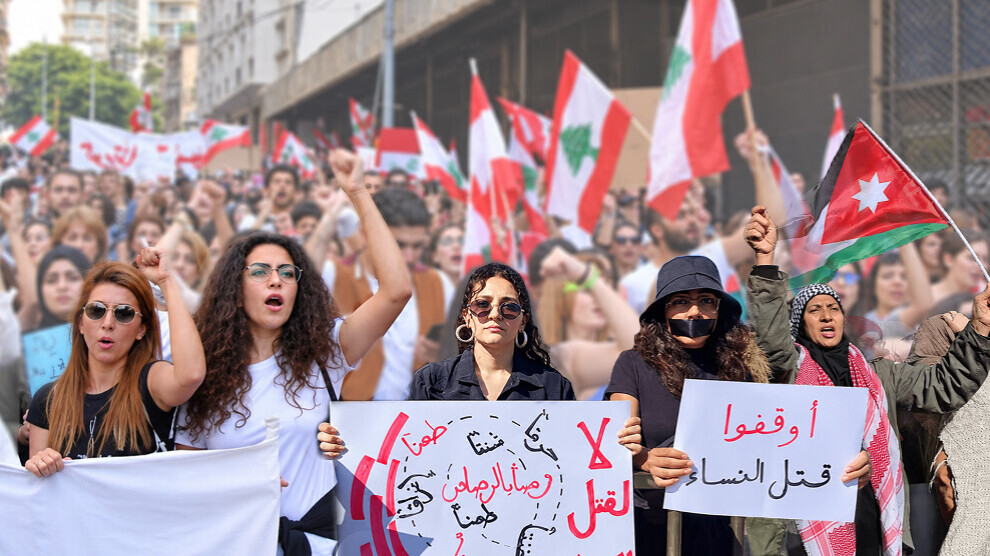
Women in Jordan and Lebanon... Between the System of Violence and the Battle to Wrest Rights
NEWS CENTER — The first seeds of social life in the Middle East began with women, as society took its first steps side by side with her, taking coexistence as a philosophy embodied in its daily reality. Over thousands of years, the experience of partnership and collective spirit, alongside the preservation of self-being, formed main pillars that shaped the historical identity of this region. Women entrenched their position in the history of this geography as the active force that laid the foundations of the first life, developed agriculture, and established the first human settlements and cities, in addition to their pivotal role in crystallizing the culture of coexistence and beliefs. Thus, the Middle East arose linked to women, and women's existence was formed linked to the Middle East.
However, this same geography, whose existence was formed linked to women, witnessed the first signs of historical rupture and social collapse through the violence directed against her. The repercussions of this violence did not stop at the limits of women's lives, but extended to create a deep crack in the social structure of the Middle East, its historical path, and the fabric of life as a whole. With the reproduction of this system of violence in multiple forms, classism worsened, wars intensified, genocides occurred, and poverty and social destruction spread. If we want to trace things back to their first roots, it becomes clear to us that the first images of violence that departed from the innate pattern of nature were represented in man's domination and his intervention against nature and against women alike.
In our contemporary Middle East, violence against women has been integrated into the heart of traditions, society's culture, and systems of governance, to be normalized over time and accepted as an ordinary behavior of the details of life. The essence of the systems that formed in the region since the Middle Ages is based on entrenching violence against women and society as a prevailing mentality, and framing the rituals of life associated with it within a strict religious mold. Since the Middle East did not experience the stages of renaissance and enlightenment, one of the deepest fractures of historical transformation in it was manifested in the person of women and their status. From this standpoint, the history of violence in the Middle East becomes a true mirror of the history of violence directed against women.
Women's bodies and lives were often an arena for those conflicts and a price for them. In turn, religious systems derived their legitimacy from imposing guardianship and control over women under the pretexts of sin, honor, and taboos, while the ideologies of nation-states rested on the pillars of gender discrimination, religious intolerance, and nationalism. Thus, women were dragged through the ages to be both a target of power struggles and a central entity intended to be subjected to domination at the same time.
In this part of our file, we shed light on both Lebanon and Jordan. In the context of capitalist modernity's endeavors to adapt its tools to the variables of the current phase and reshape the Middle East, plans to re-engineer the region have entered into actual implementation. These plans, led by Israel, the United States, and Britain, seek to impose specific political and social systems by relying on a number of countries in the region as tools for their implementation.
In contrast, the internal social reality of some countries that play the role of implementing agent for these policies is surrounded by a curtain of closure from the outside world. Jordan stands out as a clear model in this context; it appears as a state closed in on itself regarding its sociological structure, education level, economic situation, family relations, in addition to the societal presence of women's identity. This structural closure can be read as a direct reflection of its political positioning in harmony with projects to redraw the map of the region. On the other side, we find Lebanon, which is geographically adjacent to Jordan, living a state of double siege; internally pulled by sharp sectarian contradictions, and externally encircled by Israeli interventions and Iranian pressures. These intertwined interventions and internal conflicts cast their heavy shadows on the Lebanese reality, which increases the complexity of the social crisis and the women's issue in the country day after day.
Based on the experiences of Lebanon and Jordan, we review in this file the social, political, and legal dimensions of violence directed against women, while shedding light on the paths of struggle and images of solidarity that women innovate to confront and face this violence.
Jordan... Women search for protection that does not turn into a prison
Jordanian society is largely based on a tribal structure. This social reality often takes precedence over the law. Thus, laws remain under the shadow of traditions, customs, habits, and family pressures. The gap between laws and the social reality on the ground appears very deep. Although there are legal legislations in Jordan that can be cited as a model on paper, the real problem lies in the application of these laws, the procedures followed, and the social spaces that the law does not reach. The structure of the nation-state established in Jordan is also largely formed through these social and tribal relations. For this reason, it is not enough to search for the source of violence directed against women in the traditional social structure alone; the state itself and its institutional mechanisms also play a decisive role in reproducing this violence. Shortcomings in the work of legal mechanisms pave the way for the continuation of violence against women systematically.
Among the important results of this structure is also the mechanism of social stigmatization. This mechanism, which has turned into a silent pressure tool, forces women to waive their rights for fear of the "disintegration" of the family structure. Social stigmatization stands out as one of the most dangerous forms of invisible violence that women face, because the matter here relates to double violence: the woman is first subjected to violence, then society ostracizes her when she speaks of what she lived through. Thus, justifications that legitimize violence are established, while the woman finds herself increasingly besieged between the judiciary, the family, and social pressure mechanisms. In the midst of this process, the woman's identity and will are erased, while violence is reproduced under the influence of the state and the tribal mentality that it feeds.
The projects director at the "Land of Peace for Development and Human Rights" association, Lana Abu Sneineh, had pointed out in a previous interview with our agency to the covering up of violence directed against women in Jordanian society, and offered the following assessment: "The concept of 'concealment' has been sanctified in Jordanian society and has turned into a tool to silence women. The woman is constantly told: endure for the sake of your children, or you must have angered him. The woman lives, crushed under the weight of this view, in fear of 'scandal.' However, there can be no justification for violence, and breaking the silence is the greatest form of struggle." Lana Abu Sneineh's call to women to break their silence acquires great importance for understanding not only the physical dimension of violence in Jordan, but also the social mechanisms that make it invisible.
Cases of consanguineous marriage and strong tribal ties further complicate this scene. When a woman decides to break her silence and file a complaint, the case is not viewed as a mere passing dispute with her husband, but is often interpreted as a rebellion directed against the entire tribe. This view doubles the weight of fear of pressures and ostracism coming from the family and tribal surroundings, forcing many women to retract their complaints and abandon demanding their rights.
As for the shelters established for women in Jordan, they often do not exceed being a temporary solution, as these institutions, which originally aim to protect women and keep them away from abusers, in practical reality turn into another mechanism that restricts their freedoms and isolates them from social life. At a time when no deterrent penalties are applied against the perpetrator, placing abused women in shelters and keeping them away from their families and social surroundings puts the entire concept of "protection" into question. In the past, women were sent to prisons under the pretext of protecting them, and despite some progress achieved in this field today, the approach based on protecting women through isolating them continues. Data in this regard show that about two-thirds of women who are subjected to violence do not file complaints, either for fear of social stigmatization or for the absence of adequate protection mechanisms. A stark example of this is what the victim Wafa Abu Samra lived through, who was subjected to violence and death threats by her husband and her family, but was placed in prison under the name of "protection" on the pretext of ensuring her safety.
Women searching for safety that does not take away their freedom
Her sister, Jordanian activist Shaima Abu Samra, explained in a statement to our agency that Wafa was a victim of violence practiced against her by her husband, pointing out that she was subjected to severe violence and death threats by her husband and her male siblings when she decided to work with the aim of achieving her economic independence.
Shaima Abu Samra stressed that instead of protecting her sister, she was detained in a place falsely called a "protection house," where abused women are held, wondering about the fate of other women victims of violence detained there. She explained that her sister recently left the protection house after signing various pledges, affirming that this crisis revealed the existence of deep gaps in laws related to women's rights and their right to free choice in Jordan, and in Arab countries in general. The real solution lies not only in increasing the number of shelters, but in building an integrated system that prevents perpetrators from escaping punishment, enhances women's psychological and economic empowerment, and guarantees their rights and freedoms.
Official veri for 2025 show that 79% of victims of violence are women, compared to 21% of men. While the number of reports recorded annually exceeds tens of thousands, women constitute.