
Women Confronting Ideology… A Renewed Presence in Arenas of Resistance
Amid Africa’s political and military shifts, women emerge as key actors in struggle and change, from Eritrea’s revolution to diverse experiences across several African nations.
Malva Mohammad
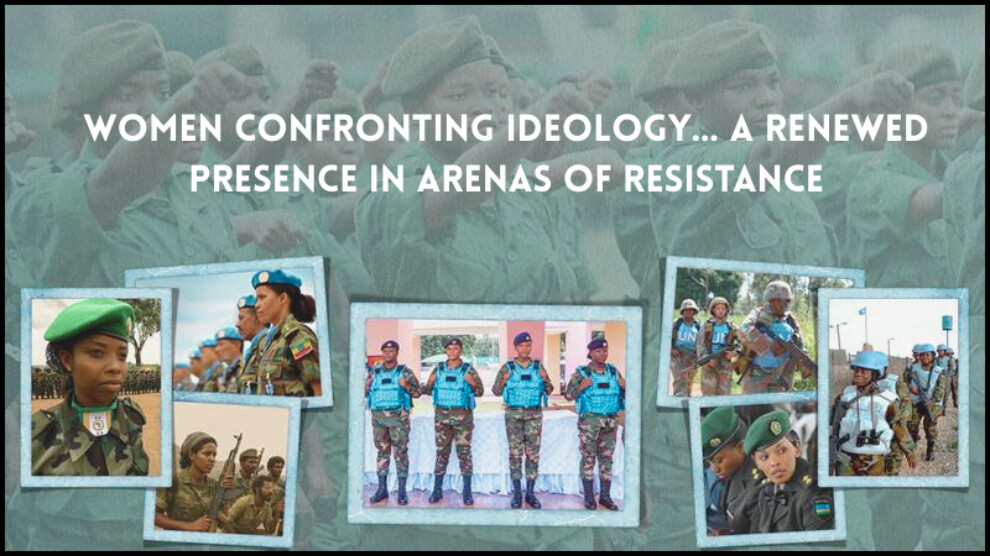
News Center — In a volatile geography shaped by complex histories, politics, and identities, African women rise from beneath traditional constraints to enter the military sphere—caught between dreams of liberation and the nightmare of violation. Their presence is not merely numerical or functional; it is a deeply rooted narrative in the continent’s consciousness, telling how weapons became part of women’s stories, and how they transformed from symbols of care into actors on the battlefield. Paradoxically, this shift often occurred under broad national slogans—some masking systematic abuses, others promoting a progressive image that did not reflect reality.
In this second part, we examine women’s experiences within African armies, analyze how weapons shifted from symbols of protection to tools of struggle, and explore the challenges women face in achieving empowerment and equality, as well as their vital role in building a more just and inclusive future in a region still searching for its identity amid rapid change.
“Sawa”… A Symbol of Transformation in the Eritrean Women’s Experience
This is not merely a heroic tale, but a dual narrative written by Eritrean women in ink of struggle and pain. Since the outbreak of the revolution in 1961, women were not spectators of history but its makers. Eritrean women moved from home to frontline, forming nearly one-third of the Eritrean People’s Liberation Front—fighters, nurses, and leaders whose presence was active and enduring.
However, after independence in 1991, the scene changed dramatically. Revolutionary glory transformed into a formal militarization policy, as the government imposed compulsory national service on both men and women. This service typically begins after secondary school and includes harsh military training in the “Sawa” camp, which became a symbol of transition from youth into militarized life.
Within this camp, childhood turned into rigorous training, and heroism became an institutional burden. Despite claims of equality, disturbing accounts of abuse, exploitation, and indefinite detention emerged. While Eritrean women were showcased in international peacekeeping missions, the internal reality remained far more complex and troubling. What appeared to be a step toward equality became a subject of international criticism, with human rights reports documenting serious violations, including sexual abuse and arbitrary detention. Instead of empowerment, military service became a heavy burden for many women.
Nevertheless, the Eritrean government promoted a different image abroad, presenting women participating in peacekeeping missions. In operations such as those in Congo and the Central African Republic, Eritrean women accounted for nearly 15% of participants.
Thus, the Eritrean experience presents a dual image: a groundbreaking revolutionary achievement in women’s participation, alongside a rigid militarization system placing women in a harsh equation between national duty and institutional coercion.
Women in the Military: Between the Rwandan Model and Ethiopian Caution
Across Africa, women’s integration into the military varies between revolutionary, reformist, and pragmatic models. Ethiopia and Rwanda offer promising examples, though not without challenges.
In Ethiopia, the state cautiously promotes women’s roles, especially in international missions. Sending over 800 women to peacekeeping reflects commitment, but may also serve to enhance the country’s external image. Despite training and participation opportunities, top leadership and strategic decisions largely remain male-dominated. The experience walks a tightrope between ambition and reality.
Rwanda, emerging from the ashes of genocide, built one of Africa’s most inclusive militaries. Women are not exceptions but integral to security structures. However, this openness may also be politically driven to project an image of reconciliation and equality, raising questions about its long-term institutional depth.
Uganda: Historical Pain and Gradual Progress
In Uganda, women’s military experience intersects with memories of war and reform. During the 1990s and early 2000s, thousands of girls were abducted by the Lord’s Resistance Army and forced into conflict, enduring severe violence.
Later, women joined the Ugandan People’s Defence Forces, gradually asserting their presence in uniform—training, leading, and participating in peacekeeping missions, including in Somalia under African Union forces, where they made up about 15%.
By 2023, women represented 10–12% of the military, a modest but growing figure. Notably, General Beatrice Anywar became the first woman to lead the logistics division.
Challenges remain: women hold less than 5% of senior positions, and implicit discrimination persists, often assigning them administrative or medical roles. Despite reforms such as psychological support units and anti-harassment laws, traditional societal views still question women’s military roles. Uganda’s experience reflects a complex path of resilience and gradual transformation.
No Women’s Army, But Women in the Army
In Burundi, following a civil war that ended in 2005, women played key roles in rebuilding the nation—not as observers, but as fighters and change-makers. In 2011, women were officially allowed into the army, supported by the African Union.
Initially comprising only 3%, women were trained in mixed units without forming a separate female army. Their participation in peacekeeping missions, such as in Somalia, reached 7%.
By 2023, women made up 5% of the army and 8% of the police—still low figures, reflecting a slow but steady struggle toward inclusion amid societal resistance.
Empowerment Surrounded by Obstacles
In Somalia, women play important roles in society, including in the military, yet their participation remains limited due to cultural, social, and security barriers. Conservative traditions and extremist narratives—such as those promoted by Al-Shabaab—reject women’s presence in public and military life.
Institutional discrimination persists, with women often confined to administrative roles, excluded from combat or leadership positions. Harassment and abuse remain underreported issues.
Outside the military, female soldiers face social stigma, sometimes leading to family rejection or forced marriage. Despite this, growing security threats have begun to shift perceptions, as Somalia increasingly needs all capable defenders.
Women’s military experience in Somalia remains a struggle between empowerment and restriction, ambition and societal limits.
From Racial Segregation to a Diverse Military
In South Africa, after the end of apartheid in the 1990s, the military was restructured to reflect social diversity. Women were integrated into the armed forces with equal opportunities in combat and leadership roles.
They were encouraged to hold senior positions, including in the air force and navy. South Africa also incorporated gender issues into military doctrine and provided psychological support units. However, challenges such as harassment and pay gaps persist.
Nigeria: Women as a Force Against Terrorism
In Nigeria, amid the rise of Boko Haram since 2014, women increasingly stepped into military roles. By November 2023, they comprised about 28% of the country’s peacekeeping forces.
Yet alongside battlefield challenges, women face societal resistance, especially in northern regions where military roles are still viewed as male-dominated.
Between Ghana’s Reform and Angola’s Revolutionary Legacy
In Ghana, reform began early, with women joining the military in 1958. Despite this, women still make up less than 15%.
In Angola, women played key roles in the independence struggle and formed the Organization of Angolan Women in 1962. However, post-independence military structures remained male-dominated, with women’s participation still limited.
Senegal: Gradual Military Transformation Through Women
Senegal presents a third model, combining traditional military discipline with gradual inclusion of women. By 2023, women still represented less than 15% of the armed forces.
Conclusion
These experiences reveal that women’s presence in African militaries was not primarily about defending women themselves or creating separate female armies. Rather, it was shaped by ideology, politics, and security needs.
Women became part of broader national or revolutionary systems, balancing between symbolic empowerment and structural constraints. Their participation has not yet translated into full equality, remaining bound by the limits of military institutions.
In the third part of this series, we will explore women’s roles in the Middle East, examining their presence in spaces of resistance and transformation.