
Women of Mardin Harvest Tobacco and Bear Production Burdens That Do Not Fairly Reward Their Efforts
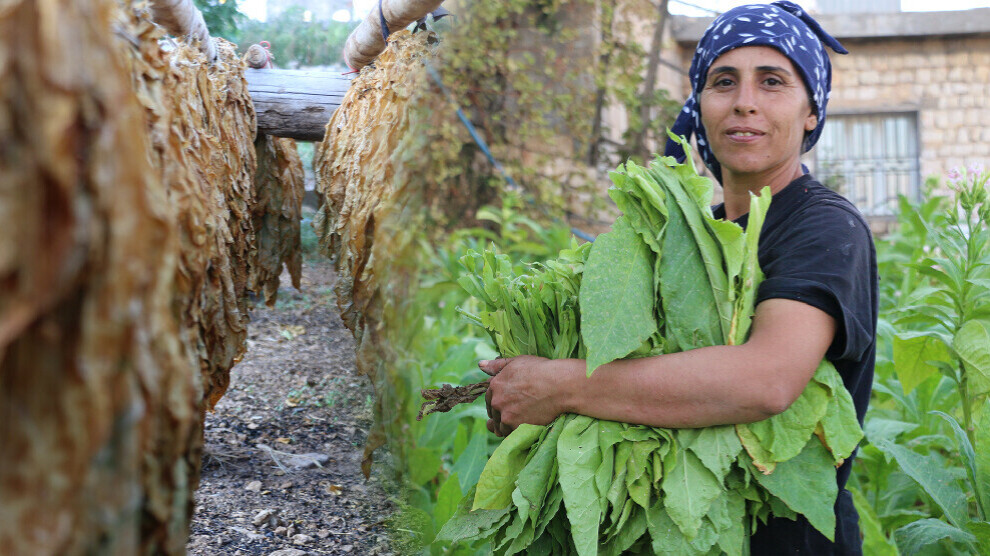
Tobacco harvesting continues in Khurs village, Qizitepe district, Mardin province, where women bear the largest share of agricultural production burdens alongside household responsibilities and family care.
AKIN STERK
MARDIN– From the early morning hours, women head to the fields to harvest the tobacco crop they spent months planting and caring for, in a work journey extending from February to November, without, according to their testimonies, obtaining a return proportionate to the size of the effort exerted.
The experience of Amina Aydemir, who works in tobacco cultivation and selling, embodies the reality of many women in the village, where working the land constitutes a fundamental source of income and a means of securing the family's needs despite the high production costs and declining returns.
A Long Journey from Cultivation to Marketing
Amina Aydemir relies on the income from tobacco cultivation to support her children, explaining that the work begins with planting seeds in March, then transferring the seedlings to the soil, before moving to weed removal during July and August. The harvest season then arrives in September, after which other stages begin that require additional time and effort.
She explained that the leaves are arranged in strings and left under the sun until they dry, then gathered into bundles and transported to the home. There, they are regularly sprayed with water to soften them, before separating the leaves one by one and processing them using a machine dedicated to spreading them, in preparation for selling them to customers.
The work is not limited to cultivating and harvesting the crop, but also includes preparing the seeds for the next season, as women extract the seeds from the flowers of tobacco plants after drying and crushing them. She noted that these seeds are preserved for use the following year, as they begin in February by placing them in greenhouses, then the seedlings are planted in March. As for irrigating the fields, it relies on a drip irrigation system.
High Costs and Limited Profits
Despite the work season extending for long months, Amina Aydemir confirms that the financial return does not reflect the size of the effort exerted, as most revenues go to paying debts and covering production costs, and little remains for the family. She says that tobacco prices fall further when the leaves are exposed to rain and moisture, which exacerbates losses and weakens the ability of female workers to achieve sufficient income.
She notes that she manages agricultural work affairs in parallel with caring for her children and completing household chores, confirming that household responsibilities fall entirely on her shoulders. This intertwining of paid and unpaid work makes women's days more arduous, as their burdens do not end with the end of working hours in the fields.
Despite these pressures, the women of the village rely on relations of solidarity and mutual cooperation to overcome difficulties. "Women help one another in completing tasks, one extends help to her neighbor, and the latter reciprocates when needed. This cooperation constitutes a fundamental part of the collective lifestyle in the village."
Women's Work Is Invisible
Amina Aydemir's contribution is not limited to tobacco cultivation, as she dedicates part of her time to cultivating various types of vegetables in her home garden, in a picture reflecting the multiplicity of tasks that women bear in rural areas.
Amina Aydemir concludes her interview by emphasizing the necessity of recognizing women's work and appreciating their contribution to agricultural production and family life. "Their efforts remain invisible, despite the time and energy they expend to ensure the continuation of work and secure livelihoods for their families."