
To the Rhythm of the Latest Escalation… Yemen's Women Bear the Cost of Conflict
"The conflict has turned our lives upside down." With these words, Yemeni women describe their harsh reality, facing displacement, illness, and disrupted education while struggling for safety and basic needs.
RAHAMA SHANZOUR
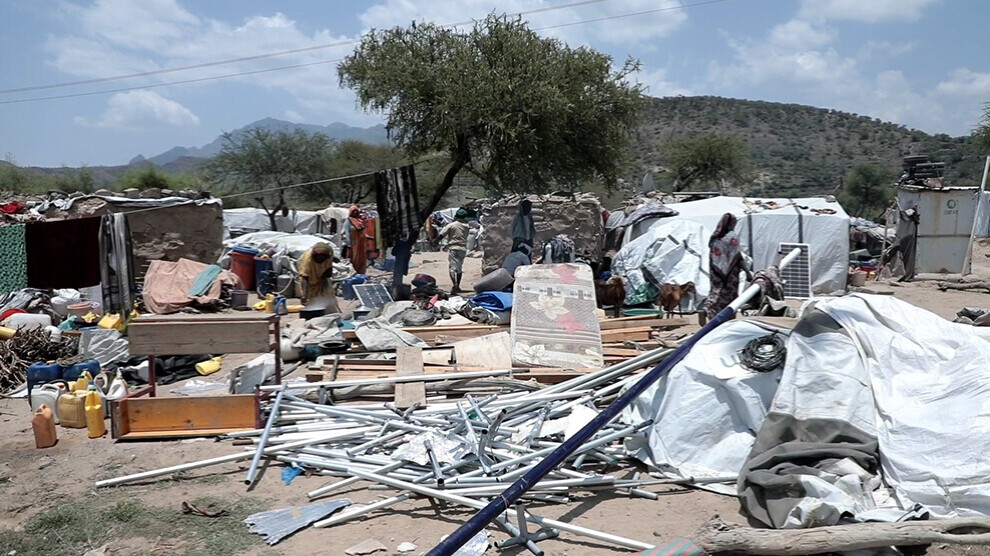
Yemen – As the conflict escalates in Taiz and other areas, thousands of families have found themselves forced to displace, leaving their homes and sources of livelihood behind. As women and children face harsh conditions in displacement sites, their needs are compounded by the absence of healthcare, education, and basic services.
At midnight on the eighth of September, Amina Saif, 56 years old, was leaving her home in the Al-Mokha District with her family in haste, after the sounds of heavy weapons pushed them to leave everything behind. She did not know where she would go, and all she was searching for was a place that would grant her family some measure of safety.
In the moments of displacement, Amina Saif left behind her home's furniture and belongings, and was unable to carry with her more than what could be carried in those moments. She says, "We displaced to this place where there are no means of life whatsoever."
Before the escalation, her family had been living a relatively stable life, and she adds, "We were comfortable, we and our children and our family. We were educating our children, and our living situation was excellent, but the conflict turned our lives upside down."
Amina Saif's story is not an exception. Since the escalation of the conflict on the third of September, tens of thousands of families have been forced to leave their areas in Taiz and other affected areas, in a rapid wave of displacement that pushed women and children to face new conditions, often without sufficient time to carry their basic needs.
The Executive Unit for the Management of Displacement Camps in Yemen recorded the displacement of 17,852 families comprising 122,297 individuals in eight cities during the first half of September, as a result of the military escalation, with Taiz and Lahj being the most affected, noting that some displaced persons were forced to displace for the second time, which reflects the continued suffering of civilians.
In an initial toll, the Ministry of Human Rights in the internationally recognized Yemeni government said that violations during this month resulted in the killing of more than 150 civilians and the injury of more than 200 others in Taiz, Hodeidah, and Marib.
The repercussions of the escalation extended beyond Yemen, as data from the International Organization for Migration showed the arrival of nearly 2,000 people to Djibouti, in an indication of the widening scope of displacement movement and its humanitarian repercussions.
The suffering of displaced women does not stop at the loss of home, as they find themselves facing multiple needs related to food, water, healthcare, and medicine, alongside women's supplies, reproductive health services, protection, and privacy.
These needs become more complex for mothers who bear the responsibility of caring for children and securing their needs under displacement conditions that often lack the basic means of life, while families that have lost their homes and sources of income face greater difficulty in rebuilding their lives.
Pregnancy Without Care
In the camp in the Al-Bireen area, Budour Ahmed, 28 years old, sits in her eighth month of pregnancy. She left her home with her family under the weight of bombardment, but found herself after displacement facing another problem: the absence of healthcare that she needs at this stage of pregnancy.
She says, "Because of the pregnancy and the displacement, I became ill, and until now I am suffering from illness. There is no center here where we can receive treatment."
Budour Ahmed and her family were forced to leave their home under the weight of shells, leaving behind the house, the source of livelihood, and the livestock, and they carried with them only what they were able to salvage during the flight.
According to those running the camp, it was established to receive displaced families, and it still lacks health or educational services, which increases the difficulty of life for the families that have arrived there, especially pregnant women and children.
Children Without Schools and Education
The repercussions of displacement do not stop at the loss of home and source of income or the difficulty of obtaining healthcare, as the children of displaced families find themselves facing a new interruption from education, amid the absence of schools or the difficulty of enrolling in alternative schools.
Fawzia Abdullah, 43 years old, a mother of five children, found herself facing this problem. She had been keen on educating her children, and she dreamed of seeing her eldest son, who is 17 years old, complete his studies and reach the secondary stage, but the conflict and displacement cut off this path, and turned education from an available right into a deferred dream.
She says, "I love education, and I was keen on educating my children, but after we left the area and displaced, they were cut off from school. Here there are no schools, and transferring them to other schools requires extracting their previous school records, while their first school is closed because of the conflict."
She explains that the family, since arriving in the displacement area, has not been able to find an educational alternative for her children, amid the absence of nearby schools and the complications of transferring their school records from the school where they were studying before displacement.
Fawzia Abdullah points out that her children's interruption from school does not represent for her merely a temporary halt from going to school, but a continuous source of worry about their future, especially her eldest son, who was approaching an important educational stage.
As the escalation continues, women remain at the heart of these repercussions, carrying the burdens of their families and trying to protect what remains of their lives, while their options recede before them and the future remains suspended between returning to homes that are no longer safe, or staying in displacement sites that lack the most basic means of life.