
The Women’s Authority Continues Empowering Women Despite Challenges
From social protection to political participation and economic empowerment, the Women’s Authority in Jazira Canton continues its efforts to strengthen women’s rights and safeguard their achievements in the face of security, political, and economic crises.
Asmaa Mohammad
Qamishlo — The Women’s Authority in Jazira Canton in Rojava continues its work to support women and protect their rights and achievements, relying on comprehensive approaches that go beyond relief assistance to include structural, social, and political empowerment of women.
The work of the Women’s Authority is not limited to providing direct support only, but also focuses on strengthening women’s organizational structures in neighborhoods, villages, and cities, starting from the communes that form the first line of defense for women’s rights, dignity, and organization.
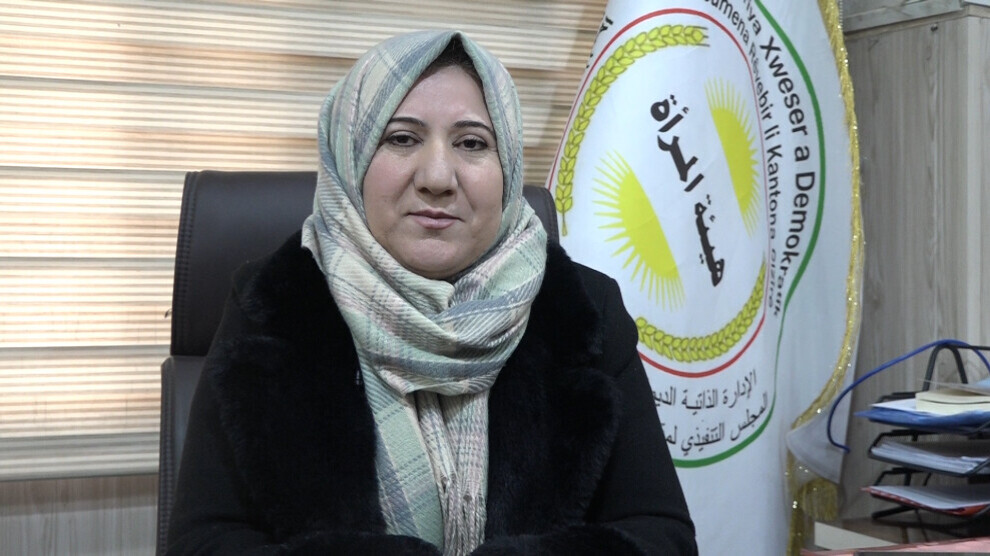
The Co-Chair of the Women’s Authority in Jazira Canton, Rohat Khalil, confirmed that the Authority focuses on several main pillars in its work. The first is protection and self-organization, through following up on cases of domestic violence and gender-based violence via women’s protection centers and community committees, with a focus on solutions that preserve women’s dignity and prevent the recurrence of violations.
She explained: “We work to strengthen women’s organizational structures and reinforce communes and local councils, so that women are able to defend themselves and their achievements, and remain an active force in society despite all challenges.”
She added that the Authority works on women’s economic empowerment through cooperative projects, production workshops, and small agricultural and industrial projects. She noted that around 40 projects have been prepared to serve women in villages and cities, despite the complex political and security conditions that have prevented their full implementation. “Economic empowerment is closely linked to social and political empowerment, to ensure that women are not dependent solely on financial support, and to enable their full participation in community life.”
She highlighted the importance of women’s participation in political and social decision-making, stating that “women played a fundamental role in the Rojava Revolution in building a free and democratic society. They participated in all political, economic, social, and diplomatic fields, leaving a clear mark on the development and organization of community institutions. The establishment of the Women’s Protection Units and the development of their organizational structures have become a model emulated globally.” She also stressed the importance of training women in leadership, management, and institutional work to enhance their capacity to influence and make decisions.
Core Pillars for Continuing the Work
As Rohat Khalil explained, the Women’s Authority relies on three fundamental pillars to ensure continuity despite difficult circumstances: flexible grassroots organization, which allows work to continue even under siege and bombardment; the philosophy of community resistance, which gives the work meaning and resilience; and cross-border women’s solidarity, which creates a strong political and social protection network.
The Authority has worked to build independent women’s institutions, including the Women’s Authority, women’s protection centers, and women’s justice houses, in addition to strengthening women’s presence in community defense and security. It has also sought to change the stereotypical image of women from victims to active partners in protecting society and decision-making. “Raising awareness of women’s rights includes all segments of society through workshops and dialogue sessions in schools, communes, councils, and universities, and by working alongside men, because women’s liberation is the liberation of society as a whole, not a struggle against men.”
She also pointed to the major challenges facing the Authority’s work, including ongoing security threats, economic crises that increase women’s vulnerability, and patriarchal customs and traditions that still hinder change. In addition, there is political and media targeting of the women’s experience in Rojava, and a prevailing authoritarian mentality that rejects the principle of co-presidency and 50% women’s participation. “Despite all these challenges, we continue working to strengthen women’s self-organization as a first line of protection, link feminist rights struggles with economic and political struggles, build alliances with regional and international women’s organizations to break political isolation, and develop long-term programs to transform culture rather than rely solely on laws.”
Achievements Are the Fruit of Women’s Sacrifices
She emphasized that the achievements made were not accidental or granted, but rather the result of women’s struggle and sacrifices in Rojava, and that protecting them is a collective responsibility. “By protecting women’s rights, we protect the future of the entire society. Women’s participation is not an option but an inevitable necessity for societal stability and justice. A strong society is measured by the extent to which it respects women’s rights and includes them in decision-making.”
The Co-Chair of the Women’s Authority in Jazira Canton, Rohat Khalil, concluded by affirming that the Women’s Authority will continue supporting women in all fields — from legal and social protection to economic and political empowerment — with a focus on building a generation of women capable of leadership and decision-making, ensuring they have a real and influential voice in the future.