
"The Body"... A Woman's Last Asset in the Reproduction Market
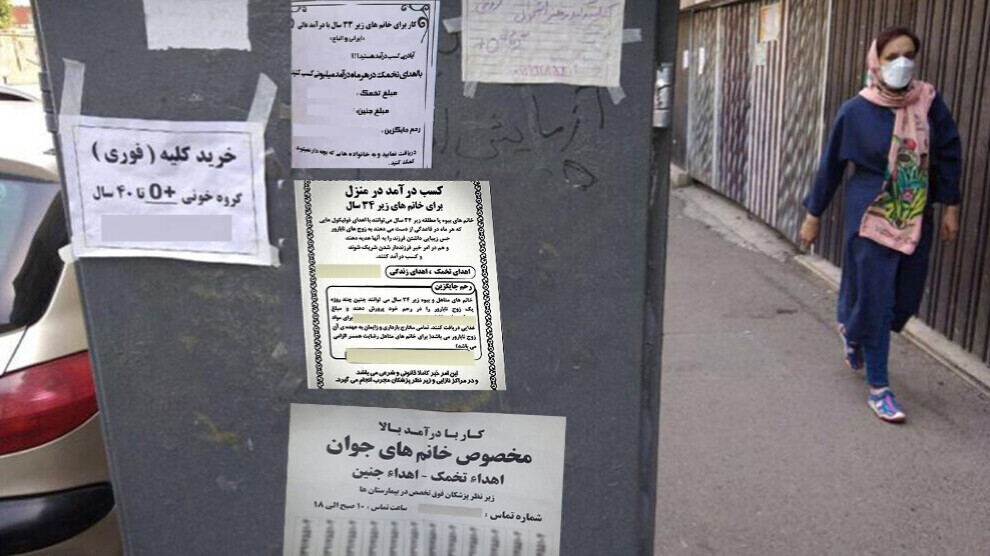
With the proliferation of advertisements for egg selling and surrogacy in Iran, women reveal that their resort to these practices was driven by economic distress, not free choice. This takes place in a market lacking clear legal regulation.
JWAN SHARIFZADEH
Bukan — Inflation and declining living conditions have turned women's bodies into one of the last assets convertible into cash. In such circumstances, the line between "free choice" and "poverty-induced coercion" becomes blurred in the matter of egg selling or surrogacy.
"I saw the advertisement for the first time online, so I decided to sell my eggs(ovum). Egg retrieval is not an easy process at all and may cause complications and health problems for any woman. But when you are forced by financial circumstances, you can no longer think about tomorrow; your only concern becomes securing today's sustenance. At the moment, I consider it better than selling a kidney. Moreover, height or beauty may make your eggs sell at a higher price."
These are the words of Fa'ezeh W., who was compelled by the economic crisis in Iran and eastern Kurdistan, along with her sister, to sell their eggs. Recently, social media and online advertisements have been filled with offers for egg selling and surrogacy. As is the case for many women who donate or sell their eggs, financial motivation was the main reason behind Fa'ezeh and her sister Farzaneh's decision.
Brokers Dominate the Market
Behind most of these advertisements are brokers who work to connect egg donors with medical centers or couples suffering from infertility. Brokers attempt to portray egg donation as a routine procedure, using phrases such as: "Help women who cannot conceive by donating the eggs your body loses monthly during menstruation."
Some even promote it as a "job opportunity and income from home," aiming to encourage women to take this step.
Brokers focus on attracting women who meet specific criteria, including being under 33 years of age, being married or previously married, enjoying good health, having no blood diseases, possessing an adequate egg reserve, providing analysis proving no drug use, and obtaining the husband's consent.
Prices, Commodification, and Brokers Breaching Their Promises
Prices vary in online advertisements, but Farzaneh W. says: "Most brokers back out of their promises. When they realize you are genuinely in need of money, they reduce the agreed amount. There are only a few well-known brokers in this field. The third time I donated my eggs, I received a larger sum, and the broker covered all medication, examination, and ultrasound costs. However, the first time, I bore the treatment costs before and after the procedure myself."
Complications Not Discussed
Naghma Z., a specialist in gynecology and infertility treatment, explains that egg donation and surrogacy are effective solutions for many cases of infertility, but she warns of the commercial aspect of these practices.
She said: "Egg donation is not a simple or consequence-free procedure. We are dealing with a woman's body undergoing hormonal treatment to stimulate the ovaries before egg retrieval. Among the most serious potential complications is ovarian hyperstimulation syndrome, in addition to the risks of infection, bleeding, or hormonal disturbances. Sometimes the potential increased risk of ovarian cancer is also raised."
She pointed out that the effects are not limited to the physical aspect but extend to the psychological, as some women may wonder after donation about the child born from their genetic material and whether they will ever meet them. Women who rent their wombs for material reasons may face more severe identity crises and find it difficult to adapt to the experience.
Ambiguous Laws and Jurisprudential Rulings
Sperm donation in Iran faces strict legal and religious restrictions due to issues of lineage and jurisprudential rulings, and therefore it is not permitted in the manner followed in many Western countries. Embryo donation or implantation, however, is permitted in some cases.
Regarding egg donation, those working in this field indicate that some families only accept eggs from a woman who has been previously married. In such cases, based on the guidance of some religious scholars, a temporary marriage (sigheh) is contracted between the donor and the recipient man until eggs are retrieved and the embryo is formed. This is often done remotely to maintain the confidentiality of both parties' identities.
Despite the existence of jurisprudential interpretations to regulate these matters, Iranian law still lacks clear provisions regulating the donation of eggs, embryos, or surrogacy and their conditions.