
Sudan… a battle for survival in which women pay the biggest piece
Sudan faces a battle for survival amid drone war, hunger and displacement, with Sudanese women paying the biggest price through violations and marginalization, making civilian protection and women's decision-making empowerment essential for peace.
MERVAT ABDEL QADER
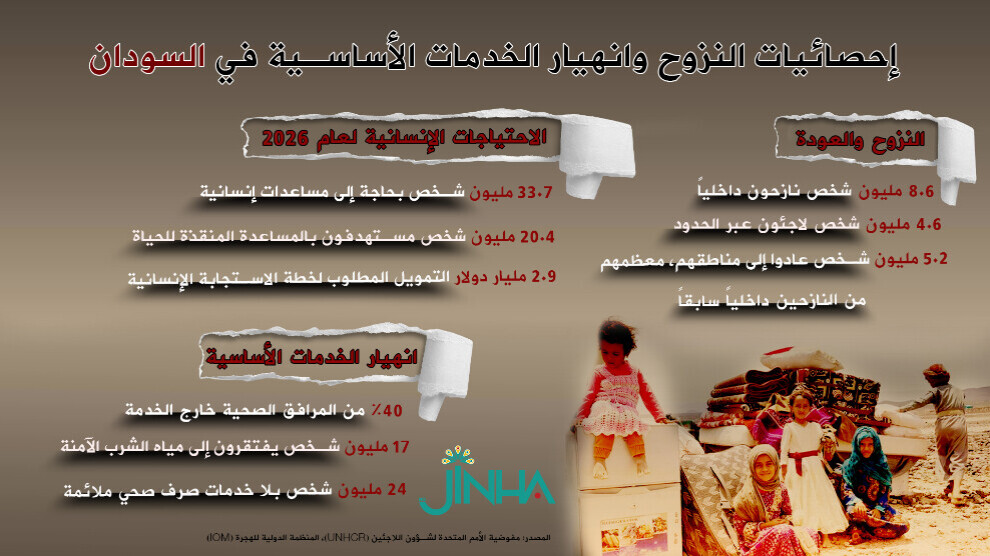
SUDAN_The story of Sudan today is no longer told from the map of frontlines, but from a sound in the sky that cannot be seen, from an empty plate on a family's table in Darfur, from a long queue in front of the bread oven, from a mother who has crossed meat off her shopping list for months, from a university student who left her studies to sell in the market, from a farmer in Al-Jazira looking at his barren land after his machinery was stolen and his crop burned, and from a woman who was yesterday honored in her home and has become today a displaced person supporting her children. It is a battle for survival in the fullest sense of the word, waged by 48 million Sudanese.
From Khartoum, which was the beating heart of the economy, to Darfur and Kordofan, the country's food basket, and reaching Port Sudan, which suddenly turned into a temporary economic capital; the same story repeats itself — a drone in the sky, a power station bombed every day, prices igniting every hour, and a citizen standing alone in the face of a crisis he did not create.
How did the third-largest country in Africa in area and the richest in agricultural and mineral resources reach this edge? How did Sudan's conflict turn into a war on civilians themselves? And what is the real price that Sudanese women pay when the state budget shifts from supporting bread and medicine to financing war materiel?
Political activist Sara Al-Tayeb Ali describes the current situation in Sudan as the worst in its modern history, as a result of the coincidence of the escalating drone war with food, displacement, and livelihood collapse crises, warning that the expansion of the use of strategic drones affects the capital Khartoum and states such as Blue Nile and Kordofan, causing comprehensive destruction of infrastructure and public facilities.
International reports indicate that both parties possess long-range arsenals, and the UN Human Rights Commission estimated that drone attacks killed more than 1,120 civilians in the first half of 2026 alone.
Sara Al-Tayeb Ali affirms, as an eyewitness, that these drones have come to cross borders from neighboring countries including Ethiopia to destroy infrastructure, pointing out that a large number of them have been shot down according to official data.
She recounts the incident of one drone falling in the neighborhood where she lives in Khartoum, which resulted in damage to facilities and the killing of children, stressing that these attacks primarily affect the civilian citizen.
According to UN reports, about 15 power stations have been bombed, and two out of every three children have been killed as a result of these drones during the year. These attacks led to horrific massacres, most notably the killing of 26 women and 4 children in Wad Al-Mahi, and the fall of 36 dead in the bombing of a market in Nyala.
Sudanese women between relative security and the greatest danger
Sara Al-Tayeb Ali points out that women are the most affected by this conflict, as targeting has reached their bodies first through rape and grave violations. She adds that the escalation of hate speech, racism, regionalism, and tribalism represents a fundamental threat to women and society alike, wondering about ways to transcend these divisions and the conflict to reach a safe and less dangerous environment.
She explains that drone bombardment threatens the basic necessities of life, especially electricity, on which women rely heavily in their daily living, noting that the conflict has turned Sudanese women overnight into displaced persons or refugees, having lost their homes and property. Although the vast majority of them reside in cities outside shelter centers, and in new environments they are not accustomed to, they have shown a high ability to adapt, support their families, and raise their children.
Sara Al-Tayeb Ali affirms the international community's disregard for the humanitarian catastrophe and the unprecedented violations of women's rights in Sudan, directing a message to UN and global organizations demanding immediate action regarding the violations being committed.
Limited political representation and trampled rights
Sara Al-Tayeb Ali points out that women's political representation in Sudan does not match the scale of their sacrifices and suffering due to the conflict and the violations they have been subjected to. Although women constitute 75% of the total workers in ministries, their presence in leadership and decision-making positions is limited to only two women in constitutional representation positions.
She stresses the need for women to be aware of their role and to redouble their efforts for political empowerment through women's organizations and parties, to transcend their current weak representation, which remains below the 40% stipulated in the constitutional document, stressing that women are the foundation of society and the pillar of peace and stability, which necessitates qualifying and training them to be active partners in decision-making centers and to contribute to stopping the conflict and building the government.
Sara Al-Tayeb Ali stressed the need to enhance women's economic empowerment through supportive and qualifying projects, affirming that Sudan today needs practical steps to protect civilians and secure their basic needs, away from statements and formal promises. She explains that the conflict has turned into direct targeting of citizens' lives and women's dignity, which makes any settlement that does not begin with protecting humans and empowering women in decision-making centers merely a fragile truce destined to collapse.