
In the absence of basic necessities... the story of a woman struggling to protect her children
Gaza, where war intersects with poverty and disease, Naama Abu Ghanem embodies the story of a woman resisting alone to protect her children from hunger, fear in the absence of basic elements of life.
Nagham Karaja
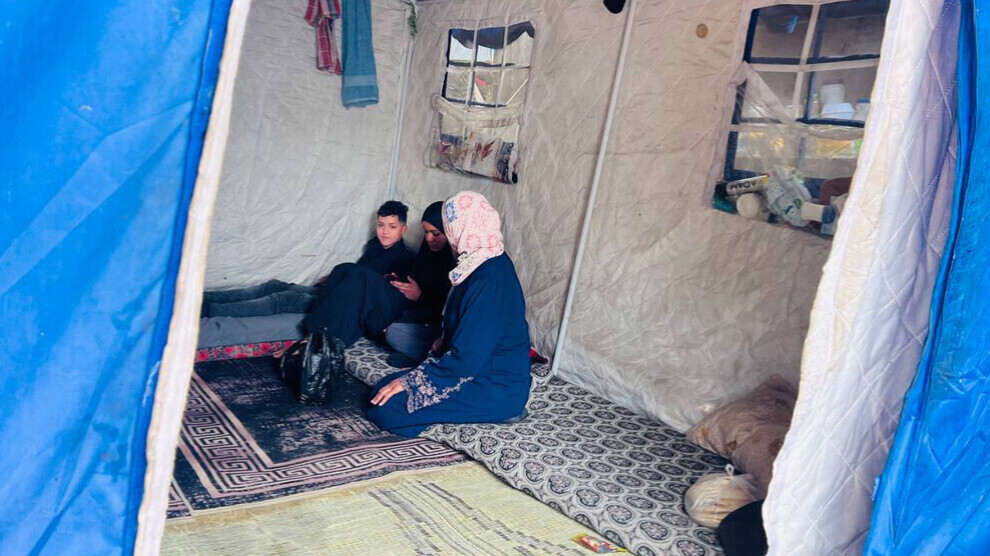
Gaza – In a tent barely standing on its edges, lives Naama Abu Ghanem (47 years old), who suddenly found herself facing a harsh world. Since the war that broke out in 2023 in Gaza, her life has turned into a daily battle for survival, armed only with a will weighed down by fear and four children who sleep hungry and wake up hungry.
Inside that dilapidated tent, the danger is not limited to hunger and need; it extends to rodents and stray dogs that surround the place, stealing whatever remains of a sense of security. Naama Abu Ghanem recounts in a tired voice: "I wake up every night to terrifying sounds. I fear that something will attack us while we are asleep. I cannot protect my children as I should, and I don't even have a door to close behind us." She adds, recalling a moment etched in her memory: "One night, I found a dog standing in front of my tent. I couldn't move. I kept screaming and crying, and my children were crying beside me. There was no one to save us."
Double suffering
Naama Abu Ghanem lives on the food provided by charitable kitchens (takyas), often finding only bread. Days pass without a real meal. She says: "My children go to sleep hungry, and I stand helpless before them."
Despite the harshness of reality, she clings to a thin thread of hope: educating her children. She searches for any free educational opportunity and tries to keep them connected to studying, as if fighting another collapse that might steal their future. She says: "I don't want them to grow up in this darkness. I want them to learn, to have a different path. But I cannot pay any fees. I can barely secure bread for them."
The suffering does not stop at the limits of poverty and hunger. She herself suffers from a severe chest condition and needs a medical inhaler that she cannot afford. Faced with this helplessness, she made a harsh decision: she gave up her own treatment for the sake of her child who suffers from the same condition. She says: "I give him the inhaler and endure the suffocation myself. I cannot see him in pain, even if it comes at the cost of my health."
Her daughter Bisan, 16 years old, carries in her body the effects of the war that never left her. She was injured by shrapnel in her brain and had part of her intestines removed, which requires constant, unavailable treatment. Her failure to adhere to treatment worsens her condition and prevents her from continuing her education.
In moments of breakdown, Bisan and her mother turn to singing as their only way to lighten the weight of what they are living through. Bisan says: "We sing to forget, to say what we cannot say. Sometimes the voice is stronger than crying."
This story reflects a broader reality lived by thousands of women in the Gaza Strip. Data from the UN Office for the Coordination of Humanitarian Affairs (OCHA) indicates that women and children constitute the largest percentage of those affected by the war. Reports estimate that more than 70% of the victims are from the most vulnerable groups, amid the near‑complete collapse of infrastructure and basic services.
A glaring gap between legal texts and field reality
The human rights dimensions of the crisis become clear when referring to the Fourth Geneva Convention of 1949, a cornerstone of international humanitarian law, which obligates the protection of civilians during conflicts and ensures their access to food and healthcare, with special attention to women and children. Article 55 stipulates the responsibility of the occupying power to provide food and medical supplies to the population, while Article 56 affirms the necessity of ensuring the continued operation of medical facilities and the uninterrupted provision of health services.
What Naama Abu Ghanem and her children are living reflects a glaring gap between legal texts and field reality. The absence of food, lack of treatment, and the collapse of basic life necessities are all indicators of serious violations of these international obligations.
Yet, the Palestinian woman – as in the case of Naama Abu Ghanem – remains a model of resilience in the face of collapse. She does not possess traditional tools of power, but she clings to the simplest forms of resistance: survival, protecting her children, and insisting on their education. She says, as if summarizing her entire journey: "I am not asking for much. I just want my children to live with dignity, to sleep without fear, and to find food when they are hungry."
In light of this reality, daily life turns into a harsh test of the ability to endure. Each passing day is a new battle, and each night that ends without disaster is a temporary salvation. Yet Naama Abu Ghanem continues to rise, to face fear, to search for food, and to embrace her children when everything around them collapses.