
Power Outages: A Worsening Crisis That Goes Far Beyond the Lights Going Out
Repeated, unscheduled power outages in Iran and East Kurdistan have caused widespread problems, and despite officials' assurances of improvement, damage across sectors keeps growing, especially after recent attacks on electricity infrastructure.
JWAN SHARIFZADE
Bukan_In recent years, repeated power outages in Iran and East Kurdistan have caused major losses across various professiional sectors, and wartime conditions along with recent American attacks on energy facilities have increased pressure on the electricity gird, placing further burdens on citizens.
A Shortfall in Electricity Production and a Deepening Crisis
Iran has one of the largest electricity grids in the Middle East, comprising around 200 power generation stations, including thermal and hydroelectric plants, renewable energy units, as well as the Bushehr nuclear power plant.
Despite this wide network, weak fuel-extraction capacity, international sanctions, aging generation stations and transmission networks, along with accumulated debts owed to power stations and continued electricity exports to countries such as Afghanistan,Pakistan, Iraq, and Armenia, have all contributed to deepening the crisis,Estimates suggest the electicity production shortfall this summer ranges between 10000 and 18000 megawatts.
War and Damage to Infrastructure
Darya Kazemi, an electricity sector worker and expert in the field, says: "In the early days of the war, people ruched to buy oil, gasolilne, oil lamps, flashlights, and other items, fearing power outages_but the damage manifested differntly."
She added: "It's true that part of the production facilities were bombed,but the resulting losses are estimated at more than 7000 megawatts, which has placed enormous and growing pressure on the interconnected national electicity grid."
According to official statistics, power stations belonging to steel and petrochemical industries in Isfahan, Mahshahr, and Asaluyeh sustained damage, while the "Ahmad Kazemi" combined-cycle power station was attacked, and parts of the distribution networks in Kish, Jask, Bandar Abbas, Qeshm, Mahshahr, and Sirik were destroyed. The loss of around 25% of gas production from service also worsened the electricity crisis.
In addition, damage to transformer stations and transmission networks in Karaj, Tehran, Sistan and Baluchestan, Bushehr, and Hormozgan knocked part of the electricity transmission capacity out of service.
Citizens at the Heart of the Crisis
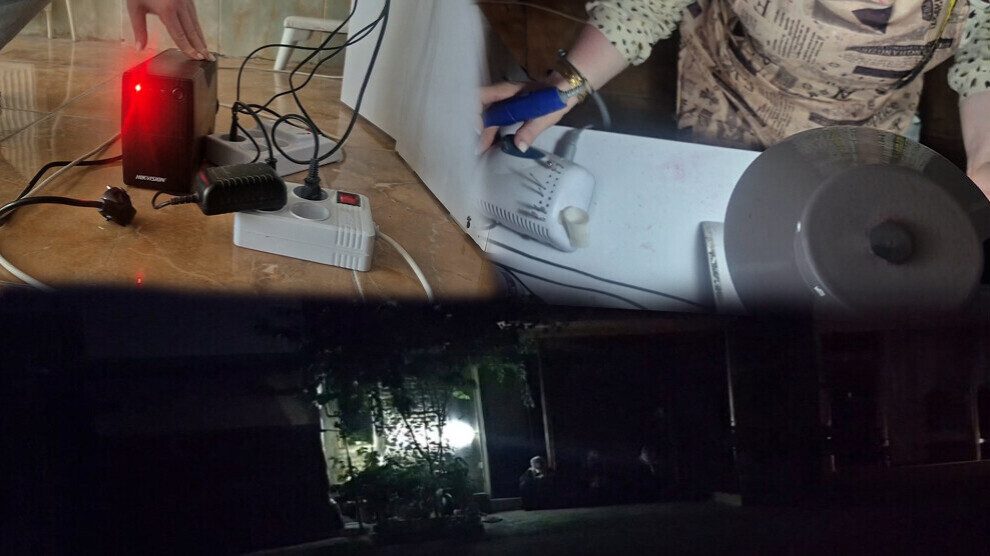
For the public, power outages are no longer simply a matter of the lights going out — they now mean the disruption of daily life, and even exposure to danger. In most cities, outages occur without warning and often last more than two hours, as Sherin W., a resident of Bukan, explains: "On some days, the power can go out for up to four hours."
Estimates suggest that losses caused by power outages in 2025 reached around 400,000 billion tomans, increasing the risks of unemployment and bankruptcy, both for small businesses and large companies.
Dilaram M., who owns a café in Tehran, says she has begun considering closing her business after a six-hour continuous power outage. Like many others, she was forced to buy a generator, but sudden and irregular outages continue to disrupt her work.
The hardship isn't limited to rising temperatures and the shutdown of cooling systems, which pushes many people to spend hours outdoors in open spaces — it also extends to water outages in some neighborhoods and buildings.
Zeinab K., a resident of the "Kawdanan" area in the city of Mahabad, explains: "Water is pumped using electric pumps, so when the power goes out, we also suffer from water shortages."
For some, a power outage is a matter of life and death. Shahla W., a resident of Sardasht who has a medical condition and relies on an oxygen machine, faces a direct threat to her life with any power outage.
These developments come at a time when the phenomenon of class-based discrimination in the distribution of power outages continues to recur, as some neighborhoods still experience far fewer hours of outages compared to less privileged areas.