
Palestinian runner loses her foot in the war and continues her dream of international professionalism
Young Palestinian Rozan Khera,who lost her leg in the war,maintains fitnees by running with cructches and training to adapt to her new situation.
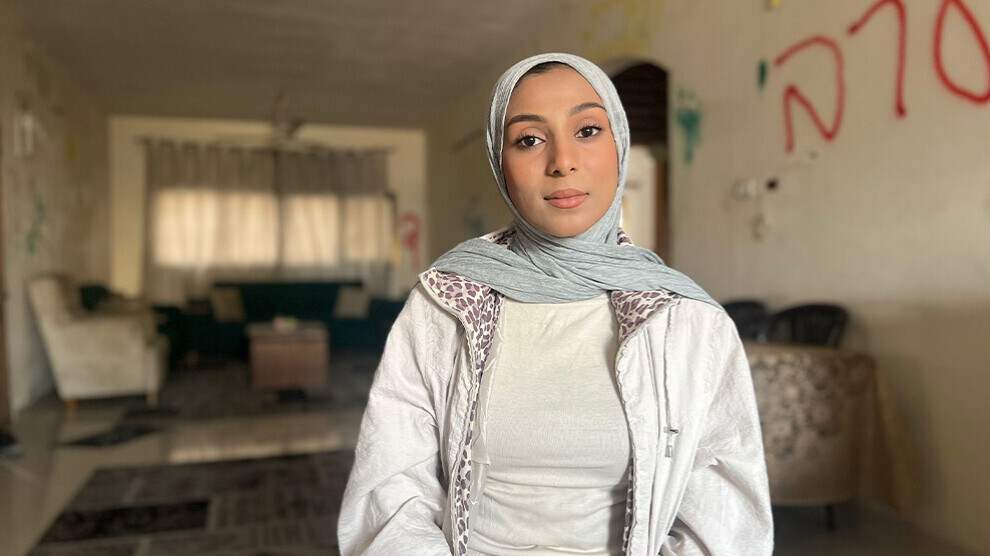
Rafif Asleem
Gaza — Palestinian runner Rozan Khera lost her foot due to amputation during the latest offensive on the Gaza Strip in 2023. This has prevented her from achieving her dream of participating in the global Olympics, after she had won numerous local awards and medals and was preparing to launch into international professionalism.
Sounds of explosions and thick smoke
Rozan Khera recalls that at the beginning of the war, on November 19, 2023, at ten o'clock at night, she woke up to the sound of rockets and rubble covering her bed. Everyone was fleeing without looking back. She tried to do the same and run, but with every step she fell. She tried to hop on one foot and lean on something amidst the foggy smoke that filled the place and obscured visibility.
In the middle of that chaos, something whispered in her ear: "Look at your foot, because what is happening to your body is not normal." So she looked and saw what she never expected to see in her life: her foot barely attached to her body. That's when she fell. Her mother noticed her and screamed for help, and the rest of the family members carried her along with them. She added that she remained sitting there, waiting for an ambulance for nearly half an hour, because at that specific time, all the hospitals in Gaza had gone out of service.
First aid and a hospital besieged by tanks
She was transferred to Al-Daraj Clinic, where she received only first aid due to the lack of medical tools and staff. She was asked to move to the Indonesian Hospital in the northern Gaza Strip, 12 kilometers away from the clinic, to undergo surgery there, despite the lack of transportation to take her. She covered those distances while holding her foot, hoping it could be reattached to her body once she reached the hospital.
Rozan Khera recounts with anguish, "What can you expect from a girl who doesn't understand the meaning of leg amputation? Her life was nothing but constant running on race tracks." When she arrived at the hospital, which is located in an area classified as a red zone with Israeli forces about to raid it at any moment—and these same forces were the ones who granted them the entry permit—she was only able to cross and stay in the hospital corridor, not in a bed or a designated room. She remained there from 12:30 AM until 4:30 AM, when she nearly fell into a coma due to continuous bleeding.
Amputation surgery under local anesthesia and shelling of the operating room
Her turn to enter the operating room came just before she took her last breath. The doctor entered and told her there were no anesthetics in the hospital, and she would only be anesthetized locally, meaning she would remain awake throughout the procedure and would witness the amputation, stitching, and cleaning. She absolutely and irrevocably refused this. During that minute, the floor was bombed as she begged the doctor to let her die in silence away from the torment. She tried to surrender to the coma, but her father refused and kept holding her hand.
Doctors rushed to rescue the wounded and the dead and placed them near her. She was crying, not knowing whether she would join them in the next few minutes or survive. Indeed, she completed her surgery and found herself left in front of one of the hospital's doors when she should have been in a bed receiving medical care from specialists, with her family nearby to support her. But there was only her father, who left her to look for a wheelchair to transport her home.
Escape from the hospital under gunfire
At 8:30 AM, Israeli forces stormed the hospital, so her father asked her to get ready to flee. He suggested carrying her on his shoulders, but she refused because he was also injured and hadn't received treatment yet. She searched with her tired eyes until she found a new shopping cart with wheels and suggested he empty its contents and carry her inside it. And so it happened. The back door of the hospital hadn't been cordoned off yet, so they escaped through it under fire from drones, tanks, and continuous shelling, covering 12 kilometers until they reached Gaza City.
She recalls that at those moments, she was wearing light clothing and hadn't eaten for two days, while Gaza was struggling with a low-pressure system (storm) along with the continuous bombardment. Survival seemed impossible; the Israeli forces could stop them after surrounding them and take them as hostages. But they had to take the risk to save their lives; otherwise, they would face the most horrific forms of torture when the hospital was fully under control. The stories are numerous about violations committed against women after the storming of Gaza hospitals.
Before the attack and societal criticism
Before the attack, Rozan Khera did not sit at home. She is the daughter of a sports-oriented family; her father would take her to the club every day and train her well. Despite society's negative view of girls practicing running, she ignored those negative comments and raced towards her dream of winning silver and gold medals, trying to change that stereotype and prove a girl's right to practice whichever sport she wants.
She recounts that running competitions for girls were rarely organized, but she tried to participate despite all obstacles to be ready to represent Palestine in international forums. Even today, she hasn't given up on achieving that dream; she will instead try to adapt her abilities to reach her goal. She stated that she seeks to obtain a permit for treatment outside the Gaza Strip and to get a prosthetic limb fitted, to help her continue both her life and her dream.
Medals won and unwavering determination
Rozan Khera participated in many competitions and won several medals, characterized by passion and challenge. She wouldn't train in open spaces for fear of people's criticism; instead, she received her training in closed clubs in the Gaza Strip, such as Al-Yarmouk and Gaza clubs, which today have turned into displacement camps. She feels pain and a lump in her throat whenever she looks at their gates, as they have transformed from places of joy and fans' cheers into centers of misery.
She wishes that sports clubs in the Gaza Strip hadn't stopped providing their services due to the attack, because she would have found a place to release her energy, if only by seeing her colleagues running on the track. She says that even her training friends, she no longer sees and barely knows their news due to the harsh living conditions in Gaza, the lack of transportation that could take her from one place to another, not to mention the crisis of unpaved roads, which make it impossible to walk on with her crutches.
Rozan Khera tries to do some exercises to maintain her physical fitness. She runs with crutches and trains herself for the new situation, as well as doing exercises for her stomach, breathing, hands, and legs, and moves her body to be ready to return to the sport of running again. She dreams of participating in international competitions and hopes not to be seen as just a member of a marginalized group that only takes; rather, she wants to give hope, not succumb to her injury, and complete her dreams.