
Mass Displacement in Yemen Due to Indiscriminate Shelling... Fleeing Without Destination or Compass
Shelling forces Yemeni families into repeated displacement, stripping their safety and livelihoods, while women, children, the elderly, and disabled suffer worsening conditions seeking shelter."
RANIA ABDULLAH
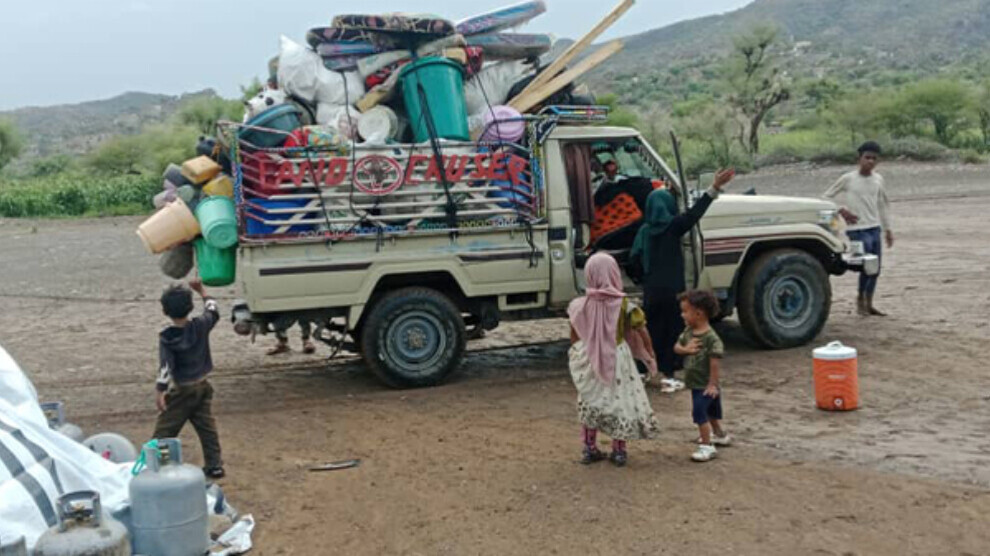
Yemen — The western countryside of Taiz witnessed mass displacement of families following Houthi targeting of the Al‑Mokha port on the Red Sea coast in Taiz, and the outbreak of military confrontations and the ignition of frontlines in the Al‑Kadha, Maqbanah, and Jabal Habashi areas west of Taiz.
As soon as Fatima Ahmed reached the asphalt road, she lost consciousness, after a journey lasting about six hours spent trying to flee the shelling that struck her village in Maqbanah Shamer, west of Taiz, accompanied by her four children and her husband.
Fatima Ahmed was forced to displace from her village, leaving her home and land, but what pains her most is leaving her parents after they were unable to leave the area. She says: "The Houthis were shelling our village indiscriminately, and shells reached in front of our homes. We waited until sunrise, then fled under the shelling and the buzz of bullets."
Unable to Flee
"There is nothing worse than displacement except being separated from family or leaving them in a dangerous place." This is what pains Fatima Ahmed. She adds bitterly and sadly: "I left my father and mother, as they could not flee due to their disability, and they encouraged us to flee." Her parents refused to leave the house.
Fatima Ahmed's experience and that of her family encapsulate part of the suffering of many displaced families, who were forced to leave their homes and land, abandon their sources of income, or remain in areas experiencing continuous shelling.
The suffering of women has multiplied significantly, as they have lost their privacy either in tents unfit for habitation or in homes overcrowded with more than one family. Older women and men, and persons with disabilities, face greater risks during displacement attempts, as was the case with Fatima's mother and father.
Regarding the rest of the village residents, Fatima Ahmed says: "Some residents fled to the mountains in the open to preserve their lives, as there is no safe place for them to go."
The suffering of families was not limited to displacement alone but extended to the future of their children, as the educational process stopped in areas that witnessed confrontations just two days after the launch of the new school year 2026‑2027.
Fatima Ahmed says: "My children left education with the displacement. We left their clothes and books, and everything I had prepared for them for the new school year that began a week ago."
The International Organization for Migration (IOM) documented the displacement of about 18,500 people during the period from September 3, 2026, to Tuesday, September 9 of the same month, coinciding with the escalation of military operations in the cities of Taiz and Al‑Hudaydah in western Yemen. Taiz recorded the largest number of displacement cases during the same period, followed by Al‑Hudaydah, while other displacement cases were distributed across several cities.
Another Displacement from Camp to Camp
Displaced families in the "Al‑Kadha" camp were forced to leave their tents and displace again to safer places and camps, but they were unsuitable, and many families found no tents to shelter them, so they remained in the open. About 200 families were displaced from the "Al‑Kadha" camp to the "Al‑Bireen" and "Al‑Nashma" camps, fleeing from indiscriminate shelling.
Taghreed Mohammed Saif says: "We were displaced from our camp, and for two days we did not taste food. Our children are homeless, their clothes are torn, and the blankets we own are also torn." She adds in a trembling voice: "We suffered the most because of the Houthis' shelling near the camp. Even our livestock remained there, and no one dares to go bring them, because whoever goes is kidnapped and does not return. They kidnapped two of our children from there."
Huda Saeed, who had hoped to return to her home after more than 10 years of displacement, was displaced to another camp instead of returning home: "We left owning no homes to shelter in, no food, no drink, not even clothes to wear. Our clothes are torn and our condition is painful. After a long wait, we were displaced again—but to the open air."
Women, girls, and children in displacement sites and host communities face difficult humanitarian conditions, amid shortages of food and clean drinking water, limited access to shelter and primary healthcare, along with the need for psychological support services and personal hygiene supplies.
These needs intensify in the most overcrowded and least accessible gatherings, especially as many families have lost their sources of income, placing women and girls at additional risks. According to the official of the displacement camp in "Al‑Kadha," the number of displaced people is larger than the humanitarian interventions can address, and they need relief bags and tents to shelter them.
Displaced women, in addition to responding to basic needs, require services that take their specificities into account, including healthcare, protection, psychological and social support, and hygiene supplies—as confirmed by the official of the displacement camps.