
Khilan Abdul Rahman as a model… How do women in Halabja manage municipalities despite crises?
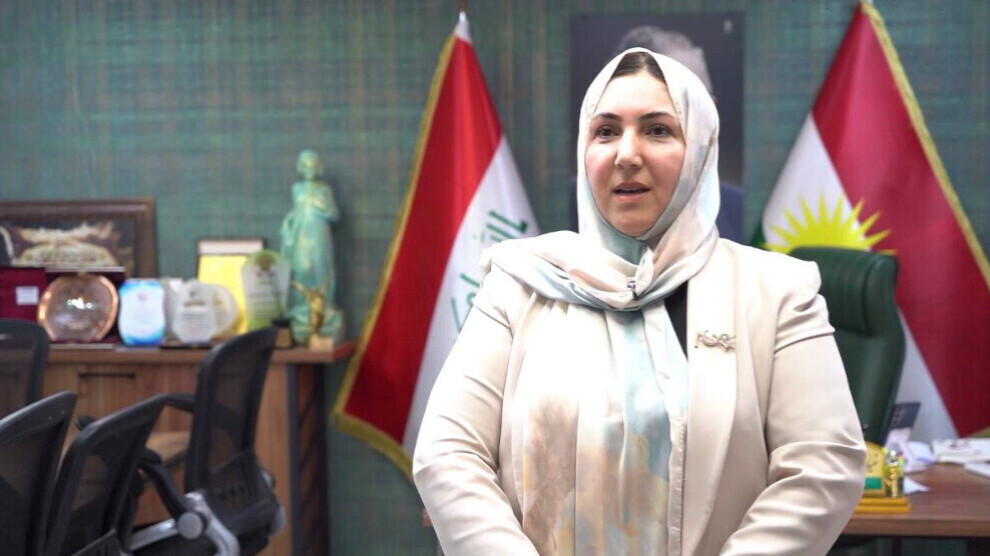
In a society facing preconceptions about women, Khilan Abdul Rahman, Halabja's municipalities director-general, proves women's competence through experience, affirming their leadership ability and accomplishments.
MEHRBAN SALAM
HALABJA_Halabja constitutes a remarkable space for women’s presence in positions of responsibility and administrative and leadership work, as many women hold senior positions in various institutions and departments. However, this presence is not without challenges, as some women have faced, during their professional careers, manifestations of patriarchal mentality and verbal violence, based on traditional perceptions that still see senior positions and decision-making centers as exclusive to men.
These practice are not merely verbal abuse, but reflect forms of discrimination, exclusion, and attempts to limit women's participation in public life.
In the face of these obstacles, Khilan Abdul Rahman presents her professional experience as a model for women's presence in decision-making positions. She completed her studies in architecture and began her duties in 2021 as director-general of Halabja municipalities.
She believes that her previous experience in administrative work contributed to preparing her to assume the new position, and gave her the ability to deal with its responsibilities and requirements.
Between responsibility and work capabilities
Khilan Abdul Rahman recalls her experience in managing municipal work, pointing out that her previous professional experience helped her overcome many difficulties and deal with the requirements of the position with confidence. "My previous experience in administrative work made it easier for me to assume my responsibilities and manage tasks, and I was also able to overcome obstacles. We work in the directorate with a one-team spirit, and in cooperation with various teams and municipalities."
The responsibilities of the General Directorate of Halabja Municipalities are not limited to a limited administrative scope, but extend to include a number of municipalities, including Khurmal, Biyara, and Sirwan, which doubles the volume of tasks placed on its shoulders, especially since the daily needs of citizens are directly linked to the level of municipal services provided to them.
She points out that recurring financial crises have affected the implementation of plans and projects and the level of services. "Due to the financial crises, we have not been able to implement our plans as required, but we continue to meet the needs of citizens according to available capabilities. We hope that the government will provide more support, to ensure the implementation of projects and the delivery of basic services to all neighborhoods without exception."
A social environment that opens space for women
Khilan Abdul Rahman affirms that family support and the social environment in Halabja constitute two fundamental factors in enabling women to assume leadership positions and continue in them, pointing out that her family's backing and society's respect for women contributed to her professional experience and bearing its responsibilities.
Khilan Abdul Rahman does not see that empowering women is limited to providing opportunities for them, but is also linked to the existence of a work environment based on cooperation and mutual support, helping them confront professional and social pressures and challenges. She points out the importance of solidarity among women in positions of responsibility. "We work with a one-team spirit, and there are a number of director-generals in this institution who cooperate and support one another. If one of us faces a problem, the others offer her support. I also try, according to my capabilities, to help everyone who needs support."
Confidence and competence
Khilan Abdul Rahman's experience affirms that women's access to leadership positions is not linked to individual competence alone, but also needs a social and institutional environment that gives them confidence and provides them with fair opportunities to prove their capabilities. She believes that the support of the relevant authorities and society's confidence in women represent two fundamental pillars for enhancing their participation in positions of responsibility.
Khilan Abdul Rahman's experience affirms that women's access to leadership positions does not depend only on individual competence, but also needs a supportive social and institutional environment that provides them with confidence and fair opportunities to prove their capabilities. She also stresses the importance of evaluating women's performance according to their competence and work results, away from preconceptions, while allowing citizens the space to follow up on and evaluate these results.
She says: "Confidence in women and the support of the relevant authorities for them are among the important factors that enable them to assume positions and responsibilities, and the evaluation of their performance should be based on competence and work results."
Her experience reflects that women's presence in decision-making positions goes beyond representation, to be a space for proving competence, bearing responsibility, and active contribution to building society.