
Kabul women cling to their professions despite the ban and pursuit
Despite the ban on beauty salons in Afghanistan, some women continue to work in secret, while other salons operate openly in exchange for paying sums of money to Taliban members.
BAHARAN LAHEEB
KABUL_ With the Taliban’s return to power, the doors of social and economic life have been closed to Afghan women one after another. Amid the wave escalating restrictions, the decision to close women’s beauty salons constituted a direct blow to the livelihoods of thousands of women who had spent years of their lives and invested their money in learning this profession and establishing an independent source of income, only to suddenly find themselves before sealed doors and an unknown future.
For many of them, the profession of hairstyling and beauty was not merely an ordinary job; these salons were a space that contributed to supporting their families, a haven for financial independence and an opportunity to train and help other women. With the closure of these salons, work moved to the back rooms of homes and some women were forced to continue practicing their profession secretly, undercover names such as sewing.
Practicing the profession despite fears of arrest
But this secret work has a heavy price; if a Taliban member discovers a woman while she is practicing the profession, it may expose both the hairstylist and the customer to the risk of arrest and detention for several days, provided they are released under conditions including paying sums of money and providing guarantees.
However, under these prohibitions in Kabul, a dual reality prevails; while the majority are forced to work in secret and under the weight of fear, some beauty salons still operate openly and actively in markets and residential neighborhoods. Their owners are even released after only a few hours, even in the event of potential arrest. This is a contradiction that raises serious questions about favoritism, influence, and hidden relationships, as well as selectivity in applying the restrictions imposed on women.
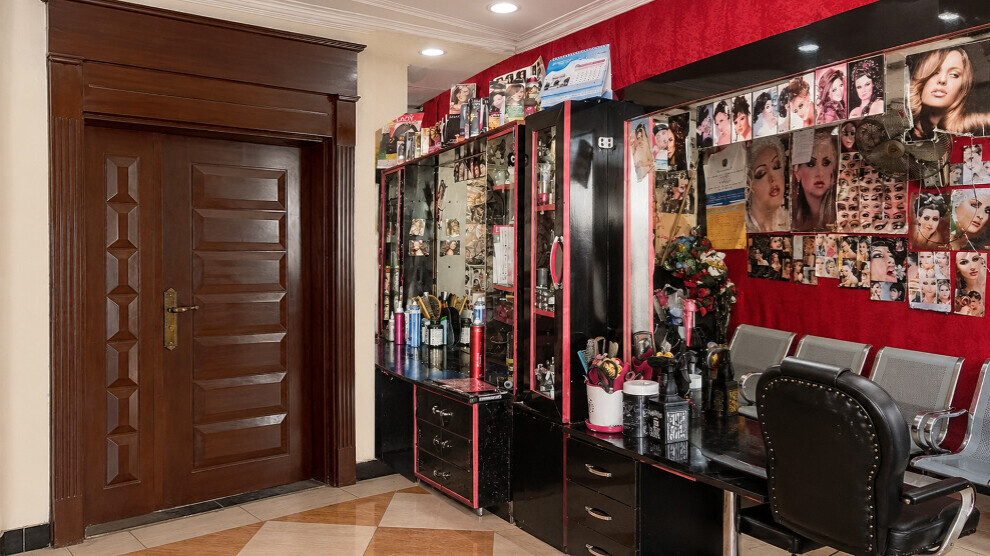
To reach answers to these questions, we headed to one of these salons, a beauty salon located in a densely populated neighborhood in Kabul, operating inside a residential complex. As soon as we knocked on the door, it was opened for us without any hesitation or inquiry. The place was bustling with activity; several customers were seated, while the workers practiced their work calmly. We waited about half an hour in one corner until the salon was empty of customers. After the last customer left, we headed to the salon owner to inquire about the secret of her continued public activity, and she welcomed conducting the interview with complete ease.
"Women in Afghanistan cling to their roles in society"
About her career, the salon owner Shakila Noor said: "I started working in the field of hairstyling and beauty ten years ago. During this period, I was able, alongside training, to attract a number of other women to work alongside me, so that they could become economically independent."
When we asked her how the salon continues its activity openly under the current circumstances, and about the nature of the treatment of the Ministry for the Promotion of Virtue and Prevention of Vice staff with her, she answered with some hesitation: "Since my income is larger, I pay monthly sums of money to members of the Ministry for the Promotion of Virtue and Prevention of Vice. For this reason, they do not subject me much to interrogation or accountability."
This answer indicates that the continuation of the salon's activity, according to its owner, does not depend only on the presence of customers and making profits; paying money also plays a role in ensuring the continuation of her work away from pursuit.
Shakila Noor continued her talk: "They say we do not accept bribes, but for a small amount they forget even that religion they talk about. I am certain that religion is nothing but a mask used to oppress women. In the building where we previously worked, there were several beauty salons, and a large number of our customers belonged to the families of Taliban members themselves."
She recalled her experience in dealing with the Taliban, saying: "There is a contradiction in the Taliban's treatment that we face in our daily lives; on the one hand, they impose official restrictions on women's activities, and on the other hand, they turn a blind eye to our activities in exchange for money."
Women in Afghanistan continue, even at the cost of paying money and risking their lives, to cling to their roles in society and keep them alive. In an Afghan patriarchal society dominated by fundamentalism, this is in itself a form of struggle.