
From Tunisia to Rojava: A Message of Solidarity and a Call for Justice and Dignity
Kurdish women are targeted not only for being women, but because of their identity and geographic belonging, similar to the targeting of women from diverse sects in Syria
Ikhlas Al-Hamrouni
Tunis – In a world where news accelerates and human details sometimes fade, the importance of solidarity and human awareness becomes clear. Today, Tunisian women raise their voices in solidarity with their sisters in Rojava, who live under a daily threat to their lives, dignity, and identity.
The testimonies of these women reveal deep pain and, at the same time, carry a message of resilience and hope, affirming that a woman’s voice cannot be marginalized or forgotten, no matter how hard injustice tries to silence it.
“We raise our voices in support of women”
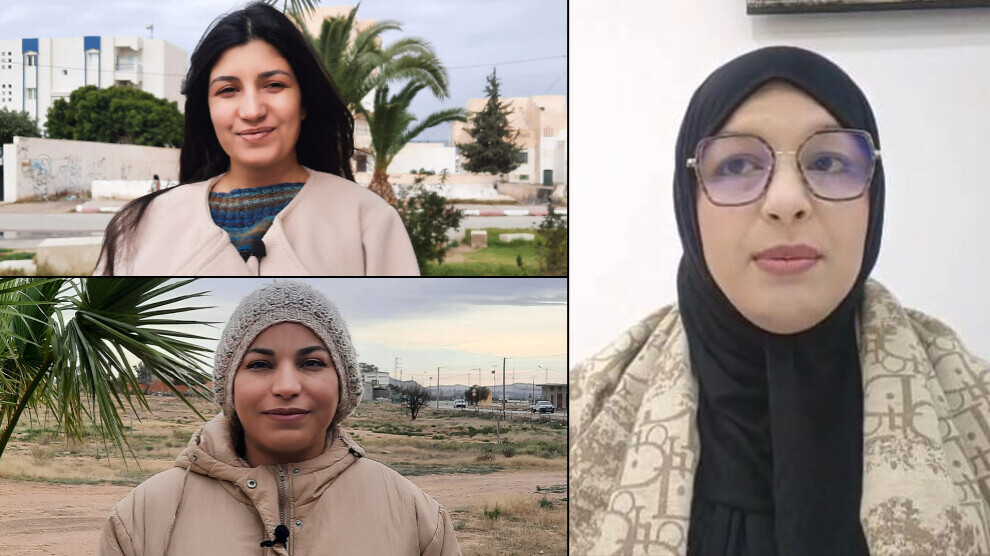
Fadwa Ben Mustapha stresses that, as a Tunisian woman with no political position, no party affiliation, and no civil society activity, she follows the daily situation of women in Rojava and stands in solidarity with them.
She says that since the attacks on the region by the jihadists of Hay’at Tahrir al-Sham, “women have been suffering daily, subjected to assaults, and their voices do not reach anyone — and if they do, no one sees or hears them.”
Regarding the violations of Kurdish women’s rights, she adds:
“What is happening is not only because they are women, but because of their identity and geographical belonging. Women there are targeted because their very existence is considered a threat.”
She continues:
“We, as Tunisian women, support these women socially, morally, and in terms of rights, and we affirm that as one voice we demand their protection. Silence about these crimes is an indirect participation in them.”
Decline of rights with the attacks
Rania Nsiri says:
“We Tunisian women raise our voices in support of women in North and East Syria. We are resistant women who defend the right and dignity of women in every country and everywhere, and what is happening there pains us all.”
She points to the areas controlled by the interim government:
“There are girls who are forced into early marriage, prevented from education, stripped of their voices in society, and targeted as women simply because they are women. These girls dream of a normal life and aspire to equal roles with men in society, but they are deprived of this because of wars and ongoing political crises.”
In light of this dark reality, she emphasizes the need for solidarity:
“We, as Tunisian women, are committed to being one voice to support these women and to raise our voices together, because the voice of one woman can become hope for thousands of women who suffer in silence.”
She called on all women of the world to stand together and to deliver a strong message that women’s rights must be respected everywhere and that violence against them has no justification.
“The Kurdish woman is strong”
For her part, Rahma Ben Faleh sent a message saying:
“We are with you and we will not leave you alone. Kurdish women are strong and resilient, and they must be supported and protected by all possible means.”
These Tunisian women agreed that solidarity with the women of Rojava is not just a passing feeling, but a human and moral. Every assault on a woman is an assault on all humanity, and every silence in the face of these crimes is participation in them.
From Tunisia today, the voices of women rise with every woman to say:
“You are not alone. Rights and dignity know no borders, and solidarity is not a choice but a human duty that transcends politics and geography, becoming the voice of justice and humanity in the face of violence and oppression.”