
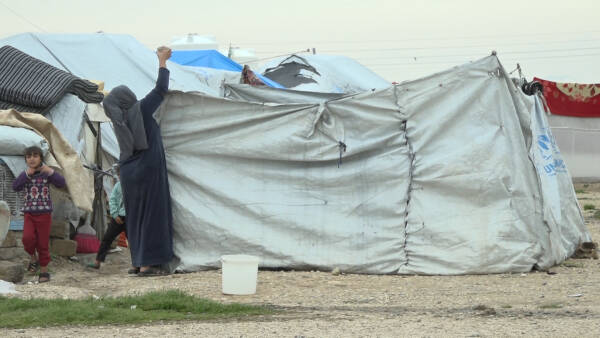
Between dilapidated tents and declining aid… the suffering of the displaced in Newroz Camp amid winter
For more than a decade of repeated displacement, Newroz Camp has transformed from a temporary humanitarian refuge into an ongoing tragedy for thousands of families, amid dwindling aid, lack of heating, and the spread of disease.

Asmaa Mohammed
Qamishlo — For over a decade, Newroz Camp in the city of Qamishlo, in the Autonomous Administration region of North and East Syria, has stood as a living witness to the suffering of thousands of families who fled the horrors of war and forced displacement.
Established in 2014 as a safe haven for the displaced of Shengal, the camp has over the years become a permanent shelter for families uprooted by Turkish occupation attacks and their mercenaries from Serekaniye/Ras al-Ain, Tal Tamr, al-Shahba, and Afrin. Today, with the harsh winter setting in, thousands of displaced people find themselves battling cold, lack of heating, and declining humanitarian support, amid worsening health and living conditions, as pleas grow louder for urgent humanitarian intervention that preserves the dignity of those worn down by long years of displacement.
The co-chair of Newroz Camp Administration, Noura Abdo, says the camp was established in 2014 in response to the humanitarian crisis caused by massive waves of displacement at the time. The primary purpose was to shelter families fleeing Shengal after widespread attacks that forced thousands of civilians to seek safety from violence and persecution.
She explained that the camp played a crucial role in those years by providing protection and basic care for Yazidi families escaping death. It continued its humanitarian mission even after most of those families returned home in 2019. With new waves of displacement, the camp reopened its doors to families from Serekaniye/Ras al-Ain and Tal Tamr, as well as large numbers of people from al-Shahba and Afrin who were forced to flee due to Turkish attacks and worsening security conditions following the mercenaries’ control of the region.

Service Conditions
Regarding the situation inside the camp, Abdo stated that service and humanitarian efforts continue despite challenges, with various organizations providing direct assistance—especially to children and women, who remain the most vulnerable.
She added that the administration has recently implemented a rainwater and flood drainage network to prevent water from entering tents and to ensure safer pathways during severe weather. Improvement works continue regularly to enhance protection and prevent flooding during winter, which often worsens life in the camp.
In education, Abdo pointed out that there is an elementary-level schooling program supervised by qualified teachers to ensure children continue receiving their right to education despite displacement. She revealed that the administration is currently preparing to open a middle-school stage inside the camp to meet the needs of students who completed primary school but cannot reach schools in the city. Work is underway to secure supplies and teaching staff to guarantee educational continuity.

Humanitarian Aid Decline
Abdo explained that humanitarian support has significantly decreased recently after several organizations withdrew, reducing food distribution standards. Families that once received two to three food baskets a month now receive only one, which is insufficient—especially for large families who rely entirely on aid.
She noted that food basket distribution stopped completely for two consecutive months, causing immense pressure on needy families and worsening their struggle to secure basic necessities.
Spread of Seasonal Diseases
Abdo also pointed to the spread of seasonal illnesses such as influenza and respiratory infections, which intensify during winter due to low temperatures and inadequate shelter. These illnesses particularly affect children and the elderly.
A fixed medical center run by the Kurdish Red Crescent operates in the camp, providing first aid and follow-up care. Additionally, Yammama Association operates three days a week offering further medical services, tests, and health guidance.
However, she highlighted a severe shortage of essential medicines, limiting the center’s ability to treat rising cases. The absence of a laboratory also complicates diagnosis, forcing many patients to travel outside the camp for tests—despite bad weather and unaffordable costs.
She emphasized that improving medical support, providing medicines, and equipping a small laboratory would significantly enhance the camp’s health situation.
Abdo added that the camp’s administration activates an emergency committee every winter to respond to severe weather. The committee oversees the distribution of materials essential for reinforcing tents and protecting families from storms and winds.
Changing the Reality of Hundreds of Displaced Families
She stressed that improving humanitarian conditions in the camp is a shared responsibility among all organizations operating in the region. Many families still hold hope of returning home, but hope alone cannot overcome the challenges. Local and international actors must assume responsibility and provide practical solutions. Humanitarian support, even if small, can transform the lives of hundreds of families and help them endure until they can return safely and with dignity.
At the end of her remarks, Abdo called on humanitarian organizations to increase coordination with local authorities to ensure aid reaches displaced families and to provide sustainable emergency programs that guarantee minimum standards of dignified living.
Days and Months Turned into Years
For her part, Hadeel Mustafa, a displaced woman from Serekaniye/Ras al-Ain, recounts long chapters of pain and hardship. Her family enters its seventh year of forced displacement after being driven from home by fear, shelling, and insecurity.
She explained that their displacement began with seeking refuge in schools, which were later closed, forcing families to move to camps to provide more stable schooling conditions for children. Eventually, they arrived at Newroz Camp—never imagining it would become their home for so many years.
“When we first entered the camp, we thought we would stay for days or months at most,” she said. “But years passed heavily, and we are still living in these tents—enduring freezing winters and scorching summers. Life in the camp lacks even the minimum conditions for stability. There is a severe shortage of tents, heating materials, diesel, and kerosene. Tents and heaters are replaced only once every two years, which is insufficient for such harsh weather.”
Children are the most affected, she emphasized. “Our children fall ill constantly due to the cold, weak immunity, and poor sanitary conditions. They suffer from continuous chest infections and severe colds, and the elderly suffer just as much.”
She added that schools lack proper heating, putting children’s health at risk and turning their right to education into yet another source of hardship.
Nighttime winter storms are a constant fear for mothers: the threat of tents collapsing or fires breaking out from primitive heaters. “We live between two dangers—storms that can destroy our tents in minutes, and fires from the only heating devices we have.”
Despite the solidarity among residents, the scale of suffering far exceeds their limited ability to cope.
Hadeel concluded with a heartfelt appeal:
“My only wish is to return to my home and land. I ask for nothing but safety. I want my voice to reach the world so they know what we are living through. Our children did not choose this harsh life. What is their fault to spend their childhood between tents, cold, and deprivation? We only want our voices to be heard, and to regain our lives with peace and dignity.