
An Algerian woman fighter recalls the memories of the revolution and tells the story of a generation that faced colonialism
Six decades after independence, many Algerian women's sacrifices remain absent from collective memory. Fighter Zuleikha Baghdour recounts moving from school benches to revolution's ranks, questioning historical fairness and women's exclusion.
NAJWA RAHIM
ALGERIA— The story of Algerian women's struggle did not begin with modern demands for equality and combating violence and discrimination; its roots go back to the colonial years, when girls and women found themselves facing a reality that deprived them of opportunities for education and participation in public life, and pushed them to confront multiple social and colonial restrictions. With the outbreak of the liberation revolution, women did not remain on the margins, but moved to the arenas of struggle and participated in organizing national work and secret communications, and some of them joined the mountains and bore the risks of arrest and torture.
More than six decades after independence, the experiences of many of them remain absent from the collective memory, at a time when the testimonies of women fighters raise questions about recognizing women's contributions, fairness in writing history, and the persistence of stereotypes that diminish their roles. These are issues that acquire additional importance with the revival of the 16 Days of Activism against Gender-Based Violence campaign, which opens the way to recall the various forms of discrimination and exclusion that women faced, and the need to protect their voices and recognize their experiences.
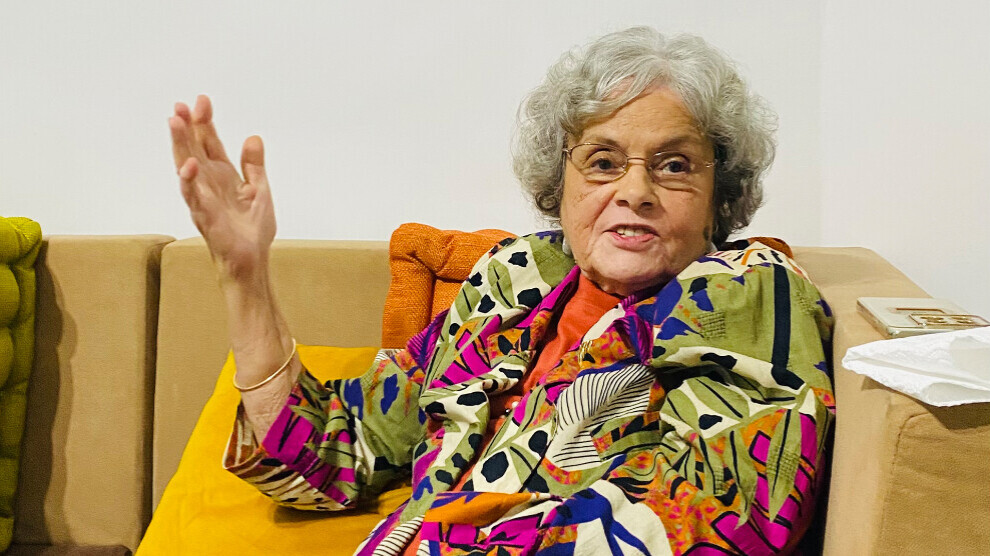
The fighter Zuleikha Baghdour recalls the beginnings of her struggle path through details linked to her school years, when she did not have the opportunity to learn Arabic sufficiently, due to the use of French in her education. She says that she was fortunate to meet a teacher named Amina Zaalan, who took on teaching her Arabic, and began with her from the alphabet of grammar and its first rules, after her studies had been in French.
She did not view the use of French as an abandonment of her identity, but saw that she could employ the colonizer's language to serve her cause, recalling in her talk how the enemy's language could be used as a tool to confront colonialism itself. It is an experience that reveals an aspect of the educational and cultural conditions in which Algerian girls lived during the colonial era, when opportunities for learning and forming national awareness intersected with a complex political and social reality.
From school benches to participation in the revolution
She returns in her memory to November 1954, describing the outbreak of the liberation revolution as akin to a bomb exploding in the sky of calm Algeria. At that time, she was studying at the "La Croix" secondary school near the university, within a group of girls, including her two younger sisters.
However, her actual participation in the struggle activity, according to her testimony, began on May 17, 1956, when the office of the General Union of Algerian Students, of which she was a member, decided to gather students and secondary school pupils to consult on engaging in the path of the revolution.
This phase acquires its importance from its connection to the transformations witnessed by the Algerian student movement, especially after the strike decision taken by students in the same month, and the call to join the ranks of the National Liberation Army. The university and secondary schools formed spaces that contributed to mobilizing youth, and the participation of female students was not separate from this movement, as some of them engaged in organizational work, communications, and support, in circumstances that entailed great risks.
The fighter's testimony reveals that women's engagement was not merely an emotional response to events, but was linked to bearing actual responsibilities within the struggle networks. Some of them moved from student activity to more sensitive tasks requiring secrecy, organization, and communication ability, which made them vulnerable to pursuit and arrest.
She recalls the circumstances of her arrest on November 11, 1956. This experience does not reveal only an individual path, but re-sheds light on a generation of girls who found themselves before the responsibility of participating in the battle of liberation, despite their limited opportunities in education and public presence, and the restrictions that governed women's lives in society at that time.
Women's struggle in multiple forms
The participation of Algerian women in the liberation revolution was not limited to students and fighters in cities, but took different forms according to the geographical and social conditions of each region. While some women contributed to political and organizational work and secret communications, others bore the responsibilities of sheltering and hiding fighters, transporting weapons and supplies, and providing information, alongside the medical and nursing roles that some women fighters undertook.
In villages and mountain areas, women faced more difficult conditions, as they bore the responsibilities of daily life, and also bore the risks of raids, arrest, and colonial violence. These roles were not always documented in images or written testimonies, which made the experiences of a large number of women far from historical circulation.